Which check catches an RTL bug: lint, random simulation or a formal equivalence proof?
research/chip-rtl-probe
What lint, random simulation and a Yosys equivalence proof each catch, on 12 small RTL tasks (companion to chip-rtl-loop); mutation probe shows 30 of 389 rejected bugs are caught only by the formal proof. Session-written attempts, not an LLM benchmark.
What it found
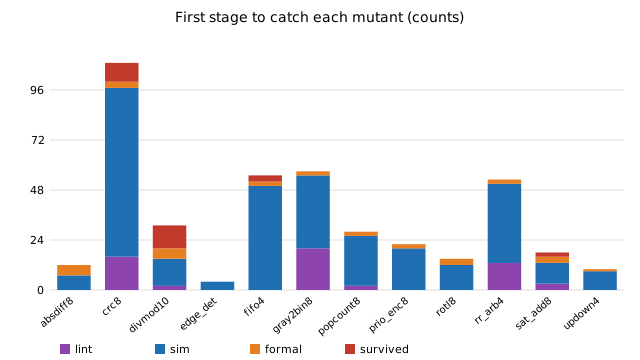
A harness (a proposer writes Verilog; lint, random-vector simulation and a Yosys equivalence proof score it) with 12 small tasks. One attempt per task written by the session agent (not an LLM benchmark) passed every stage at round 0, so the loop never had a failure to use. Of 414 single-point mutants of those designs, lint rejects 56, simulation 303 and only the formal proof 30 (7.7% of the 389 rejected), while 25 pass everything. A no-LLM random-mutation repair baseline fixes 11/36 broken designs within 4 proposals and 22/36 within 16. Toy: tiny modules, bounded 10-cycle proof for sequential tasks, syntactic mutants.
A figure from its own output
Paper, code and results
More in LLM chip design loops
- How much does simulation and formal feedback help a proposer repair small Verilog designs?Lint, simulation and formal-equivalence feedback for Verilog repair on nine small tasks; 6/9 pass at round 0 and 9/9 after one round, with the session as proposer (anecdotal, not an LLM benchmark).
- What does a no-model baseline repair when a scripted RTL checker is the only feedback?No-model mutation-repair baseline for a scripted Verilog checker (compile, lint, simulation, SAT miter) on ten small tasks: 9/20 one-fault cases repaired in 60 evaluations; the session agent passed all ten first try, so the feedback loop is unmeasured. Preliminary.
- Does a rewrite proposer beat a parameter sweep on area and depth when every rewrite must be proved equivalent?Equivalence-gated area/depth rewrites of a 16-bit adder and 6x6 multiplier against a no-model parameter sweep; best adder 0.85x the reference cells×depth, tied by the sweep, no multiplier gain (stylised, gate counts).
- How does generic-gate area grow with bit width for adders, shifters, popcount and multipliers?How generic-gate cells and depth scale with bit width for seven arithmetic blocks: adder, comparator and mux are near-linear, the multiplier quadratic (exponent 2.19), and adder depth grows ~2×W (stylised, generic gates).
- Does writing a fixed-weight multiplier as shift-and-add with canonical signed digits beat Yosys's x * K?Fixed-weight multipliers for all 255 8-bit constants: Yosys's
x * Ktracks binary shift-add (Pearson 0.97 with set bits), and a canonical-signed-digit form has 33% fewer generic-gate cells at similar depth (every form proved equivalent). - Does sharing sub-sums across a bank of fixed-weight multipliers cut gates beyond per-constant shift-and-add?A bank of fixed-weight multipliers sharing sub-sums (multiple-constant multiplication): 9% fewer generic-gate cells than per-constant signed-digit shift-add at 2 constants and about 20% fewer at 8 and 16 (43% fewer than Yosys's
*), every form proved equivalent; random constants, not trained weights.
All 40 LLM chip design loops projects →
Other research topics
Proper scoring & elicitation28Effort & peer prediction9Verification games & slashing19Detection & tolerances14Markets as routers13Prediction-market design9Paying contributors8Decentralised training systems23Digital twins & sim-to-real164LLM chip design loops40Robot manufacturing loops53Ambient AI assistant46Self-replicating manufacturing34Simulation-first design64Engineered clothing45Task-specific AI accelerators40Algorithmic chip-design loops42Open-source purpose-built robots44The software-engineering loop43Adversarial human imitation41Open-source residential construction41Autonomous multi-angle capture34Sensing, imaging and 3D31Energy supply and dense energy storage39Robot societies among people31Agentic co-design of low-cost robots27Laundry-hanging robots25Machine learning on qualitative data23Robots on the building site27Civilizations & group psychology1History & human sciences1
Produced with AI assistance (Claude). Results are from the code in this repository and are simulated or stylised unless the abstract says otherwise; nothing here implies affiliation with or endorsement by any lab, researcher or company cited. MIT licensed.