For a fixed budget, how much should a fitted digital twin spend on real data and how much on simulation length?
research/budget-twin
Real data or more simulation for a fitted twin: relative variance a(ρ)/n + b(ρ)/m (matches simulation), one real pair ≈ 2 simulated jobs at any load, optimal real-data share 0.57–0.97 by cost ratio, and a simulation-only interval whose real coverage falls 0.79→0.17 as the run lengthens while the input-aware one stays 0.92–0.95.
What it found
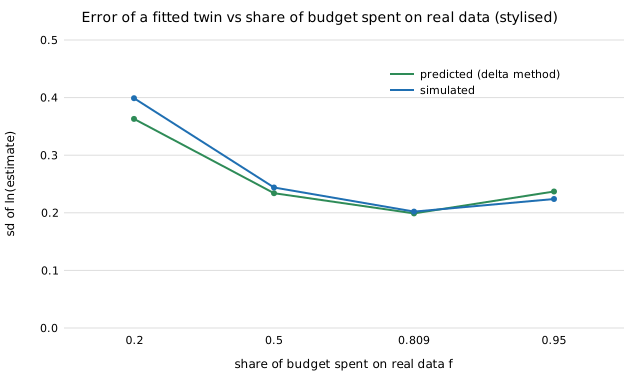
A twin fitted to n real observations and simulated for m jobs has relative variance a(ρ)/n + b(ρ)/m about the real wait (Whitt’s M/M/1 constant matched to simulation: 30.4 vs 29.0). One real interarrival–service pair carries the information of about two simulated jobs at any load (ratio 2.23 → 2.00), so the optimal real-data share of a budget is interior: 0.97 / 0.81 / 0.57 as a simulated job costs 0.001 / 0.05 / 0.5 of a real observation. In a full pipeline the optimal split has 2.5× lower RMSE than 20% real data. A simulation-only confidence interval is for the twin, not the system: its coverage of the real wait falls from 0.79 to 0.17 as the run grows from 200 to 50 000 jobs, while adding the input variance gives 0.92–0.95 for runs of 1000 or more. Stylised: M/M/1, simulated data, first-order variances.
A figure from its own output
Paper, code and results
More in Digital twins & sim-to-real
- When should a twin run that counts rare failures stop?When to stop a twin run counting rare failures: sequential Wald stopping halts on zero failures (90% of runs at
p=10⁻³, coverage 9.6%), inverse sampling tomfailures gives exactly unbiased(m−1)/(N−1)with relative sd≈1/√(m−2)and an exact interval (95.0–95.5%), while a fixed run planned for the wrongpdelivers 63–200% half-width. - What stopping distance can a twin with independent terrain cells certify?Stopping distance certified by a twin with independent per-cell friction: exact incomplete-gamma law (matches braking simulation), 100 twin cells certify 1.17× the mean distance but real terrain with 1–10 patches exceeds it 44%–18% (claimed 0.1%), finer cells are worse, the mean is nearly right, and the measured patch count repairs it.
- What approach speed can a lidar twin that returns every beam certify?Approach speed certified by a lidar twin with independent beam dropout vs real whole-scan fades: exact scan-product miss law, real miss ~100× the level at the twin's speed, speed off 10–30% (probabilities off by orders of magnitude), sign reverses when several returns are needed, repaired by a few hundred calibration scans.
- How do you estimate a one-in-a-million failure from a twin you can only run a thousand times?Importance sampling of a rare twin failure: exact mean-shift variance, 10⁸→535 runs for 10% error at p=1e-6, a narrow shift target (2× the optimum is 1.7·10⁵× worse, 0% coverage) and effective sample size as the only warning.
- Which ego-velocity estimator should a radar twin choose when the real scene has moving targets?Radar ego-velocity from Doppler returns: a static-world twin picks least squares, but with moving targets its variance is exactly
1+ετ²times the claim (95% interval covers 48.7% at ε=0.1, τ=10) and the median wins on a band of ε (0.006–0.97 at τ=10; never at τ=1). - A radar twin with no Doppler folding certifies an ego-velocity estimator at every speed: what does the folding sensor do to it, and when can it be unfolded?A radar twin with no Doppler folding: the twin-tuned ego-speed estimator breaks at
v_u−2σwith an exact closed-form bias (saturating at one fold off), and a wrapped-cost search unfolds it iff azimuths are diverse, with a confusion probabilityΦ(−√E₁/2σ)matching Monte Carlo.
All 164 Digital twins & sim-to-real projects →
Other research topics
Proper scoring & elicitation28Effort & peer prediction9Verification games & slashing19Detection & tolerances14Markets as routers13Prediction-market design9Paying contributors8Decentralised training systems23Digital twins & sim-to-real164LLM chip design loops40Robot manufacturing loops53Ambient AI assistant46Self-replicating manufacturing34Simulation-first design64Engineered clothing45Task-specific AI accelerators40Algorithmic chip-design loops42Open-source purpose-built robots44The software-engineering loop43Adversarial human imitation41Open-source residential construction41Autonomous multi-angle capture34Sensing, imaging and 3D31Energy supply and dense energy storage39Robot societies among people31Agentic co-design of low-cost robots27Laundry-hanging robots25Machine learning on qualitative data23Robots on the building site27Civilizations & group psychology1History & human sciences1
Produced with AI assistance (Claude). Results are from the code in this repository and are simulated or stylised unless the abstract says otherwise; nothing here implies affiliation with or endorsement by any lab, researcher or company cited. MIT licensed.