What approach speed can a lidar twin that returns every beam certify?
research/beam-twin
Approach speed certified by a lidar twin with independent beam dropout vs real whole-scan fades: exact scan-product miss law, real miss ~100× the level at the twin's speed, speed off 10–30% (probabilities off by orders of magnitude), sign reverses when several returns are needed, repaired by a few hundred calibration scans.
What it found
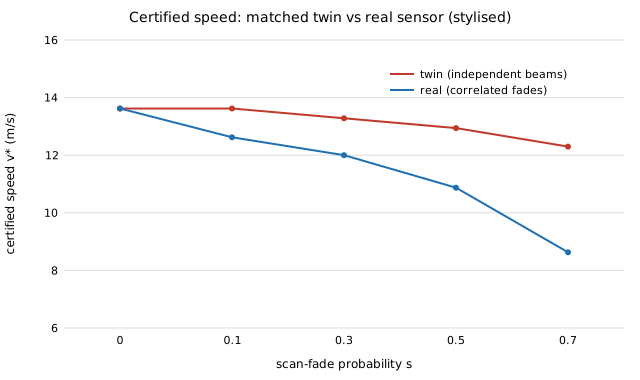
Scanning-lidar detection of a thin obstacle has an exact random-phase beam-count law and a product-over-scans miss probability (matched to a beam-pattern Monte Carlo). A twin calibrated on the mean return rate but with independent beams has no whole-scan fades; the real miss probability cannot fall below sn for n scans. At level 10−3 the twin certifies 13.3 and 12.9 m/s against the real 12.0 and 10.9 (fade rates 0.3, 0.5), with real miss probability 0.09–0.125, about 100× the level; the gap vanishes for early-visible obstacles and reverses sign when several returns are required. The probabilities are off by orders of magnitude but the speed by only 10–30%, because miss probability is a cliff in speed. A few hundred calibration scans repair it. Stylised.
A figure from its own output
Paper, code and results
More in Digital twins & sim-to-real
- How do you estimate a one-in-a-million failure from a twin you can only run a thousand times?Importance sampling of a rare twin failure: exact mean-shift variance, 10⁸→535 runs for 10% error at p=1e-6, a narrow shift target (2× the optimum is 1.7·10⁵× worse, 0% coverage) and effective sample size as the only warning.
- Which ego-velocity estimator should a radar twin choose when the real scene has moving targets?Radar ego-velocity from Doppler returns: a static-world twin picks least squares, but with moving targets its variance is exactly
1+ετ²times the claim (95% interval covers 48.7% at ε=0.1, τ=10) and the median wins on a band of ε (0.006–0.97 at τ=10; never at τ=1). - A radar twin with no Doppler folding certifies an ego-velocity estimator at every speed: what does the folding sensor do to it, and when can it be unfolded?A radar twin with no Doppler folding: the twin-tuned ego-speed estimator breaks at
v_u−2σwith an exact closed-form bias (saturating at one fold off), and a wrapped-cost search unfolds it iff azimuths are diverse, with a confusion probabilityΦ(−√E₁/2σ)matching Monte Carlo. - How many real trials before “the twin passed validation” means anything for a rare failure?Validating a twin's rare-failure rate against real trials: an exact difference test "passes" a 3×-wrong twin 81% of the time at 500 trials, rejecting a 2× error needs ~11 real failures (any q), and an equivalence test needs ~20/58/178 failures for margins 2/1.5/1.25 (~20/q trials).
- How safe is a robot's goal inference when its commit threshold was tuned against a simulated human?Goal inference tuned against a simulated human: exact real error
1/(1+r^h)of a commit threshold, 3.9×–165× over target for a too-rational twin, 2–4.5× slower for a too-irrational one, population floorP(p<½), and calibration from n real cues misses the target 14–42% of the time. - How much does a twin's perfectly synchronised sensor clock over-promise a fused estimate?Sensor clock offset and jitter a twin does not simulate: exact added variance
2σ²[1−(1+s²/ℓ²)^{−½}e^{−δ²/2(ℓ²+s²)}], a synchronised-clock fusion design is1+ag/(b(a+b))× its claim (+44% at 0.3ℓ) and worse than one sensor beyond 0.225ℓ, better delayed sensors hurt more, clock randomisation fixes it.
All 164 Digital twins & sim-to-real projects →
Other research topics
Proper scoring & elicitation28Effort & peer prediction9Verification games & slashing19Detection & tolerances14Markets as routers13Prediction-market design9Paying contributors8Decentralised training systems23Digital twins & sim-to-real164LLM chip design loops40Robot manufacturing loops53Ambient AI assistant46Self-replicating manufacturing34Simulation-first design64Engineered clothing45Task-specific AI accelerators40Algorithmic chip-design loops42Open-source purpose-built robots44The software-engineering loop43Adversarial human imitation41Open-source residential construction41Autonomous multi-angle capture34Sensing, imaging and 3D31Energy supply and dense energy storage39Robot societies among people31Agentic co-design of low-cost robots27Laundry-hanging robots25Machine learning on qualitative data23Robots on the building site27Civilizations & group psychology1History & human sciences1
Produced with AI assistance (Claude). Results are from the code in this repository and are simulated or stylised unless the abstract says otherwise; nothing here implies affiliation with or endorsement by any lab, researcher or company cited. MIT licensed.