How much does a twin's perfectly synchronised sensor clock over-promise a fused estimate?
research/sync-twin
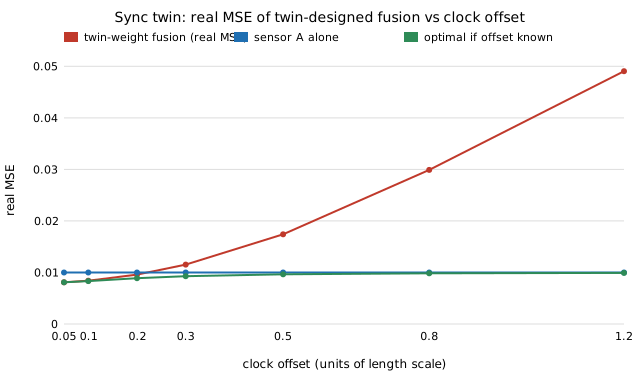
Sensor clock offset and jitter a twin does not simulate: exact added variance 2σ²[1−(1+s²/ℓ²)^{−½}e^{−δ²/2(ℓ²+s²)}], a synchronised-clock fusion design is 1+ag/(b(a+b))× its claim (+44% at 0.3ℓ) and worse than one sensor beyond 0.225ℓ, better delayed sensors hurt more, clock randomisation fixes it.
What it found
Two sensors observe a smooth signal (length scale ℓ); the second has a clock offset δ and jitter s, which the twin does not simulate. The added variance is exactly g = 2σ2[1−(1+s2/ℓ2)−1/2e−δ2/2(ℓ2+s2)] ≈ σ2(δ2+s2)/ℓ2 (matched to simulation within 0.5%), so inverse-variance fusion designed in the twin has real MSE 1 + ag/(b(a+b)) times its claim: +44% at a 0.3ℓ offset, +118% at 0.5ℓ, and worse than the reference sensor alone beyond 0.225ℓ. The more accurate the delayed sensor, the more it hurts. Randomising the twin’s clock at the right variance recovers the optimal weight; no randomisation costs up to 29%, a range 4× too wide only 1–4%. Stylised: very smooth signal, static weights, offset known, no real logs.
A figure from its own output
Paper, code and results
More in Digital twins & sim-to-real
- What does a twin get wrong when its gain is fitted from a noisy logged input, and does more data fix it?A twin gain fitted from a noisy logged input is attenuated by exactly the reliability ratio
λ(0.800 vs 0.802 simulated), more data makes the twin's own 95% interval worse (covers the true gain 53%→0% for n=20→200) with no residual warning, a feedforward controller overshoots by exactly1/λ, and known-noise or instrument repairs cost variance and fail at small n. - What does a twin with no actuator deadband promise a proportional loop, and what does the real one do?An actuator deadband the twin lacks: real loop rests at exactly
d/kwhile the twin goes to 0, toleranceεneedsk ≥ d/ε, a fitted linear gain is2Q(d/s)(excitation-dependent, small-signal gain 0), and bisection compensation leaves exact(d−d̂)/kor a(d̂−d)/(2−k)chatter (8 probes: 0.784 → 0.0005). - Does measurement noise, or dither, hide an actuator deadband the twin lacks?Follow-up to
deadband-twin: measurement noise flips the linear twin's error from 27× optimistic (s=0.01) to conservative (0.37× at s=0.05), dither helps only without noise, and mild under-compensation beats the exact width under noise (single-seed simulations). - How large a manoeuvre can a twin without an actuator rate limit be trusted for?A twin without an actuator rate limit is exact only for
x₀ ≤ r/k; beyond it the real loop overshoots (0.90 ofx₀atx₀/r=10⁴) and settles in O(amplitude) steps, with an empirical overshoot threshold2n(2n−1)fork=1/n. - Does a twin with a rigid drivetrain miss the hunting cycle caused by gear backlash?A rigid-drivetrain twin says the PI loop converges but gear backlash makes the real loop hunt at 1.3–2.9× the gap (exactly ∝ h); describing-function prediction 7–10% high, and bistable starts can hide it.
- How wrong is the stopping distance of a twin that models friction as purely viscous?A viscous-only twin never stops (6.5–17.7 s to reach 1e-3…1e-9 vs 1.95 s real) and its fitted gain
b + c·E[v]/E[v²]depends on the logged speed range; fitted on [1,3] it overestimates stopping distance ×1.8–17 below and underestimates abovev*=7.3, no single viscous gain beats 0.87 worst error over [0.05,3], affine fit recovers exactly.
All 164 Digital twins & sim-to-real projects →
Other research topics
Proper scoring & elicitation28Effort & peer prediction9Verification games & slashing19Detection & tolerances14Markets as routers13Prediction-market design9Paying contributors8Decentralised training systems23Digital twins & sim-to-real164LLM chip design loops40Robot manufacturing loops53Ambient AI assistant46Self-replicating manufacturing34Simulation-first design64Engineered clothing45Task-specific AI accelerators40Algorithmic chip-design loops42Open-source purpose-built robots44The software-engineering loop43Adversarial human imitation41Open-source residential construction41Autonomous multi-angle capture34Sensing, imaging and 3D31Energy supply and dense energy storage39Robot societies among people31Agentic co-design of low-cost robots27Laundry-hanging robots25Machine learning on qualitative data23Robots on the building site27Civilizations & group psychology1History & human sciences1
Produced with AI assistance (Claude). Results are from the code in this repository and are simulated or stylised unless the abstract says otherwise; nothing here implies affiliation with or endorsement by any lab, researcher or company cited. MIT licensed.