Which ego-velocity estimator should a radar twin choose when the real scene has moving targets?
research/doppler-twin
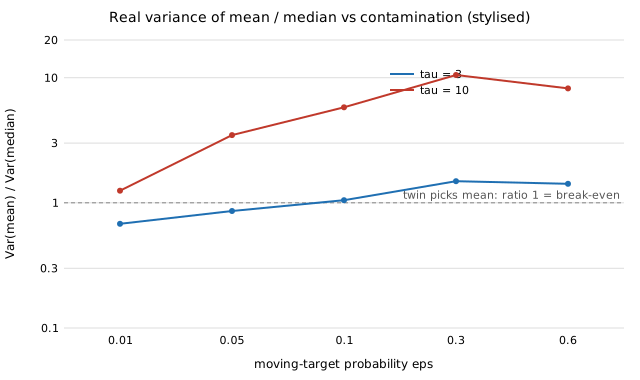
Radar ego-velocity from Doppler returns: a static-world twin picks least squares, but with moving targets its variance is exactly 1+ετ² times the claim (95% interval covers 48.7% at ε=0.1, τ=10) and the median wins on a band of ε (0.006–0.97 at τ=10; never at τ=1).
What it found
Radar ego-velocity from n Doppler returns. In a static-world twin least squares beats the median by exactly π/2, so the twin picks the mean; in a scene where a fraction ε of returns come from moving targets (extra offset sd τσ) the mean’s variance is exactly 1 + ετ2 times the twin’s claim and the median’s exact variance is a one-dimensional integral, both matched to simulation. The twin’s choice is wrong on a band of ε (τ=10: 0.006–0.97; τ=3: 0.086–0.83; τ=1: never); at ε=0.1, τ=10 the mean has 5.8× the median’s variance and the twin’s 95% interval covers 48.7% of the time. 2-D least squares scales the same way. A residual-kurtosis test needs about 50 returns to detect it at ε=0.1, τ=10, and hundreds at ε=0.02, τ=3. Stylised: zero-mean Gaussian contamination, no RANSAC, no radar data.
A figure from its own output
Paper, code and results
More in Digital twins & sim-to-real
- A radar twin with no Doppler folding certifies an ego-velocity estimator at every speed: what does the folding sensor do to it, and when can it be unfolded?A radar twin with no Doppler folding: the twin-tuned ego-speed estimator breaks at
v_u−2σwith an exact closed-form bias (saturating at one fold off), and a wrapped-cost search unfolds it iff azimuths are diverse, with a confusion probabilityΦ(−√E₁/2σ)matching Monte Carlo. - How many real trials before “the twin passed validation” means anything for a rare failure?Validating a twin's rare-failure rate against real trials: an exact difference test "passes" a 3×-wrong twin 81% of the time at 500 trials, rejecting a 2× error needs ~11 real failures (any q), and an equivalence test needs ~20/58/178 failures for margins 2/1.5/1.25 (~20/q trials).
- How safe is a robot's goal inference when its commit threshold was tuned against a simulated human?Goal inference tuned against a simulated human: exact real error
1/(1+r^h)of a commit threshold, 3.9×–165× over target for a too-rational twin, 2–4.5× slower for a too-irrational one, population floorP(p<½), and calibration from n real cues misses the target 14–42% of the time. - How much does a twin's perfectly synchronised sensor clock over-promise a fused estimate?Sensor clock offset and jitter a twin does not simulate: exact added variance
2σ²[1−(1+s²/ℓ²)^{−½}e^{−δ²/2(ℓ²+s²)}], a synchronised-clock fusion design is1+ag/(b(a+b))× its claim (+44% at 0.3ℓ) and worse than one sensor beyond 0.225ℓ, better delayed sensors hurt more, clock randomisation fixes it. - What does a twin get wrong when its gain is fitted from a noisy logged input, and does more data fix it?A twin gain fitted from a noisy logged input is attenuated by exactly the reliability ratio
λ(0.800 vs 0.802 simulated), more data makes the twin's own 95% interval worse (covers the true gain 53%→0% for n=20→200) with no residual warning, a feedforward controller overshoots by exactly1/λ, and known-noise or instrument repairs cost variance and fail at small n. - What does a twin with no actuator deadband promise a proportional loop, and what does the real one do?An actuator deadband the twin lacks: real loop rests at exactly
d/kwhile the twin goes to 0, toleranceεneedsk ≥ d/ε, a fitted linear gain is2Q(d/s)(excitation-dependent, small-signal gain 0), and bisection compensation leaves exact(d−d̂)/kor a(d̂−d)/(2−k)chatter (8 probes: 0.784 → 0.0005).
All 164 Digital twins & sim-to-real projects →
Other research topics
Proper scoring & elicitation28Effort & peer prediction9Verification games & slashing19Detection & tolerances14Markets as routers13Prediction-market design9Paying contributors8Decentralised training systems23Digital twins & sim-to-real164LLM chip design loops40Robot manufacturing loops53Ambient AI assistant46Self-replicating manufacturing34Simulation-first design64Engineered clothing45Task-specific AI accelerators40Algorithmic chip-design loops42Open-source purpose-built robots44The software-engineering loop43Adversarial human imitation41Open-source residential construction41Autonomous multi-angle capture34Sensing, imaging and 3D31Energy supply and dense energy storage39Robot societies among people31Agentic co-design of low-cost robots27Laundry-hanging robots25Machine learning on qualitative data23Robots on the building site27Civilizations & group psychology1History & human sciences1
Produced with AI assistance (Claude). Results are from the code in this repository and are simulated or stylised unless the abstract says otherwise; nothing here implies affiliation with or endorsement by any lab, researcher or company cited. MIT licensed.