Do trained keyword-spotting models fit a Tiny Tapeout tile's 16-bit bias and 20-bit accumulator?
research/accel-ttretrain
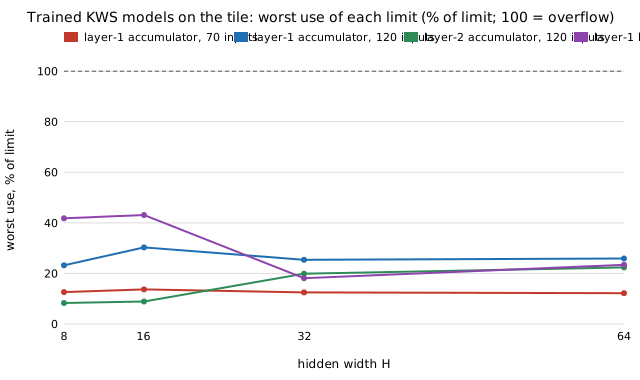
All 96 retrained keyword-spotting models fit the Tiny Tapeout engine's 16-bit bias and 20-bit accumulator limits (worst use 43% and 30%), accuracy through the tile contract equals the reference, and 32 trained models run bit-exact in RTL.
What it found
All 96 retrained accel-kws models (70 and 120 inputs, hidden width 8–64, 2–8-bit weights, 3 seeds) on Speech Commands stay inside the streaming engine's limits: the largest layer-1 bias is 43% of the 16-bit limit and the largest accumulator 30% of the 20-bit limit, with no overflow on train or test clips. Accuracy through the tile's wrapping contract equals the integer reference on every model, and the 32 trained seed-0 models run bit-exact (class and cycles) through the Icarus RTL on 30 clips each. The accuracies accel-ttfit used are reproduced to within 0.010 for 3-, 4- and 8-bit weights. Stylised: one hidden layer, weak features, synthesis-only area.
A figure from its own output
Paper, code and results
More in Task-specific AI accelerators
- Does Tiny Tapeout's real tile-size table change which keyword-spotting model fits a tile?Tiny Tapeout's real SKY130 tile sizes (1x1 is 161 × 111.52 µm = 17,955 µm², 0.43% below the value assumed earlier) applied to the synthesised keyword-spotting engine and the retrained models: the best 1x1 model is unchanged at 100% and 50% utilisation and flips at 70% (H = 16, 4-bit, 0.596 instead of 8-bit, 0.616, a 29 µm² miss); H = 64 with 8-bit weights (0.737) fits a 1x2 tile.
- How small can a keyword-spotting accelerator get, and what does each bit of precision cost?Keyword-spotting accelerator: quantised MLP on Speech Commands, serial-MAC RTL bit-exact against an integer reference, accuracy vs cycles, cells and modelled energy over width and weight bits (stylised).
- Does a keyword-spotting accelerator fit in a Tiny Tapeout tile, and how accurate can it be?A streaming keyword-spotting engine with no weight memory, exact against an integer reference and synthesised to SKY130 on 32 geometries (6,300 to 24,500 um2); 16 hidden units at 8-bit weights is the most accurate (0.616) that fits one assumed 1x1 Tiny Tapeout tile at 70% utilisation, 64 units at 4 bits (0.738) needs two. Stylised: synthesis only.
- Under a latency deadline, how much engine area does picking the most accurate model first cost, compared with choosing model and lane count together?Model-first vs joint choice of model and MAC lane count under a latency deadline, on the 40 measured
accel-kwsmodels; accepting 2 validation points less cuts engine area 31–42% (stylised, table-based, cycles for more than one lane analytic). - Does NSGA-II find a keyword-spotting accelerator's Pareto front faster than random search at equal budgets?NSGA-II against random search at equal budgets on a 3,840-design keyword-spotting accelerator space with exact ground truth; NSGA-II finds 54 to 89% of the exact front at 20.8% of the space against 19 to 21% for random search, though hypervolume is 0.97 to 1.00 for both. Stylised.
- Was accel-nsga's NSGA-II win a tuning accident? Does population size, mutation rate or crossover change how much of the exact front it finds?Sweeps NSGA-II's population, mutation rate and crossover on the
accel-nsgaspace; mutation 0.02 to 0.1 finds about 0.38 and 0.71 to 0.77 of the exact front at 400 designs, against 0.28 and 0.59 ataccel-nsga's setting and 0.13 and 0.12 for random search (stylised).
All 40 Task-specific AI accelerators projects →
Other research topics
Proper scoring & elicitation28Effort & peer prediction9Verification games & slashing19Detection & tolerances14Markets as routers13Prediction-market design9Paying contributors8Decentralised training systems23Digital twins & sim-to-real164LLM chip design loops40Robot manufacturing loops53Ambient AI assistant46Self-replicating manufacturing34Simulation-first design64Engineered clothing45Task-specific AI accelerators40Algorithmic chip-design loops42Open-source purpose-built robots44The software-engineering loop43Adversarial human imitation41Open-source residential construction41Autonomous multi-angle capture34Sensing, imaging and 3D31Energy supply and dense energy storage39Robot societies among people31Agentic co-design of low-cost robots27Laundry-hanging robots25Machine learning on qualitative data23Robots on the building site27Civilizations & group psychology1History & human sciences1
Produced with AI assistance (Claude). Results are from the code in this repository and are simulated or stylised unless the abstract says otherwise; nothing here implies affiliation with or endorsement by any lab, researcher or company cited. MIT licensed.