Does the pruning and ternary-weight result from digits hold on real keyword-spotting features?
research/accel-kwssparse
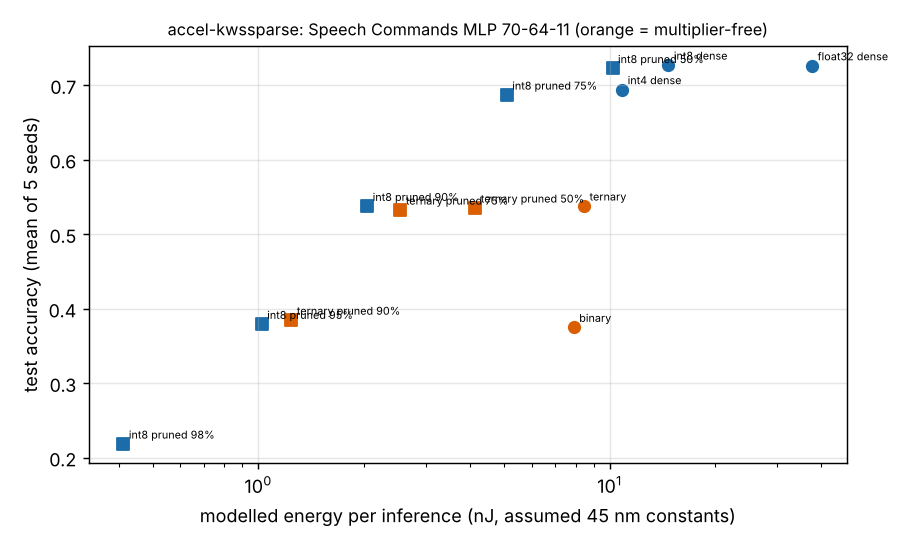
accel-sparse's pruning, int4/int8, ternary and binary sweep re-run on real Speech Commands MFCC features: no multiplier-free design is within 5 points of float32 (ternary 19 down), where digits said 1; int8 pruned 50% is the cheapest within 2 points. Stylised, untuned negative.
What it found
accel-sparse's 13 designs (pruned and quantised, ternary, binary) re-run on Speech Commands MFCC features of accel-kws (70-64-11 MLP, 5 seeds, same modelled energy). Negative: no multiplier-free design is within 5 points of float32 (ternary is 19 points down, where digits lost under 1); the cheapest design within 2 points is int8 pruned 50% at 69% of dense int8 energy. Stylised: untuned training, one hidden width, assumed 45 nm constants.
A figure from its own output
Paper, code and results
More in Task-specific AI accelerators
- Does weight-sharing lookup-table inference beat a multiply-accumulate engine for a small accelerator?Weight-sharing product-table inference against int8 MAC engines on the digits MLP: negative at this size, break-even only for wide layers with cheap table reads. Stylised, modelled energy.
- Does a wider hidden layer make weight-sharing product-table inference beat an int8 MAC engine?Product-table inference on trained wide digits MLPs (32, 128, 512 hidden): at best 14% under int8 energy, only with an assumed cheap table read. Stylised, modelled energy.
- Does fine-tuning the shared weight values rescue low-K lookup-table inference?Fine-tuning the shared values of
accel-lut's product-table engine: rescues K=2 in the 75%-pruned digits MLP (14% under int8 energy only at an assumed cheap table read), not the dense network. Stylised, modelled energy. - What does a product-table inference engine cost in RTL, against a serial MAC engine?The product-table engine and a serial MAC engine in Verilog, bit-exact against NumPy and synthesised with Yosys: negative, the table needs an accumulator per output (stylised)
- Does a tiny always-on keyword model that wakes a bigger one beat the best single model on energy?Classifier-only energy of two-stage keyword-spotting cascades vs 40 single MLPs retrained on the original Speech Commands v0.02 (5 seeds, 200 models, about 41,000 cascades per seed, thresholds chosen on validation): cascades cut modelled energy by 0 to 28% at the same validation target, losing 0.3 to 1.4 test points, and the saving is under 1% of a system whose MFCC front end costs about 50 times the classifier
- Does the MFCC front end cost more than the keyword-spotting network it feeds?An instrumented Q15 MFCC front end (512-point FFT, 40 mel bands, DCT) costs 7,532 multiplies per 20 ms frame against the 5,184-MAC
accel-kwsclassifier per inference; under assumed 45 nm constants the front end is 8 to 150 times the classifier's power, and 16-bit FFT scaling decides its accuracy (synthetic frames, no Speech Commands)
All 40 Task-specific AI accelerators projects →
Other research topics
Proper scoring & elicitation28Effort & peer prediction9Verification games & slashing19Detection & tolerances14Markets as routers13Prediction-market design9Paying contributors8Decentralised training systems23Digital twins & sim-to-real164LLM chip design loops40Robot manufacturing loops53Ambient AI assistant46Self-replicating manufacturing34Simulation-first design64Engineered clothing45Task-specific AI accelerators40Algorithmic chip-design loops42Open-source purpose-built robots44The software-engineering loop43Adversarial human imitation41Open-source residential construction41Autonomous multi-angle capture34Sensing, imaging and 3D31Energy supply and dense energy storage39Robot societies among people31Agentic co-design of low-cost robots27Laundry-hanging robots25Machine learning on qualitative data23Robots on the building site27Civilizations & group psychology1History & human sciences1
Produced with AI assistance (Claude). Results are from the code in this repository and are simulated or stylised unless the abstract says otherwise; nothing here implies affiliation with or endorsement by any lab, researcher or company cited. MIT licensed.