Does a patch-averaged stress converge under mesh refinement where the peak element stress does not?
research/simdesign-patchstress
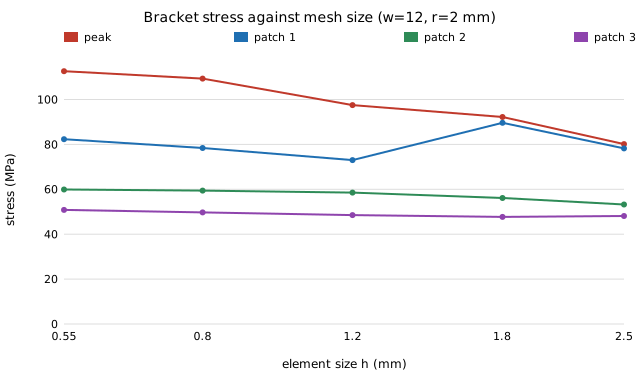
Compares peak and patch-averaged von Mises stress under mesh refinement on the L-bracket: the peak rises 18–41% from h = 2.5 to 0.55 mm while a 3 mm patch average moves 1–6%, but it reads only 0.45–0.69 of the peak so needs its own limit (stylised, assumed values).
What it found
On four L-bracket designs solved on five meshes (h = 2.5 to 0.55 mm), the peak von Mises stress rises by 18–41% while a 3 mm patch average moves by 1–6%. The peak is not monotone along the sequence, so a two-mesh check can mislead. The patch average is not conservative: it reads 0.45–0.69 of the fine-mesh peak and would need its own calibrated limit. Stylised: 2D plane stress, one load case, a non-nested mesh family, assumed material, nothing made.
A figure from its own output
Paper, code and results
More in Simulation-first design
- Does a patch-averaged stress change what manufacturing rules cost a sized bracket?Repeats the process-rule bracket search with a 3 mm patch-averaged stress instead of the peak: the ordering of mass prices (casting > CNC > laser ≈ FDM) holds, the laser price spread across seeds shrinks from 0.16 to under 0.005, and designs overshoot their limit by 2–12% on a fine mesh against 19–34% for the peak (stylised, assumed values, uncalibrated limit).
- Is the shrinking laser-cutting price scatter under the patch stress caused by the near-sharp fillet floor?Tests whether a near-sharp fillet floor explains the laser-cutting price scatter seen in
simdesign-patchsearch: it does not (peak-stress designs already use 7.6–14.3 mm fillets, so floors of 0.2 and 1 mm give identical designs); the patch-stress price is steady (sd 0.006–0.011) at every floor, and the cause of the peak scatter is not identified (negative, five seeds, stylised). - Where does the peak-stress price scatter of laser-cutting rules come from?Follow-up to
simdesign-filletfloor: the peak-stress price scatter of laser-cutting rules (sd 0.063) sits in the 2 mm gauge sub-search, not the fillet floor; a four-times search budget cuts it to 0.025 but not monotonically, so several nearby optima are plausible but not shown (five seeds, stylised). - Does a patch-averaged stress give a mesh-converged stress concentration for a bolt hole?Patch-averaged stress for a bolt hole in a tension strip: nearly settled under mesh refinement already, matches Kirsch's disc averages, needs its own limit (stylised).
- How far below the exact stress concentration does a finite-element peak stress sit, and how fast does it close?Checks the finite-element peak stress at a circular hole against Kirsch's exact 3× concentration: the element-centroid peak sits 27% (coarse) to 1.1% (fine) below it and closes only at first order, while hole-edge vertex values are within 1% (stylised).
- What causes the peak-stress price scatter of laser-cutting rules in the bracket search?The peak-stress price scatter of laser-cutting rules is a missed search at the narrow 2 mm gauge (1 seed in 20), not a cost of the rules; stylised, mesh effects untested.
All 64 Simulation-first design projects →
Other research topics
Proper scoring & elicitation28Effort & peer prediction9Verification games & slashing19Detection & tolerances14Markets as routers13Prediction-market design9Paying contributors8Decentralised training systems23Digital twins & sim-to-real164LLM chip design loops40Robot manufacturing loops53Ambient AI assistant46Self-replicating manufacturing34Simulation-first design64Engineered clothing45Task-specific AI accelerators40Algorithmic chip-design loops42Open-source purpose-built robots44The software-engineering loop43Adversarial human imitation41Open-source residential construction41Autonomous multi-angle capture34Sensing, imaging and 3D31Energy supply and dense energy storage39Robot societies among people31Agentic co-design of low-cost robots27Laundry-hanging robots25Machine learning on qualitative data23Robots on the building site27Civilizations & group psychology1History & human sciences1
Produced with AI assistance (Claude). Results are from the code in this repository and are simulated or stylised unless the abstract says otherwise; nothing here implies affiliation with or endorsement by any lab, researcher or company cited. MIT licensed.