Where does the peak-stress price scatter of laser-cutting rules come from?
research/simdesign-gaugebudget
Follow-up to simdesign-filletfloor: the peak-stress price scatter of laser-cutting rules (sd 0.063) sits in the 2 mm gauge sub-search, not the fillet floor; a four-times search budget cuts it to 0.025 but not monotonically, so several nearby optima are plausible but not shown (five seeds, stylised).
What it found
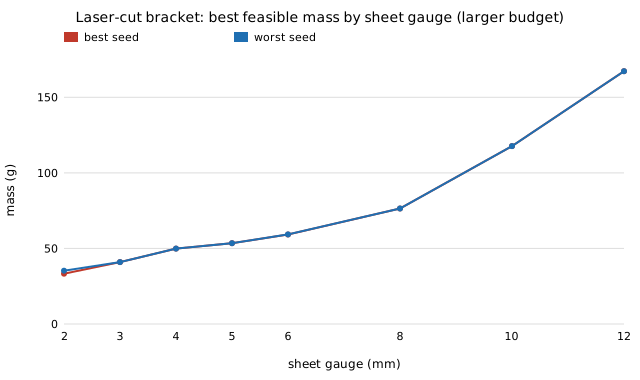
A stylised follow-up to the fillet-floor negative result. Keeping the best mass of each of the ten stock-gauge sub-searches shows that the scatter in the rules mass (price 0.990–1.145 over five seeds) sits in the 2 mm gauge: in one seed that sub-search found nothing feasible and the 3 mm gauge won, giving the 1.145 outlier, while gauges of 3 mm and above agree across seeds to within 0.05 g at four times the budget. Quadrupling the search budget cuts the price sd from 0.063 to 0.025, but not monotonically, the no-rules twin moves too, and the 2 mm gauge still spreads over 2 g, so the data are consistent with several nearby optima there, not proof of it. Five seeds, one process and load case, 2D plane stress, assumed rules. Simulated only. Produced with AI assistance.
A figure from its own output
Paper, code and results
More in Simulation-first design
- Does a patch-averaged stress give a mesh-converged stress concentration for a bolt hole?Patch-averaged stress for a bolt hole in a tension strip: nearly settled under mesh refinement already, matches Kirsch's disc averages, needs its own limit (stylised).
- How far below the exact stress concentration does a finite-element peak stress sit, and how fast does it close?Checks the finite-element peak stress at a circular hole against Kirsch's exact 3× concentration: the element-centroid peak sits 27% (coarse) to 1.1% (fine) below it and closes only at first order, while hole-edge vertex values are within 1% (stylised).
- What causes the peak-stress price scatter of laser-cutting rules in the bracket search?The peak-stress price scatter of laser-cutting rules is a missed search at the narrow 2 mm gauge (1 seed in 20), not a cost of the rules; stylised, mesh effects untested.
- Do search restarts remove the missed 2 mm sub-search in the laser-cut bracket problem?A second DE restart or a doubled population removes the missed 2 mm sub-search (0 misses in 40 runs against 1 in 20 at baseline) and shifts results to the lighter of two mass groups at about twice the cost; stylised, 2.5 mm search mesh only.
- Are the two mass groups of the 2 mm laser-cut bracket search two separate basins?The two gauge-2 mass groups differ in web width w (about 14.3–14.9 against 15.2–15.6 mm), not fillet radius, and the lighter group matches ragged isolated feasible pockets on the 2.5 mm mesh rather than a second broad basin; stylised, preliminary.
- Do the isolated feasible pockets of the 2 mm laser-cut bracket survive mesh refinement?The isolated feasible pockets of the gauge-2 bracket scan (web width below 15.4 mm) vanish when the mesh is refined from 2.5 to 1.5 mm and the smallest feasible width rises by about 1 mm; stylised, preliminary.
All 64 Simulation-first design projects →
Other research topics
Proper scoring & elicitation28Effort & peer prediction9Verification games & slashing19Detection & tolerances14Markets as routers13Prediction-market design9Paying contributors8Decentralised training systems23Digital twins & sim-to-real164LLM chip design loops40Robot manufacturing loops53Ambient AI assistant46Self-replicating manufacturing34Simulation-first design64Engineered clothing45Task-specific AI accelerators40Algorithmic chip-design loops42Open-source purpose-built robots44The software-engineering loop43Adversarial human imitation41Open-source residential construction41Autonomous multi-angle capture34Sensing, imaging and 3D31Energy supply and dense energy storage39Robot societies among people31Agentic co-design of low-cost robots27Laundry-hanging robots25Machine learning on qualitative data23Robots on the building site27Civilizations & group psychology1History & human sciences1
Produced with AI assistance (Claude). Results are from the code in this repository and are simulated or stylised unless the abstract says otherwise; nothing here implies affiliation with or endorsement by any lab, researcher or company cited. MIT licensed.