How far below the exact stress concentration does a finite-element peak stress sit, and how fast does it close?
research/simdesign-kirsch
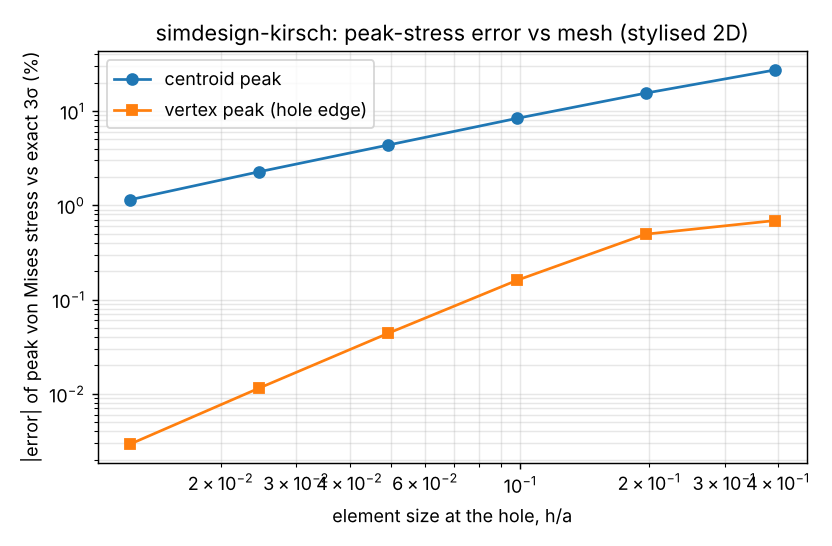
Checks the finite-element peak stress at a circular hole against Kirsch's exact 3× concentration: the element-centroid peak sits 27% (coarse) to 1.1% (fine) below it and closes only at first order, while hole-edge vertex values are within 1% (stylised).
What it found
A plate with a circular hole under tension has an exact peak stress of 3× the remote stress (Kirsch). On a graded quarter-plate mesh with exact-solution tractions (48 384 elements at the finest), the usual element-centroid peak sits 27% below it on the coarsest mesh and 1.1% below on the finest, closing only at first order, while the field itself converges at second order: the shortfall is sampling position, not solver error. Reading the stress at the hole-edge vertices instead is within 1% on every mesh. Stylised 2D plane stress, one geometry, regular mesh; the numbers do not transfer to other fillets.
A figure from its own output
Paper, code and results
More in Simulation-first design
- What causes the peak-stress price scatter of laser-cutting rules in the bracket search?The peak-stress price scatter of laser-cutting rules is a missed search at the narrow 2 mm gauge (1 seed in 20), not a cost of the rules; stylised, mesh effects untested.
- Do search restarts remove the missed 2 mm sub-search in the laser-cut bracket problem?A second DE restart or a doubled population removes the missed 2 mm sub-search (0 misses in 40 runs against 1 in 20 at baseline) and shifts results to the lighter of two mass groups at about twice the cost; stylised, 2.5 mm search mesh only.
- Are the two mass groups of the 2 mm laser-cut bracket search two separate basins?The two gauge-2 mass groups differ in web width w (about 14.3–14.9 against 15.2–15.6 mm), not fillet radius, and the lighter group matches ragged isolated feasible pockets on the 2.5 mm mesh rather than a second broad basin; stylised, preliminary.
- Do the isolated feasible pockets of the 2 mm laser-cut bracket survive mesh refinement?The isolated feasible pockets of the gauge-2 bracket scan (web width below 15.4 mm) vanish when the mesh is refined from 2.5 to 1.5 mm and the smallest feasible width rises by about 1 mm; stylised, preliminary.
- Does the feasible boundary of the 2 mm laser-cut bracket converge when the mesh is refined to 0.5 mm?On meshes of 1.0 and 0.5 mm no width in the usable 15.0–16.0 mm window of the gauge-2 bracket scan is feasible (one point at 0.75 mm), and the lowest peak stress rises 11–14% from 1.5 to 0.5 mm; negative, stylised, preliminary.
- Does the 1.5 mm bracket clear buckling when the whole L is one 3D body with a flexible corner?The whole 1.5 mm L-bracket as one 3D body clears the buckling floor under the design load (factor 4.01 vs closed-form 3.47) but not with the load reversed (2.25, below 3); sharp corner, ideal sheet, preliminary.
All 64 Simulation-first design projects →
Other research topics
Proper scoring & elicitation28Effort & peer prediction9Verification games & slashing19Detection & tolerances14Markets as routers13Prediction-market design9Paying contributors8Decentralised training systems23Digital twins & sim-to-real164LLM chip design loops40Robot manufacturing loops53Ambient AI assistant46Self-replicating manufacturing34Simulation-first design64Engineered clothing45Task-specific AI accelerators40Algorithmic chip-design loops42Open-source purpose-built robots44The software-engineering loop43Adversarial human imitation41Open-source residential construction41Autonomous multi-angle capture34Sensing, imaging and 3D31Energy supply and dense energy storage39Robot societies among people31Agentic co-design of low-cost robots27Laundry-hanging robots25Machine learning on qualitative data23Robots on the building site27Civilizations & group psychology1History & human sciences1
Produced with AI assistance (Claude). Results are from the code in this repository and are simulated or stylised unless the abstract says otherwise; nothing here implies affiliation with or endorsement by any lab, researcher or company cited. MIT licensed.