Which surrogate should train a verifier that can escalate?
research/reject-surrogates
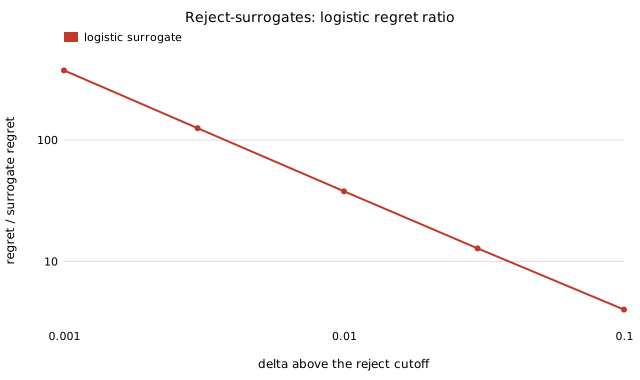
Polyhedral surrogates for accept/reject/escalate verifiers: minimiser embeds the Bayes action, linear regret transfer with constant exactly 2d, logistic transfer ratio 2d(1-d)/δ, and a negative SGD result.
What it found
Reject-option surrogates for accept/reject/escalate decisions: the generalised-hinge conditional risk embeds the Bayes action at its kinks, regret transfers linearly with constant exactly 2d (grid-verified), logistic transfer degrades as 2d(1−d)/δ, and a negative result shows logistic-plus-thresholds still learns faster in scalar SGD. Stylised.
A figure from its own output
Paper, code and results
More in Proper scoring & elicitation
- How do you pay a verifier whose report decides the job?Scoring verifiers whose report decides acceptance and whose outcome is seen only on acceptance: a truthful reserve exists iff the score centre
τ_s ≥ τ_d(uniquec0 = 1+τ_d²−2τ_dτ_s), plain Brier fails aboveτ_d = ½, recentring fixes it at rentτ³/3, exploration costs1/εpayment variance. - What if the referee itself is noisy?Scoring verifiers against a noisy judge: raw proper scores elicit
e0+γpand shrink Brier incentives byγ², can reverse rankings (η*=0.25), the unbiased surrogate score is exactly proper at a1/γpayment spread and1/γ²sample cost, and misestimated rates give a closed-form bias. - Can audits be predictable without corrupting scores?Scoring when truth exists only on audited tasks: report-dependent audit rates make naive scoring improper (shift
−bp(1−p)/(2(a+bp)), full hiding for steep rates), inverse-propensity weighting is exactly proper for any audit rule, and Neyman allocation gains only 3–11% variance. - Can a calibration test certify a verifier?Calibration tests are gameable: an information-free Foster–Vohra/Blackwell hedger keeps expected ECE ≤
√(K+1)(1/(2K)+1/√T)against any outcome sequence (measured 0.016, Brier 0.254 vs 0 informed), so slashing must use a resolution-sensitive score; a Brier-gap test detects it in 100/100 runs. - Can a protocol pay workers to report how often honest replicas agree?Eliciting the chance two honest runs of a nondeterministic op agree (Γ=Σp²) from run pairs: proper with exact regret, one run provably cannot, all-pairs U-statistic variance ~¼ of disjoint pairs, fleet of H hardware classes false-slashes strict equality at
1−H^{1−k}, colluders' blind spot at ε=2Γ/(1+Γ). - Is a skill score normalised by the realised base rate safe to pay on?Brier skill scores normalised by the realised base rate are improper: exact optimal report,
≈ −(1−2p)/nbias, cross-task leakage through the pooled baseline, and a leave-one-out fix.
All 28 Proper scoring & elicitation projects →
Other research topics
Proper scoring & elicitation28Effort & peer prediction9Verification games & slashing19Detection & tolerances14Markets as routers13Prediction-market design9Paying contributors8Decentralised training systems23Digital twins & sim-to-real164LLM chip design loops40Robot manufacturing loops53Ambient AI assistant46Self-replicating manufacturing34Simulation-first design64Engineered clothing45Task-specific AI accelerators40Algorithmic chip-design loops42Open-source purpose-built robots44The software-engineering loop43Adversarial human imitation41Open-source residential construction41Autonomous multi-angle capture34Sensing, imaging and 3D31Energy supply and dense energy storage39Robot societies among people31Agentic co-design of low-cost robots27Laundry-hanging robots25Machine learning on qualitative data23Robots on the building site27Civilizations & group psychology1History & human sciences1
Produced with AI assistance (Claude). Results are from the code in this repository and are simulated or stylised unless the abstract says otherwise; nothing here implies affiliation with or endorsement by any lab, researcher or company cited. MIT licensed.