Can a generator imitate a person's webcam emotion signals well enough to fool a detector?
research/mimic-webcam
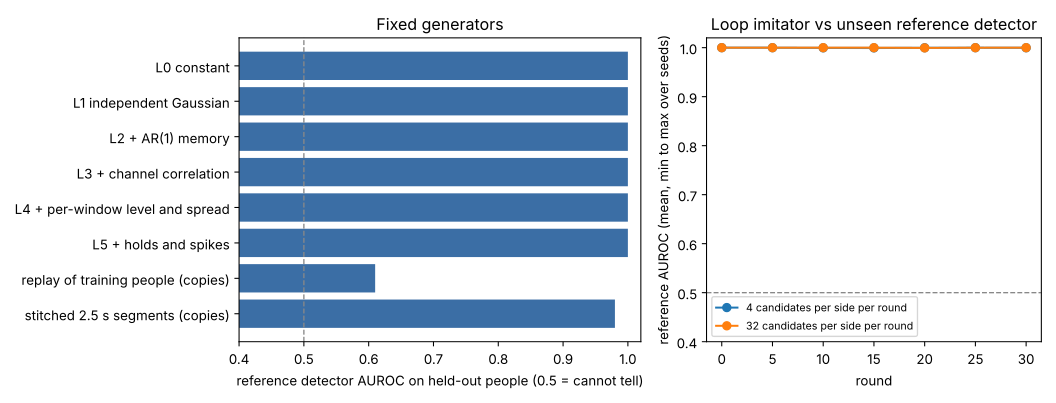
Can a generator imitate a person's webcam emotion signals well enough to fool a detector? On DUX Affectiva scores of 46 people, every fixed generator and every loop-tuned imitator is caught at AUROC 0.997 or higher by a detector the loop never saw; only replaying real windows gets close to chance (0.61). Preliminary.
What it found
Webcam, the third subject of the adversarial-imitation track, signals first: no pixels or faces. Ten-second windows of 12 facial-coding channels (Affectiva scores logged by DUX, CC-BY-4.0) from 46 people, split by person. Six fixed generators from constant to AR(1) with channel correlation, holds and spikes, and an imitator that tunes its own generator code against a 3-feature-group detector for 30 rounds (8 seeds; 4 seeds at 8× the budget), are all separated from held-out people by a boosted-tree reference detector the loop never saw at AUROC 0.997 or higher. Only replaying whole windows of other people gets near chance (0.61, which is the gap between people). Preliminary and stylised: one context, a fixed component library, and windows biased toward moments when the person was using the mouse or keyboard.
A figure from its own output
Paper, code and results
More in Adversarial human imitation
- Does giving a webcam-signal generator real heavy tails and bursts fool a detector?Does giving a webcam-signal generator real heavy tails and bursts fool a detector? No: copula and quiet/burst generators still separate from held-out people at AUROC 1.000 (8 seeds); restoring per-window level and spread brings level and spread to near chance, but extremes (0.995) still give it away; copying a real window's value set (G6) puts those at chance too, yet all-groups AUROC stays 0.998 on temporal structure.
- Is the prompted detector's inversion (AUROC below 0.5 on machine text) a model-size effect?Does a bigger Qwen make a better human-vs-machine detector? Partly: plain-prompt AUROC rises from 0.278 (0.5B) to 0.329 (1.5B), but 1.5B is still below chance in 84% of family-by-prompt cells.
- Can a small open code model write a cursor-stroke generator that fools a human-vs-bot detector?A 1.5B code model rewrites the cursor generator against the mimic-cursor detector: only 25 to 29% of its candidates run, and the reference detector stays at AUROC 1.000, tied with the component search at the same 24-candidate budget (one seed, preliminary negative).
- Does a human-vs-machine text detector still work on a language model, or a decoding setting, it never saw?Does a prompt-free detector transfer to unseen generators? Mostly: char+word n-grams keep AUROC 0.97 to 0.98 on a held-out chat model and 0.94 across a greedy-to-sampling shift; function-word cues alone drop to 0.69 to 0.85.
- Do prompts that fool a prompted LLM detector also fool detectors that use no prompt?Do the mimic-loop imitator prompts fool detectors they never saw? No: matched on length, all 26 testable prompts are still caught (n-gram AUROC 0.83 to 0.96, Binoculars-style 0.84 to 1.00); low raw scores come from text length.
- Can a learned Markov chain over a person's webcam frames fool a detector?Can a Markov chain over a person's frames fool a detector? No: chains with 8, 32 or 128 states, fitted on one person or on everyone, emitting state centres or real frames, are caught at AUROC 1.000 (one cell 0.999), where stitching the same real frames in 50-frame blocks scored 0.57 to 0.65.
All 41 Adversarial human imitation projects →
Other research topics
Proper scoring & elicitation28Effort & peer prediction9Verification games & slashing19Detection & tolerances14Markets as routers13Prediction-market design9Paying contributors8Decentralised training systems23Digital twins & sim-to-real164LLM chip design loops40Robot manufacturing loops53Ambient AI assistant46Self-replicating manufacturing34Simulation-first design64Engineered clothing45Task-specific AI accelerators40Algorithmic chip-design loops42Open-source purpose-built robots44The software-engineering loop43Adversarial human imitation41Open-source residential construction41Autonomous multi-angle capture34Sensing, imaging and 3D31Energy supply and dense energy storage39Robot societies among people31Agentic co-design of low-cost robots27Laundry-hanging robots25Machine learning on qualitative data23Robots on the building site27Civilizations & group psychology1History & human sciences1
Produced with AI assistance (Claude). Results are from the code in this repository and are simulated or stylised unless the abstract says otherwise; nothing here implies affiliation with or endorsement by any lab, researcher or company cited. MIT licensed.