Does demand-driven simulation mislead leak detection on a stressed water network, and where does pressure-driven demand change the answer?
research/infra-leakpdd
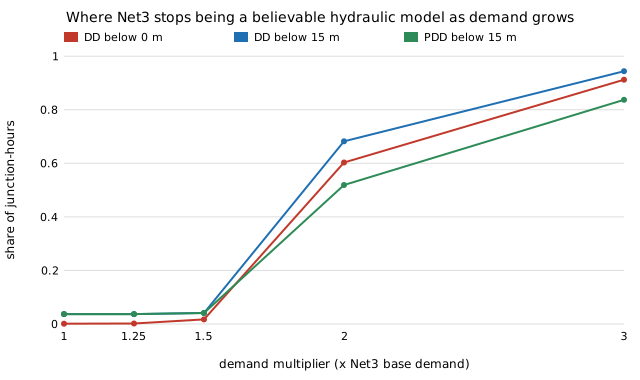
Net3 leak signals under demand-driven and pressure-driven demand (WNTR): identical at 1 to 1.25 times base demand and nearly so at 1.5 times; beyond that both models fail because the pumps cannot meet demand (simulated; one network).
What it found
WNTR simulates EPANET’s Net3 for 72 hours at demand multipliers 1 to 3 under the default demand-driven model and the pressure-driven model (required pressure 15 m, 10 and 25 m swept), with a leak of 2 % of mean demand at 30 seeded junctions read at five sensors. At 1 and 1.25 times base demand the two models agree to the three decimals printed; at 1.5 times the median sensor drop is 0.798 m against 0.792 m and 29 of 30 locations are seen by both. At 2 and 3 times the pumps run past their rated flow, the demand-driven run has 60–91 % of junction-hours below 0 m (down to −458 m) and the leak passes no flow, while the pressure-driven run serves 86 % and 62 % of demand and still sits below the required pressure over half the time, so neither is believable there. Hence the conclusions of the earlier detector study, drawn at base demand, do not depend on the demand model. Limits: one textbook network whose low-pressure nodes are mostly zero-demand, noise-free sensor response only (no detectors or false-alarm budget), assumed required pressure, 30 locations and one leak size.
A figure from its own output
Paper, code and results
More in Detection & tolerances
- How small a water-main leak can pressure sensors find, and does a changepoint detector beat a threshold or CUSUM?Water-leak detection from pressure residuals on EPANET's Net3 (WNTR): at a 5% weekly false-alarm budget, 5 sensors and 10% demand error, CUSUM finds all leaks the sensors can see at 4% of demand but 8% at 1% (3% of all leaks); demand error, not sensor noise or detector choice, sets the limit (simulated leaks; BattLeDIM L-Town was unreachable).
- Reproducible operators and refereed trainingMeasured float32 reduction-order drift, RepOps-style canonical order, Merkle-committed training traces with a teacher-forced referee; per-step tolerance is a cumulative hidden-deviation budget.
- How many honest runs does a slashing tolerance need?Calibrating slashing tolerances from honest runs: split-conformal false-slash law
(n+1-k)/(n+1)is exact but only ~51–56% of calibration sets are ≤ α, PAC safety needsn ≥ ln δ/ln(1−α)(459 at 1%/1%), the margin is cheater hiding room (×1.26 at n=2000, Pareto-3), Gaussian plug-ins over-slash skewed drift up to 17×, pooled hardware calibration over-slashes the noisy class 4.8× and lets the quiet class hide 2.9×. - Should drift tolerances be per layer or on the total?Per-layer vs total drift tolerances: a tolerance per layer admits
L·c(L,α)σvsz_α√L σon the total (6.6× at L=16), the sum test ignores how a cheat is spread while the max test catches 2.7σ in one layer but lets 16σ through spread over all, and a union test caps the hidden budget at the sum test's. - How well does Freivalds' check work in floating point?Freivalds' matrix-product check in floating point: rank-one corruption missed with probability exactly
erf(t/(√2F))(worst case for fixed norm),erf^mfor m probes, Rademacher probes stuck at ½ for any size, measured float32 noise floor, and1/erfgrinding tries when the probe is hashed from the result. - How many skipped training steps hide in the loss noise?Detecting skipped training steps from the loss alone: hidden compute is the loss curve inverted at the noise band (
f* = 1−(1+(e^q−1)/r)^{−1/β}), grows as reducible loss falls, seed noise sets a floor no eval size removes, simulation matches within 1.5 points, and the loss test is worth ≈4.4 step audits at best.
All 14 Detection & tolerances projects →
Other research topics
Proper scoring & elicitation28Effort & peer prediction9Verification games & slashing19Detection & tolerances14Markets as routers13Prediction-market design9Paying contributors8Decentralised training systems23Digital twins & sim-to-real164LLM chip design loops40Robot manufacturing loops53Ambient AI assistant46Self-replicating manufacturing34Simulation-first design64Engineered clothing45Task-specific AI accelerators40Algorithmic chip-design loops42Open-source purpose-built robots44The software-engineering loop43Adversarial human imitation41Open-source residential construction41Autonomous multi-angle capture34Sensing, imaging and 3D31Energy supply and dense energy storage39Robot societies among people31Agentic co-design of low-cost robots27Laundry-hanging robots25Machine learning on qualitative data23Robots on the building site27Civilizations & group psychology1History & human sciences1
Produced with AI assistance (Claude). Results are from the code in this repository and are simulated or stylised unless the abstract says otherwise; nothing here implies affiliation with or endorsement by any lab, researcher or company cited. MIT licensed.