How many skipped training steps hide in the loss noise?
research/compute-shirking
Detecting skipped training steps from the loss alone: hidden compute is the loss curve inverted at the noise band (f* = 1−(1+(e^q−1)/r)^{−1/β}), grows as reducible loss falls, seed noise sets a floor no eval size removes, simulation matches within 1.5 points, and the loss test is worth ≈4.4 step audits at best.
What it found
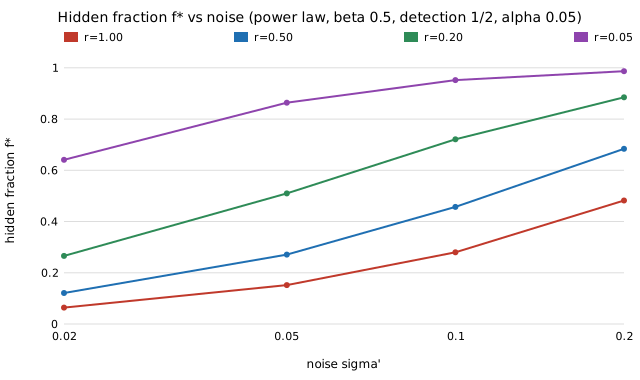
If a worker paid for T steps runs only (1−f)T, the verifier’s log-loss test (null sd σ′, level α) hides exactly the compute at which the loss curve, inverted, crosses the noise band: L((1−f*)T) = L(T)eσ′(zα+zP). For a power law with a loss floor this is closed form and grows as the reducible share r falls (6% at r=1 but 64% at r=0.05 for σ′=0.02). Run-to-run seed noise is a floor that no evaluation size removes: with 2% seed noise a 5% cap is unreachable for r ≥ 0.05, while without it 104 to 4×10⁶ eval samples suffice. On exactly solvable quadratic GD the predicted detection probability matches simulation within 1.5 points, and the loss test is worth only about 4.4 random step audits at best (0.16 once training is floor-dominated). Stylised: one statistic, normal approximation, known curve family.
A figure from its own output
Paper, code and results
More in Detection & tolerances
- How much can a provider steal by serving a cheaper model?Detecting a provider that serves a cheaper model on a fraction of queries: mixture e-process (valid under peeking), delay
∝ 1/(f p² χ²), so the cheater's best response is to leak rarely and steal∝ √NnotN; closed-form audit rate and cost-optimal check rate(hK/2Nc)^{2/3}. - Can you slash while watching the data stream?Anytime-valid slashing of miscalibrated verifiers: peeking z-test falsely slashes 37% of honest verifiers (nominal 5%), an e-process holds ≤α by Ville, detection delay ≈
ln(1/α)/KL(within 12%), q-free mixture costs ×1.36. - Can two verifiers be compared while the data streams in?Anytime-valid duels between two verifiers: the optimal betting e-process on the Brier difference grows at exactly
KL(q‖(rA+rB)/2), a peeking z-test falsely declares a winner 19–38% of the time at nominal 5%, a bet mixture stays ≤3.8% and costs 15–41% more decisions. - Which of n verifiers is best, decided at any time?Anytime-valid best-of-n verifier identification: delay set by the rival whose report midpoint sits nearest
q(the best opposite-side rival, not the runner-up), mixture within 1.35–1.60× of oracle, elimination 4–5× cheaper, peeking declares a false best in 59% of ties vs 1.6%. - How much can Byzantine verifiers move an aggregate?Byzantine-robust aggregation of verifier reports: mean bias
βBunbounded, median biasσΦ⁻¹(1/(2(1−β)))independent of B, trimmed-mean closed form for τ≥β verified by simulation. - Can a verifier tell from old-task losses that a continual-learning job skipped or shortchanged tasks?Auditing skipped or partial continual-learning training from old-task losses: exact loss law (
ρ^{t−1}[(1−2m₁+m₂)(r/d)λᵏ+(r/d)ρ(ρᵏ−λᵏ)]), a skipped task is ≥d/(d−r)× worse but only clearly so inside a lag window, detecting a skipper takes ~0.7/s²jobs at any lag, a 10% step shortfall needs ~9600.
All 14 Detection & tolerances projects →
Other research topics
Proper scoring & elicitation28Effort & peer prediction9Verification games & slashing19Detection & tolerances14Markets as routers13Prediction-market design9Paying contributors8Decentralised training systems23Digital twins & sim-to-real164LLM chip design loops40Robot manufacturing loops53Ambient AI assistant46Self-replicating manufacturing34Simulation-first design64Engineered clothing45Task-specific AI accelerators40Algorithmic chip-design loops42Open-source purpose-built robots44The software-engineering loop43Adversarial human imitation41Open-source residential construction41Autonomous multi-angle capture34Sensing, imaging and 3D31Energy supply and dense energy storage39Robot societies among people31Agentic co-design of low-cost robots27Laundry-hanging robots25Machine learning on qualitative data23Robots on the building site27Civilizations & group psychology1History & human sciences1
Produced with AI assistance (Claude). Results are from the code in this repository and are simulated or stylised unless the abstract says otherwise; nothing here implies affiliation with or endorsement by any lab, researcher or company cited. MIT licensed.