How many dryers can a laundry-hanging arm serve when the fold takes as long as published robots take?
research/hanger-foldrate
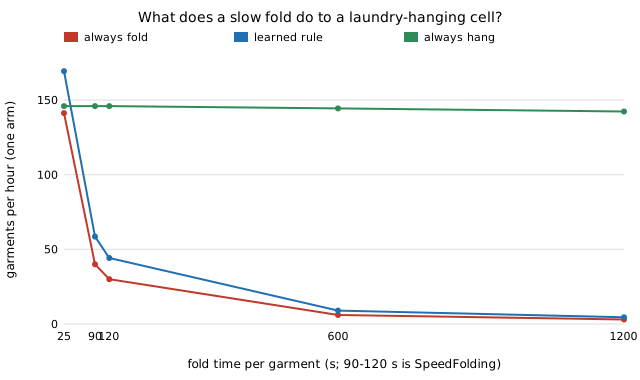
How many dryers can a laundry-hanging arm serve when folding takes as long as published robots take? At SpeedFolding's 90–120 s per fold the learned-rule cell falls from 169 to 58–44 garments an hour; always hanging holds 146. Only the fold time is sourced.
What it found
Taking the fold time from Avigal et al. (2022), SpeedFolding (30–40 folds per hour, about 90–120 s each) instead of hanger-cell's assumed 25 s, the one-arm cell with the learned hang-or-fold rule drops from 169 to 58–44 garments an hour (5.1 to 1.8–1.3 dryers) and is fold-bound (table 98% busy, arm 24–31%). Always hanging stays at 146 an hour, 3.3 times the learned rule at 120 s, and beats always folding for any fold time above about 24 s. More fold tables recover throughput only slowly (115 an hour needs 3 at 120 s). Sourced: the fold rate. Assumed and unchanged: every other station time, the load mix and the claim that the fold runs on a table separate from the arm; hanging quality is not scored, so ‘always hang’ is a speed bound, not a recommendation.
A figure from its own output
Paper, code and results
More in Laundry-hanging robots
- How many dryers can a laundry-hanging cell serve when its fold station runs at published robot speeds?How many dryers can a laundry-hanging cell serve when its fold station runs at published robot speeds? Timed from the SpeedFolding paper (68 to 167 s per garment) rather than an assumed 25 s, one arm and one fold table serve 0.8 to 2.1 dryers instead of 5.1, and with two arms five dryers need 3 to 10 fold tables. Fold times are sourced; every other station time is still assumed.
- Does the hanger-fit width rule hold on fabrics with published KES-FB bending rigidity and weight?Does "arm 1 cm wider than the half shoulder" hold on four fabrics with published KES-FB bending rigidity (0.0066–0.125) and weight (12.5–24.6 mg/cm²)? Best offset is +1 cm in all 12 cases (with stretch swept 40–800 N/m); heavy suiting at 40 N/m nearly ties with +2 cm. B and weight sourced; stretch swept; tee geometry assumed.
- Does it matter that the garment a robot picks is also the garment it decides to hang or fold?Does it matter that the garment a robot picks is also the garment it decides to hang or fold? Linking them moves a one-arm cell from 147 to 141 garments an hour, but two arms swing from 141 to 250 with an assumed kind-to-archetype map. Stylised.
- Does the hanger a sim loop designs change for stretchy, heavy knits, and what does a tee-designed hanger cost them?Does the hanger that
hanger-fit's CMA-ES designs change for stretchy, heavy knits? The best arm width moves from +0.9 cm past the half shoulder (tee) to +1.5–1.8 cm (EA 40 N/m), but slope, bow and end radius are not pinned down at 150 scores; a tee hanger scores 1.06 cm on a soft double-weight knit against 0.52 cm for one designed for it. Fabric constants swept, not measured. - Should a laundry-hanging arm also steer clear of the other arm's next pick? A paired test on 1000 loadsShould a laundry-hanging arm also steer clear of the other arm's next pick? No: paired on 1000 loads, lookahead loses to avoiding the current pick in 14 of 18 settings and ties in 4, by up to 11 an hour. Stylised: inputs are placeholders.
- What does it cost two laundry-hanging arms to empty the same dryer pile?What does it cost two laundry-hanging arms to empty one dryer pile and wait for each other? Blocking at 0.30 m clearance takes aiming from 201 to 191 garments an hour and blind pinching from 179 to 151; a third arm adds only 3 to 5. Stylised: clearance and spacing assumed.
All 25 Laundry-hanging robots projects →
Other research topics
Proper scoring & elicitation28Effort & peer prediction9Verification games & slashing19Detection & tolerances14Markets as routers13Prediction-market design9Paying contributors8Decentralised training systems23Digital twins & sim-to-real164LLM chip design loops40Robot manufacturing loops53Ambient AI assistant46Self-replicating manufacturing34Simulation-first design64Engineered clothing45Task-specific AI accelerators40Algorithmic chip-design loops42Open-source purpose-built robots44The software-engineering loop43Adversarial human imitation41Open-source residential construction41Autonomous multi-angle capture34Sensing, imaging and 3D31Energy supply and dense energy storage39Robot societies among people31Agentic co-design of low-cost robots27Laundry-hanging robots25Machine learning on qualitative data23Robots on the building site27Civilizations & group psychology1History & human sciences1
Produced with AI assistance (Claude). Results are from the code in this repository and are simulated or stylised unless the abstract says otherwise; nothing here implies affiliation with or endorsement by any lab, researcher or company cited. MIT licensed.