Does it matter that the garment a robot picks is also the garment it decides to hang or fold?
research/hanger-kindlink
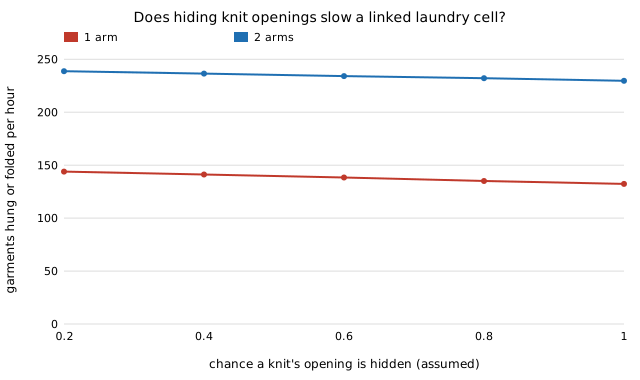
Does it matter that the garment a robot picks is also the garment it decides to hang or fold? Linking them moves a one-arm cell from 147 to 141 garments an hour, but two arms swing from 141 to 250 with an assumed kind-to-archetype map. Stylised.
What it found
Linking the hanger-pick pile's garment kinds to the hanger-cell archetypes moves a one-arm laundry cell from 147 to 141 garments hung or folded per hour (look-then-aim), but the effect on two arms depends on an assumed map from pile kinds to archetypes: 141 to 250 per hour across five maps. The correlation the link adds is small beside that: raising a knit's chance of hiding its opening from 0.2 to 1.0 costs 144 to 132 per hour on one arm and sets 0.23 knits per load aside. Stylised: station times, pile probabilities and the kind-to-archetype map are assumed placeholders.
A figure from its own output
Paper, code and results
More in Laundry-hanging robots
- Does the hanger a sim loop designs change for stretchy, heavy knits, and what does a tee-designed hanger cost them?Does the hanger that
hanger-fit's CMA-ES designs change for stretchy, heavy knits? The best arm width moves from +0.9 cm past the half shoulder (tee) to +1.5–1.8 cm (EA 40 N/m), but slope, bow and end radius are not pinned down at 150 scores; a tee hanger scores 1.06 cm on a soft double-weight knit against 0.52 cm for one designed for it. Fabric constants swept, not measured. - Should a laundry-hanging arm also steer clear of the other arm's next pick? A paired test on 1000 loadsShould a laundry-hanging arm also steer clear of the other arm's next pick? No: paired on 1000 loads, lookahead loses to avoiding the current pick in 14 of 18 settings and ties in 4, by up to 11 an hour. Stylised: inputs are placeholders.
- What does it cost two laundry-hanging arms to empty the same dryer pile?What does it cost two laundry-hanging arms to empty one dryer pile and wait for each other? Blocking at 0.30 m clearance takes aiming from 201 to 191 garments an hour and blind pinching from 179 to 151; a third arm adds only 3 to 5. Stylised: clearance and spacing assumed.
- Can a laundry hanger be printed in two halves on a 220 mm bed, and is the bolted joint strong enough?Can a laundry hanger be printed in two halves on a 220 mm bed, and is the bolted joint strong enough? A half-lap hub joint with two M4 bolts lets every width up to XXL print on a 220 mm bed; the joint (safety factor 3.7–13) is then weaker than the arm (40–70), and printed pegs fail. Stylised, assumed material constants; nothing printed.
- Does the hanger-fit width result survive when its assumed fabric constants are swept two orders of magnitude?Does
hanger-fit's "arm 1 cm wider than the half shoulder" survive 162 swept fabrics (bending rigidity 0.003–1, weight ×0.5–2, stretch 40–800 N/m, strip depth 10–30 cm)? Best offset is +1 cm in 151 and +2 cm in 11, all of them stretch 40 N/m; bending rigidity alone moves the best error under 10%. Constants swept, not sourced. - Does a second 3D cloth model, wrapped over the hanger arm, agree with the 2D hanger drape?Does a second 3D cloth model, wrapped over the arm, agree with the 2D hanger drape? On the cases both run, it picks the same best arm width (22.8 cm for a size M tee; error correlation 0.994) and adds the bend across the arm (119 deg/cm over a 0.5 cm arm, 34 over a 2 cm one), but disagrees for a heavy knit on a thin arm and is not grid-converged. Stylised.
All 25 Laundry-hanging robots projects →
Other research topics
Proper scoring & elicitation28Effort & peer prediction9Verification games & slashing19Detection & tolerances14Markets as routers13Prediction-market design9Paying contributors8Decentralised training systems23Digital twins & sim-to-real164LLM chip design loops40Robot manufacturing loops53Ambient AI assistant46Self-replicating manufacturing34Simulation-first design64Engineered clothing45Task-specific AI accelerators40Algorithmic chip-design loops42Open-source purpose-built robots44The software-engineering loop43Adversarial human imitation41Open-source residential construction41Autonomous multi-angle capture34Sensing, imaging and 3D31Energy supply and dense energy storage39Robot societies among people31Agentic co-design of low-cost robots27Laundry-hanging robots25Machine learning on qualitative data23Robots on the building site27Civilizations & group psychology1History & human sciences1
Produced with AI assistance (Claude). Results are from the code in this repository and are simulated or stylised unless the abstract says otherwise; nothing here implies affiliation with or endorsement by any lab, researcher or company cited. MIT licensed.