How many dryers can one laundry-hanging arm serve once the pick is simulated, not assumed?
research/hanger-cellpick
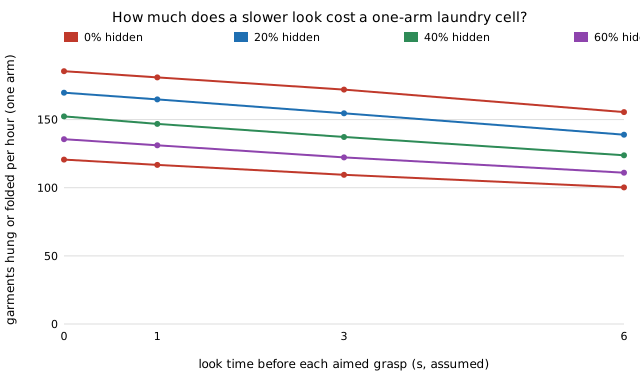
How many dryers can one laundry-hanging arm serve once the pick is simulated, not assumed? A one-arm cell drops from 169 to 147 garments an hour (5.1 to 4.4 dryers) with look-then-aim picking and to 104 with blind pinching; with two arms the fold table is the limit. Stylised.
What it found
Replacing the assumed 8 s, 0.85 pick of the hanger-cell discrete-event model with the hanger-pick pile model cuts a one-arm cell from 169 to 147 garments hung or folded per hour (5.1 to 4.4 dryers) with look-then-aim picking, and to 104 with blind pinching. With two arms the fold table is the limit and the policy matters little (206 assumed, 201 aiming, 179 pinching); quartering all pick times still leaves about 6.2 dryers. Aiming leaves 2.8 garments per 100 for a person, pinching 7.2. Stylised: every station time is an assumed placeholder.
A figure from its own output
Paper, code and results
More in Laundry-hanging robots
- How many dryers can a laundry-hanging arm serve when the fold takes as long as published robots take?How many dryers can a laundry-hanging arm serve when folding takes as long as published robots take? At SpeedFolding's 90–120 s per fold the learned-rule cell falls from 169 to 58–44 garments an hour; always hanging holds 146. Only the fold time is sourced.
- How many dryers can a laundry-hanging cell serve when its fold station runs at published robot speeds?How many dryers can a laundry-hanging cell serve when its fold station runs at published robot speeds? Timed from the SpeedFolding paper (68 to 167 s per garment) rather than an assumed 25 s, one arm and one fold table serve 0.8 to 2.1 dryers instead of 5.1, and with two arms five dryers need 3 to 10 fold tables. Fold times are sourced; every other station time is still assumed.
- Does the hanger-fit width rule hold on fabrics with published KES-FB bending rigidity and weight?Does "arm 1 cm wider than the half shoulder" hold on four fabrics with published KES-FB bending rigidity (0.0066–0.125) and weight (12.5–24.6 mg/cm²)? Best offset is +1 cm in all 12 cases (with stretch swept 40–800 N/m); heavy suiting at 40 N/m nearly ties with +2 cm. B and weight sourced; stretch swept; tee geometry assumed.
- Does it matter that the garment a robot picks is also the garment it decides to hang or fold?Does it matter that the garment a robot picks is also the garment it decides to hang or fold? Linking them moves a one-arm cell from 147 to 141 garments an hour, but two arms swing from 141 to 250 with an assumed kind-to-archetype map. Stylised.
- Does the hanger a sim loop designs change for stretchy, heavy knits, and what does a tee-designed hanger cost them?Does the hanger that
hanger-fit's CMA-ES designs change for stretchy, heavy knits? The best arm width moves from +0.9 cm past the half shoulder (tee) to +1.5–1.8 cm (EA 40 N/m), but slope, bow and end radius are not pinned down at 150 scores; a tee hanger scores 1.06 cm on a soft double-weight knit against 0.52 cm for one designed for it. Fabric constants swept, not measured. - Should a laundry-hanging arm also steer clear of the other arm's next pick? A paired test on 1000 loadsShould a laundry-hanging arm also steer clear of the other arm's next pick? No: paired on 1000 loads, lookahead loses to avoiding the current pick in 14 of 18 settings and ties in 4, by up to 11 an hour. Stylised: inputs are placeholders.
All 25 Laundry-hanging robots projects →
Other research topics
Proper scoring & elicitation28Effort & peer prediction9Verification games & slashing19Detection & tolerances14Markets as routers13Prediction-market design9Paying contributors8Decentralised training systems23Digital twins & sim-to-real164LLM chip design loops40Robot manufacturing loops53Ambient AI assistant46Self-replicating manufacturing34Simulation-first design64Engineered clothing45Task-specific AI accelerators40Algorithmic chip-design loops42Open-source purpose-built robots44The software-engineering loop43Adversarial human imitation41Open-source residential construction41Autonomous multi-angle capture34Sensing, imaging and 3D31Energy supply and dense energy storage39Robot societies among people31Agentic co-design of low-cost robots27Laundry-hanging robots25Machine learning on qualitative data23Robots on the building site27Civilizations & group psychology1History & human sciences1
Produced with AI assistance (Claude). Results are from the code in this repository and are simulated or stylised unless the abstract says otherwise; nothing here implies affiliation with or endorsement by any lab, researcher or company cited. MIT licensed.