How much can the sand store's heat exchanger cost before a heat pump wins again?
research/energy-store-hx
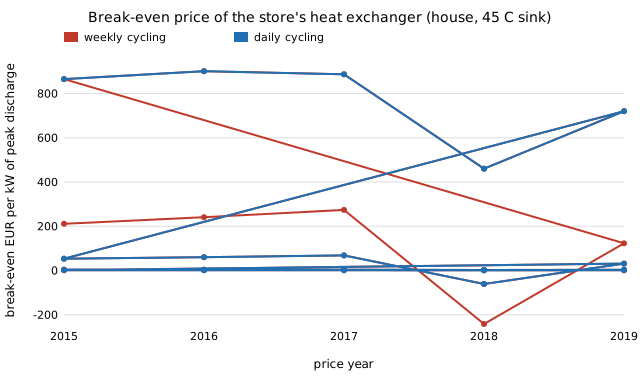
How much can the sand store's heat exchanger cost? Weekly cycling survives about 120 to 270 EUR per kW in four of five price years; daily cycling survives 460 to 900; 2018 never wins.
What it found
The sand-store versus heat-pump comparisons leave out the equipment that takes heat out of the sand. No sourced sand-to-water exchanger price is in the cost table, so the price (EUR per kW of peak discharge) is solved for rather than assumed: the break-even at which the store stops beating the air-source pump on German prices and ERA5 weather 2015–2019, house scale, 45 °C sink. Weekly cycling survives an exchanger of 211, 241 and 274 EUR/kW in 2015–2017 and 123 in 2019; 2018 loses even with a free exchanger. Daily cycling survives 460–901 EUR/kW. At 100 EUR/kW the exchanger adds 0.0032 EUR/kWh. The break-even halves if the house is sized for 1,000 full-load hours. Not from a source: the exchanger price (swept), the 2000-hour peak rule, and the exchanger's lifetime and O&M, borrowed from the sand charger row; the sand-side discharge limit is not modelled.
A figure from its own output
Paper, code and results
More in Energy supply and dense energy storage
- Does the sand-store versus heat-pump verdict survive a modelled electricity price instead of the real one?Does the sand-store vs heat-pump verdict survive a modelled price? Mostly: 32 of 40 cells agree with real prices (21 for the flat merit-order price), but weekly cycling, whose margin is under EUR 0.011/kWh, is wrong in sign in 5 of 5 years; as a charge scheduler the model costs under EUR 0.0011/kWh.
- How much cheaper must a store's electricity be than a heat pump's for a sand heat store to deliver heat for less?How much cheaper must electricity be for a sand heat store to beat a heat pump? Sourced costs (PyPSA technology-data) on the
energy-thermalmodel: a daily-cycled store needs the pump's electricity about 2 times dearer, weekly 5, monthly 16, seasonal 120 (house); the heat lost in standby, not the sand, rules out seasonal storage. - If a sand heat store buys electricity only in the cheap hours of a German price series, when does it beat a heat pump?When does a sand heat store beat a heat pump on hourly prices? With 189 GW solar and 137 GW wind and a modelled German price series, a daily or weekly store wins in all 5 years (EUR 0.027/kWh against 0.071); a levy of 0.10/kWh or a surplus-hour price above about 20–35 EUR/MWh removes the win.
- On real German day-ahead prices, does a sand heat store beat a heat pump, and was the modelled price right?On real German day-ahead prices, does a sand heat store beat a heat pump? Yes at wholesale: daily cycling wins in all 5 years (EUR 0.045–0.062/kWh against 0.070–0.074) and weekly in 4; the earlier merit-order model was flat at EUR 54.6/MWh and wrong; a EUR 0.10/kWh levy removes the win.
- How much is a home battery worth on a time-of-use tariff if it is dispatched optimally?How much is a home battery worth on a time-of-use tariff with optimal dispatch? An LP breaks even at $867/kWh for 10 kWh behind 6 kW PV, against $674 for the best fixed rule ($742 with a 4,000-cycle life); a rolling 36 h plan matches the year optimum (
energy-touwith an optimiser). - How much of an optimal home-battery controller's gain survives a realistic forecast?How much of an optimal home-battery controller's gain survives a realistic forecast? With yesterday's weather or a 7-day mean as the forecast, a rolling LP saves $726 or $691 a year against the fixed rule's $694 (perfect forecast: $892); 84–101% of the gain is lost (
energy-tou-lpwith forecasts).
All 39 Energy supply and dense energy storage projects →
Other research topics
Proper scoring & elicitation28Effort & peer prediction9Verification games & slashing19Detection & tolerances14Markets as routers13Prediction-market design9Paying contributors8Decentralised training systems23Digital twins & sim-to-real164LLM chip design loops40Robot manufacturing loops53Ambient AI assistant46Self-replicating manufacturing34Simulation-first design64Engineered clothing45Task-specific AI accelerators40Algorithmic chip-design loops42Open-source purpose-built robots44The software-engineering loop43Adversarial human imitation41Open-source residential construction41Autonomous multi-angle capture34Sensing, imaging and 3D31Energy supply and dense energy storage39Robot societies among people31Agentic co-design of low-cost robots27Laundry-hanging robots25Machine learning on qualitative data23Robots on the building site27Civilizations & group psychology1History & human sciences1
Produced with AI assistance (Claude). Results are from the code in this repository and are simulated or stylised unless the abstract says otherwise; nothing here implies affiliation with or endorsement by any lab, researcher or company cited. MIT licensed.