Can per-channel power-of-two scales make the per-neuron quantiser an integer-exact MAC lane, and what accuracy does it keep at 2 to 4 weight bits?
research/chip-digits-pot
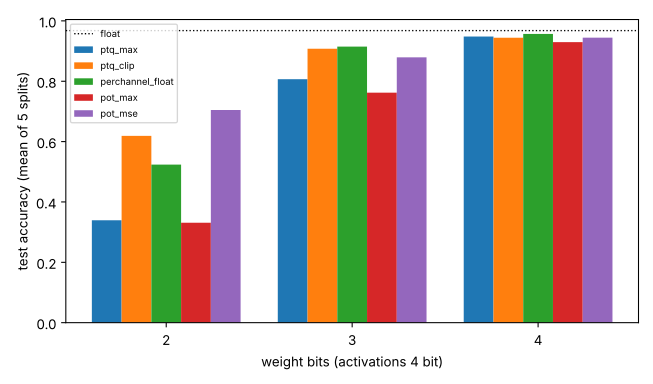
Giving each neuron of the digits MLP its own power-of-two weight scale turns the per-channel rescale into one or two shift stages and keeps the lane integer-exact: at W2A4 the MSE-chosen exponents reach 70.5% (against 62% for per-tensor clipping), but at W3A4 they give 87.9%, below clipping's 90.8%.
What it found
Follow-up to chip-digits-qat, whose per-channel quantiser rescaled each accumulator in float and so was not a hardware lane. Here each output channel gets a scale 2e; the rescale becomes a left shift of the layer-1 accumulator to a common unit followed by one common right shift, and a left shift of each layer-2 logit. The forward pass is pure integer and a test compares it with a float64 recomputation (exact for powers of two). Two exponent rules are compared with chip-digits max scaling, chip-digits-qat MSE clipping and the float per-channel reference on the same 64-16-10 MLP and five scikit-learn digits splits: smallest non-clipping exponent (pot_max), and the exponent within three of that minimising each column's squared weight error (pot_mse). At W2A4, pot_mse reaches 70.5% (baseline 33.9%, per-tensor clip 61.9%); at W3A4 87.9% (clip 90.8%, float-scale per-channel 91.5%, so rounding scales to powers of two costs about 3.5 points there); at W4A4 94.4% (float 96.8%). The shifts are small: at most 4 distinct net shifts in layer 1 and 2 in layer 2 over the five splits, i.e. two and one mux2 stages per channel. Limitations: one small network and dataset, five splits with spreads of several points at W≤3, no QAT, gate cost counted as shifter stages only and not synthesised, exponent search window of four values. All inputs are measured on the dataset; none is assumed.
A figure from its own output
Paper, code and results
More in LLM chip design loops
- Does clipping, per-channel scaling or quantisation-aware training move the 3-bit cliff of an MLP lane on real digits?MSE-optimal weight clipping lifts the 3-bit-weight digits MLP from 81% to 91% test accuracy at the same MAC-lane hardware and integer-exact; per-channel scales and QAT help at 4 bits (95.7% at W4A4, within 1.1 points of float) but QAT fails at 2 bits.
- What does an all-open RTL flow report for small designs, and can it prove them equivalent?Reproducible open RTL flow (Yosys, Icarus, Verilator): gate count and depth for adders, a multiplier and a FIFO, SAT equivalence of two adders plus a broken-adder control. Gate counts, not silicon.
- Which check catches an RTL bug: lint, random simulation or a formal equivalence proof?What lint, random simulation and a Yosys equivalence proof each catch, on 12 small RTL tasks (companion to
chip-rtl-loop); mutation probe shows 30 of 389 rejected bugs are caught only by the formal proof. Session-written attempts, not an LLM benchmark. - How much does simulation and formal feedback help a proposer repair small Verilog designs?Lint, simulation and formal-equivalence feedback for Verilog repair on nine small tasks; 6/9 pass at round 0 and 9/9 after one round, with the session as proposer (anecdotal, not an LLM benchmark).
- What does a no-model baseline repair when a scripted RTL checker is the only feedback?No-model mutation-repair baseline for a scripted Verilog checker (compile, lint, simulation, SAT miter) on ten small tasks: 9/20 one-fault cases repaired in 60 evaluations; the session agent passed all ten first try, so the feedback loop is unmeasured. Preliminary.
- Does a rewrite proposer beat a parameter sweep on area and depth when every rewrite must be proved equivalent?Equivalence-gated area/depth rewrites of a 16-bit adder and 6x6 multiplier against a no-model parameter sweep; best adder 0.85x the reference cells×depth, tied by the sweep, no multiplier gain (stylised, gate counts).
All 40 LLM chip design loops projects →
Other research topics
Proper scoring & elicitation28Effort & peer prediction9Verification games & slashing19Detection & tolerances14Markets as routers13Prediction-market design9Paying contributors8Decentralised training systems23Digital twins & sim-to-real164LLM chip design loops40Robot manufacturing loops53Ambient AI assistant46Self-replicating manufacturing34Simulation-first design64Engineered clothing45Task-specific AI accelerators40Algorithmic chip-design loops42Open-source purpose-built robots44The software-engineering loop43Adversarial human imitation41Open-source residential construction41Autonomous multi-angle capture34Sensing, imaging and 3D31Energy supply and dense energy storage39Robot societies among people31Agentic co-design of low-cost robots27Laundry-hanging robots25Machine learning on qualitative data23Robots on the building site27Civilizations & group psychology1History & human sciences1
Produced with AI assistance (Claude). Results are from the code in this repository and are simulated or stylised unless the abstract says otherwise; nothing here implies affiliation with or endorsement by any lab, researcher or company cited. MIT licensed.