Which proper score should verifiers face with K outcomes?
research/categorical-scores
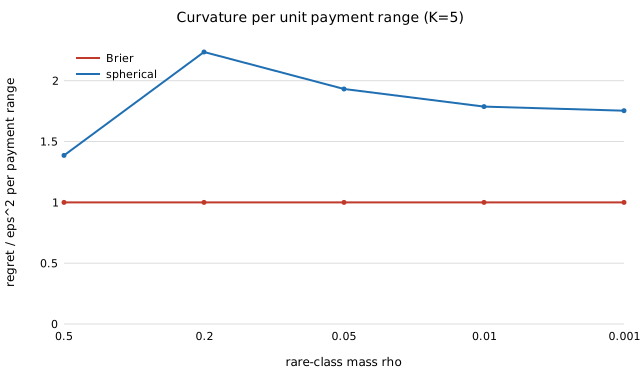
K-ary proper scores: exact worst-case regrets (1−2p_min+‖p‖² Brier, ‖p‖−p_min spherical), spherical beats Brier by exactly √K per payment range at a uniform truth, and both bounded scores nearly ignore a dropped rare class (1e-4 vs 0.15 for log).
What it found
For K-ary reports the Brier, spherical and log scores have exact regrets and exact worst cases (1−2pmin+‖p‖² for Brier, ‖p‖−pmin for spherical). Per unit of payment range the spherical score gives exactly √K times Brier’s incentive at a uniform truth, but both bounded scores nearly ignore a dropped rare class: at a 1% class the loss is 1.3×10⁻⁴ (Brier) and 1.0×10⁻⁴ (spherical) against 0.15 for log. Multiclass follow-up to tangent-log.
A figure from its own output
Paper, code and results
More in Proper scoring & elicitation
- Can the multiclass log score be made payable?Bounded multiclass log score by quadratic tangent extension of
x ln x: log-identical when allr_j≥ε, payment range exactly1−ln εfor any K, 63× Brier's rare-class incentive per range at ρ=10⁻³ with best cutoff ε=p_min, and a closed-form bounded cost for dropping a rare class. - What does it cost to pay for a ranking instead of probabilities?Eliciting class rankings with linear rank-weight scores: strictly proper, adjacent-swap regret exactly
(p_i−p_j)(w_r−w_{r+1}), beats Brier-derived rankings per unit range below gap1/(K−1)(250× at gap 10⁻³), equal spacing is optimal, top-k set costs the same as the mode, detection sample size unchanged. - Should severity reports be scored with the order in mind?Ranked probability score for ordered severities: exact regret
Σ(R_k−P_k)², shift over distance d costsdε²(Brier2ε²), pooling adjacent classes costs half of Brier's, threshold errors ≤√regret, and per range RPS never beats Brier's incentive. - Can the tail of benign drift be elicited with a proper score?Jointly eliciting VaR and expected shortfall of benign drift: 0-homogeneous Fissler–Ziegel score minimised at (VaR, ES) with profile
ln ES, ES alone non-elicitable (mixture 12.5 vs 10), exact regret formulas, ES-understatement of 30% detectable with ~1k samples at τ=0.95 while pinball is blind. - Can we elicit the mode of a mixture of honest and cheating drift?Eliciting the modal drift with the window loss
1[|y−r|>α]: exact window-mass regret, best widthα=σ(normal) /γ/√3(Cauchy), closed-form critical widthα*above which bimodal drift has one α-mode, and 0 bias against contamination where the mean moves5ε. - Can a verifier be paid for a tolerance interval, not a point?Companion to interval-elicitation: Winkler interval score for drift-tolerance intervals: strictly proper for the α/2 and 1−α/2 quantiles, closed-form regret, optimal expected score
4sφ(z)/α, width-misreport costs whose asymmetry flips with the level, and Cauchy drift where scores have no mean but paired differences are bounded.
All 28 Proper scoring & elicitation projects →
Other research topics
Proper scoring & elicitation28Effort & peer prediction9Verification games & slashing19Detection & tolerances14Markets as routers13Prediction-market design9Paying contributors8Decentralised training systems23Digital twins & sim-to-real164LLM chip design loops40Robot manufacturing loops53Ambient AI assistant46Self-replicating manufacturing34Simulation-first design64Engineered clothing45Task-specific AI accelerators40Algorithmic chip-design loops42Open-source purpose-built robots44The software-engineering loop43Adversarial human imitation41Open-source residential construction41Autonomous multi-angle capture34Sensing, imaging and 3D31Energy supply and dense energy storage39Robot societies among people31Agentic co-design of low-cost robots27Laundry-hanging robots25Machine learning on qualitative data23Robots on the building site27Civilizations & group psychology1History & human sciences1
Produced with AI assistance (Claude). Results are from the code in this repository and are simulated or stylised unless the abstract says otherwise; nothing here implies affiliation with or endorsement by any lab, researcher or company cited. MIT licensed.