Where in a camera ring should the sentinel go when the subject faces a favourite direction?
research/capture-sentinel
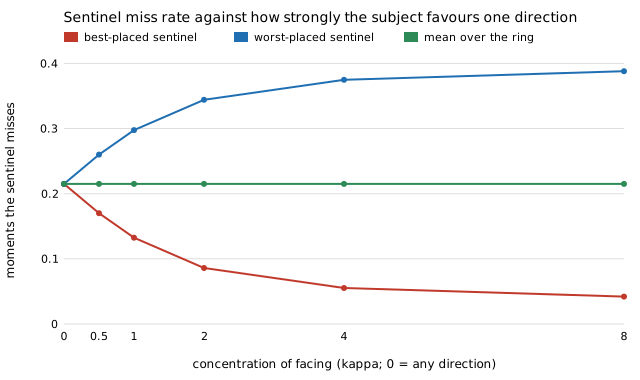
Where in a camera ring should the sentinel go when the subject faces a favourite direction? A sentinel facing the favourite direction misses 8.6% of moments against 34.4% for the one behind; spread cameras' misses are anti-correlated, so capture-wake's independence assumption overstates the all-miss rate by 2x on a ring of 4 and understates it 12x for a tight cluster. With the turned-face miss measured in capture-detectors (54 faces) in place of the assumed curve, placement matters only if the back of a head goes undetected (untested), and weak detectors miss 8 to 45% of moments even with four cameras listening.
What it found
A model with assumed detector figures (a miss rate of 3% when the subject faces the camera, 40% when facing away) and a subject whose facing at each moment is von Mises distributed around a favourite direction. In a four-camera ring with concentration κ = 2, the sentinel at the favourite direction misses 8.6% of moments, the one behind the subject 34.4%, and a rotating sentinel 21.5%; the closed form matches a 40,000-moment simulation to within 0.4 points. Misses across a spread ring are negatively correlated (a subject turned from one camera faces another), so assuming independent misses, as capture-wake did, overstates the chance that every detector misses by about 2× on a ring of four; for a tight cluster of cameras the correlation is positive and the independent figure understates it about 12×. A second part replaces the assumed cosine curve with the miss measured on 54 faces in capture-detectors (YuNet at 0.6: 3% near-frontal, 5% turned; YuNet at 0.9: 46% and 84%; frontal Haar cascade: 34% and 84%): placement then matters only if the back of a head goes undetected, which is untested (best 6–7% against worst 81% for YuNet at 0.6 if so, 3–4% against 5% if not), and for a weak detector the four-camera any-of miss is 0.08–0.45 rather than 0.0007. The cosine curve and the 54-face sample (a detector’s own detections, a landmark proxy for turn) are the limits. Stylised: the cosine figures are assumed; the step figures are measured on 54 faces.
A figure from its own output
Paper, code and results
More in Autonomous multi-angle capture
- Does a longer window, a lower gamma or a delay prior fix the period aliasing and early-start failures of GCC audio sync on real clips?Does a longer window or a delay prior fix GCC sync's aliasing on real clips? Window length (shared audio) is the lever: 97% wrong at 1 s, 38% at 2 s, 16% at 3 s on the failing clips; a tone clip needs a prior tighter than its period.
- How long a window of sound does it take to sync two drifting cameras, and how often must you redo it?How long a window of sound syncs two drifting cameras? GCC-PHAT plus a robust line fit syncs to under 0.02 ms over an hour from -10 dB SNR with 2 s windows; a sync made once at the start drifts one frame in 833 s at 40 ppm.
- How small can a face or a person be before a real detector stops finding it?How small can a face be before a real detector misses it? YuNet found every face of 16 px or wider and half at 10 px (assumed: 20), cutting the modelled blur leak on an 8K 360 camera from 4.8% to 0.01%; YOLOX finds half of people at 23 px tall. A pilot on 22 easy faces in 128 COCO photos: an optimistic bound.
- Does a predictive gap-seeking planner recover the framing a follow camera loses when it avoids pedestrians?Does a predictive planner recover the framing a follow camera loses by avoiding pedestrians? Not at equal settings (drone 58% framed vs 68% for repulsion at 0.1 people/m²), but it halves-to-tenths the contacts (36 vs 161 per hour; wheeled 21 vs 326) and moves the framing/contacts front left. 2-D simulation, assumed platform figures.
- How much of a predictive follow camera's contact reduction survives noisy, delayed pedestrian detections?How much of a predictive follow camera's contact reduction survives noisy, delayed pedestrian detections? Framing is unchanged (57-61%) but a drone's contacts rise from 36 per hour with exact data to 120 at 0.3 m noise and 0.25 s delay, and 373 at 1 m and 1 s (ignoring pedestrians: 523). 2-D simulation, swept noise, perfect association assumed.
- What does it cost a travel filming kit to also carry its footage backup?What does it cost a travel filming kit to carry its footage backup? Counting storage costs 3 of 18 shots at 4 kg; the lightest kit reaching all 18 grows from 3,900 g to 4,125 g.
All 34 Autonomous multi-angle capture projects →
Other research topics
Proper scoring & elicitation28Effort & peer prediction9Verification games & slashing19Detection & tolerances14Markets as routers13Prediction-market design9Paying contributors8Decentralised training systems23Digital twins & sim-to-real164LLM chip design loops40Robot manufacturing loops53Ambient AI assistant46Self-replicating manufacturing34Simulation-first design64Engineered clothing45Task-specific AI accelerators40Algorithmic chip-design loops42Open-source purpose-built robots44The software-engineering loop43Adversarial human imitation41Open-source residential construction41Autonomous multi-angle capture34Sensing, imaging and 3D31Energy supply and dense energy storage39Robot societies among people31Agentic co-design of low-cost robots27Laundry-hanging robots25Machine learning on qualitative data23Robots on the building site27Civilizations & group psychology1History & human sciences1
Produced with AI assistance (Claude). Results are from the code in this repository and are simulated or stylised unless the abstract says otherwise; nothing here implies affiliation with or endorsement by any lab, researcher or company cited. MIT licensed.