What does it cost a travel filming kit to also carry its footage backup?
research/capture-kitstore
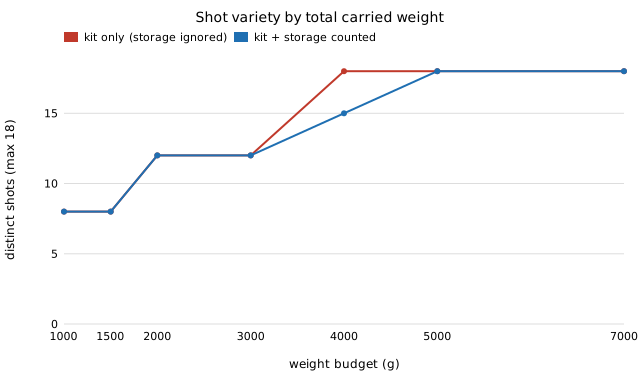
What does it cost a travel filming kit to carry its footage backup? Counting storage costs 3 of 18 shots at 4 kg; the lightest kit reaching all 18 grows from 3,900 g to 4,125 g.
What it found
Chooses the capture kit (11,520 kits of capture-realkit, sourced devices) together with the lightest nightly-offload storage plan from capture-storage (microSD cards, two SSD copies of a 7-day trip, parallel readers, copy within 1 h) under one weight budget. Counting storage costs 3 of 18 shots at a 4 kg budget (18 become 15), and the lightest kit reaching all 18 shots grows from 3,900 g to 4,125 g (+225 g). Scaling bitrates from 0.25× to 1.5× moves that total between 4,025 and 4,300 g, and reader speed (90, 104, 312 MB/s) changes no shot count at any budget tried. Sweeping filming hours (2–8 h/day) and trip length (3–28 days) moves the lightest 18-shot total from 3,492 g to 5,307 g; within 4 kg only the 2 h/day kit keeps all 18 shots. Sourced: the action-camera bitrate, microSD mass, bus ceilings and the device catalogue. SSD and reader masses were checked against retailer listings (32–58 g per SSD, 28–85 g reader): the lightest 18-shot kit then weighs 4,040–4,262 g and 4 kg still reaches 15 shots. Not sourced: the 360-camera, phone and mirrorless bitrates (swept), and the laptop or hub the offload needs (not counted).
A figure from its own output
Paper, code and results
More in Autonomous multi-angle capture
- Can a small model trained on many random scenes choose the per-pixel blend weight for stereo-depth view synthesis better than a hand-set ramp?Can a small model trained on many random scenes pick the per-pixel blend weight better than a hand-set ramp? A one-hidden-layer network beats the best soft gate by 0.57 dB on 40 held-out scenes (all 40 ahead) and recovers 0.36 of the headroom to the best per-pixel blend.
- Does the audio-sync threshold found on synthetic noise hold on real recorded sound?Does the synthetic audio-sync threshold hold on real sound? No: on 10 real clips 2 s windows fail 53% of the time at -10 dB SNR (0% synthetic), and partial whitening instead of PHAT halves that.
- Does an automatic multi-camera edit survive the audio-sync errors measured on real recorded clips?Does an automatic multi-camera edit survive sync errors measured on real clips? Not as on synthetic audio: 34% of cuts jump over a frame at 0 dB SNR (64% at -10 dB) against none, depending on the clip; partial whitening cuts the 0 dB figure to 1.4%.
- Does the capture-kit packing result survive real, sourced device weights, energies and runtimes?What does the capture-kit packing result look like with real, sourced devices (Insta360 X4, DJI Osmo Action 4, iPhone 15 Pro Max, Sony a7C II and lenses, Anker packs)? Exact search reaches all 18 shots at 4 kg, greedy stalls at 12; the unsourced mount masses move the exact figure by up to 10 shots.
- Does trimming sync windows by their distance from the fitted clock line, with no tuned threshold, beat the peak-sharpness gate on real audio?Does a clip-free residual-from-the-clock-line trim beat the PSR gate? At 0 dB a little (1.4% to 0.9% of cuts over a frame); at -10 dB no (46% vs 38% for PSR).
- In a reverberant room, does PHAT win after all, and can the whitening exponent be chosen per window?In a reverberant room, does PHAT win after all? No: across 10 simulated rooms PHAT is the worst fixed weighting; gamma 0.5 cuts failures from 0.26 to 0.09, and choosing gamma per window by peak-to-sidelobe ratio helps less than just fixing it.
All 34 Autonomous multi-angle capture projects →
Other research topics
Proper scoring & elicitation28Effort & peer prediction9Verification games & slashing19Detection & tolerances14Markets as routers13Prediction-market design9Paying contributors8Decentralised training systems23Digital twins & sim-to-real164LLM chip design loops40Robot manufacturing loops53Ambient AI assistant46Self-replicating manufacturing34Simulation-first design64Engineered clothing45Task-specific AI accelerators40Algorithmic chip-design loops42Open-source purpose-built robots44The software-engineering loop43Adversarial human imitation41Open-source residential construction41Autonomous multi-angle capture34Sensing, imaging and 3D31Energy supply and dense energy storage39Robot societies among people31Agentic co-design of low-cost robots27Laundry-hanging robots25Machine learning on qualitative data23Robots on the building site27Civilizations & group psychology1History & human sciences1
Produced with AI assistance (Claude). Results are from the code in this repository and are simulated or stylised unless the abstract says otherwise; nothing here implies affiliation with or endorsement by any lab, researcher or company cited. MIT licensed.