Does the capture-kit packing result survive real, sourced device weights, energies and runtimes?
research/capture-realkit
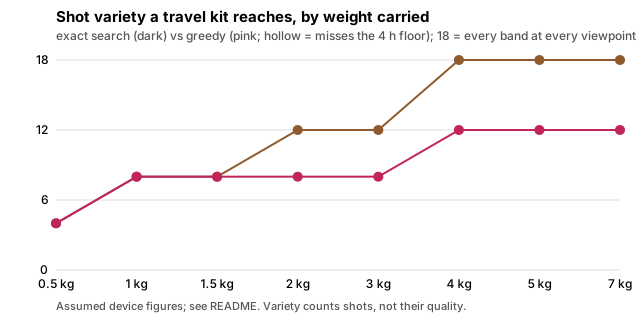
What does the capture-kit packing result look like with real, sourced devices (Insta360 X4, DJI Osmo Action 4, iPhone 15 Pro Max, Sony a7C II and lenses, Anker packs)? Exact search reaches all 18 shots at 4 kg, greedy stalls at 12; the unsourced mount masses move the exact figure by up to 10 shots.
What it found
Re-runs the capture-kit search (11,520 kits, 6,912 legal) on a catalogue of real devices whose weights, battery energies and runtimes come from manufacturer and retailer pages read 2026-10-21 (Insta360 X4, DJI Osmo Action 4, iPhone 15 Pro Max, Sony a7C II with three lenses, Peak Design tripod, two Anker banks). With a 4 h recording floor, exact search reaches all 18 band × viewpoint shots at 4 kg (the assumed catalogue needed 5 kg) and a greedy packer stalls at 12, as before: the lens-needs-a-body complementarity survives real figures. Sweeping the figures no source gave (phone recording draw, selfie-pole, mini-tripod and mast masses, within ±30%) shows the ranking is robust (greedy is below exact in 77–99% of draws from 1.5 kg up) but the exact variety at a given budget is not: at 4 kg it falls from 18 to as low as 8, so the mount masses, which no source gave, matter more than any camera. Not sourced: those mass and draw figures, the iPhone recording draw (Apple publishes playback only), cell voltages used to turn mAh into Wh, and which bands each device covers.
A figure from its own output
Paper, code and results
More in Autonomous multi-angle capture
- Does trimming sync windows by their distance from the fitted clock line, with no tuned threshold, beat the peak-sharpness gate on real audio?Does a clip-free residual-from-the-clock-line trim beat the PSR gate? At 0 dB a little (1.4% to 0.9% of cuts over a frame); at -10 dB no (46% vs 38% for PSR).
- In a reverberant room, does PHAT win after all, and can the whitening exponent be chosen per window?In a reverberant room, does PHAT win after all? No: across 10 simulated rooms PHAT is the worst fixed weighting; gamma 0.5 cuts failures from 0.26 to 0.09, and choosing gamma per window by peak-to-sidelobe ratio helps less than just fixing it.
- Does a soft confidence weight beat a hard switch for repairing stereo-depth view synthesis, and does matching cost help?Does a soft confidence weight beat a hard switch for repairing stereo-depth view synthesis, and does the matcher's cost help? A ramped weight on warp disagreement beats the hard gate by 0.1 to 0.5 dB in every condition (29.5 vs 29.3 dB held out at 15°) and leaves a quarter fewer seams, closing only a tenth of the oracle gap; matching cost is a worse signal than disagreement (level with hole filling, worse with a bystander). Toy scene.
- How much footage does a multi-camera travel kit produce, and what limits carrying and backing it up?How much footage does a multi-camera travel kit produce, and what limits carrying and backing it up? Four cameras make ~860 GB a day; cards weigh ~8 g but the evening copy takes 2.7 h on one reader, so a safe plan needs 6 readers and ~450 g (assumed device figures).
- How often must free-running cameras be re-synced by audio, and does rejecting wild estimates help?How often must free-running cameras be re-synced by audio? At 40 ppm a sync lasts 1000 s for a 40 ms tolerance; a drift gate on fresh estimates helps only if you re-sync every 300 s. Synthetic audio.
- Does a residual audio-sync error show at the cuts of an automatic multi-camera edit?Does a residual audio-sync error show at the cuts of an automatic edit? A sync made once leaves 50% of cuts jumping over a frame; a robust fit leaves none down to -10 dB SNR (2 s windows) and then fails outright, with 11 to 24% of cuts repeating or dropping a loud event.
All 34 Autonomous multi-angle capture projects →
Other research topics
Proper scoring & elicitation28Effort & peer prediction9Verification games & slashing19Detection & tolerances14Markets as routers13Prediction-market design9Paying contributors8Decentralised training systems23Digital twins & sim-to-real164LLM chip design loops40Robot manufacturing loops53Ambient AI assistant46Self-replicating manufacturing34Simulation-first design64Engineered clothing45Task-specific AI accelerators40Algorithmic chip-design loops42Open-source purpose-built robots44The software-engineering loop43Adversarial human imitation41Open-source residential construction41Autonomous multi-angle capture34Sensing, imaging and 3D31Energy supply and dense energy storage39Robot societies among people31Agentic co-design of low-cost robots27Laundry-hanging robots25Machine learning on qualitative data23Robots on the building site27Civilizations & group psychology1History & human sciences1
Produced with AI assistance (Claude). Results are from the code in this repository and are simulated or stylised unless the abstract says otherwise; nothing here implies affiliation with or endorsement by any lab, researcher or company cited. MIT licensed.