How much footage does a multi-camera travel kit produce, and what limits carrying and backing it up?
research/capture-storage
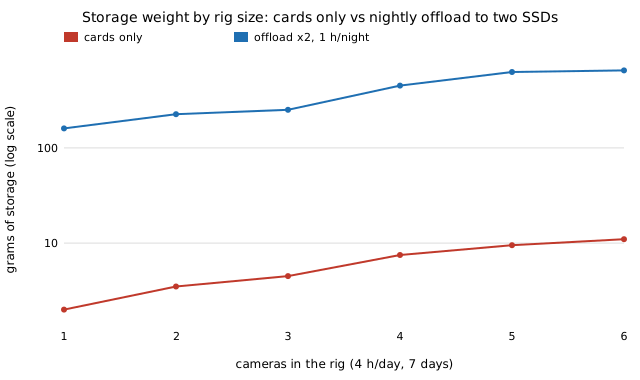
How much footage does a multi-camera travel kit produce, and what limits carrying and backing it up? Four cameras make ~860 GB a day; cards weigh ~8 g but the evening copy takes 2.7 h on one reader, so a safe plan needs 6 readers and ~450 g (assumed device figures).
What it found
Data volume, card and SSD weight, nightly offload time and unbacked footage for a rig of 1 to 8 cameras filming 4 h a day for a week, at assumed 60 to 200 Mbit/s bitrates. Four cameras make about 860 GB a day (6 TB a week), yet their cards weigh about 8 g and a camera's battery is 440 to 980 times heavier per recording hour than its card. The binding limit is the evening: one reader copying one day to one SSD takes 2.7 h, so two SSD copies inside 1 h need 6 readers and about 450 g, half an hour is infeasible, and halving the bitrate halves the weight. Figures in the first version are assumed, not datasheets. Update 2026-10-21: action-camera bitrate (120 Mbit/s), card mass (0.25 g microSD) and card bus ceilings (UHS-I 104, UHS-II 312 MB/s) are now sourced, and SHA-256 hashing was measured at about 1,460 MB/s per core; the conclusion holds (copy time binds, not card weight; a UHS-II reader cuts the plan from 426 g to 351 g; verify while copying). The 360-camera, phone and mirrorless bitrates and SSD figures remain assumed.
A figure from its own output
Paper, code and results
More in Autonomous multi-angle capture
- How often must free-running cameras be re-synced by audio, and does rejecting wild estimates help?How often must free-running cameras be re-synced by audio? At 40 ppm a sync lasts 1000 s for a 40 ms tolerance; a drift gate on fresh estimates helps only if you re-sync every 300 s. Synthetic audio.
- Does a residual audio-sync error show at the cuts of an automatic multi-camera edit?Does a residual audio-sync error show at the cuts of an automatic edit? A sync made once leaves 50% of cuts jumping over a frame; a robust fit leaves none down to -10 dB SNR (2 s windows) and then fails outright, with 11 to 24% of cuts repeating or dropping a loud event.
- Does a robust fit or a Kalman filter hold a camera's clock better between audio re-syncs than a least-squares line, once the clock drift comes from a real crystal curve?Does a robust fit or a Kalman filter hold a camera clock better between audio re-syncs? On a clock rate computed from a sourced AT-cut crystal curve the plain offset hold is already fine up to 1800 s and every fit ties; only a Kalman filter tuned to an assumed 30 ppm wobble wins. Synthetic audio.
- Does finding the start offset first let short audio windows sync two drifting cameras at lower SNR?Does a coarse offset first let short windows sync drifting cameras? A 10 s window finds the offset, then 0.5 s windows hold within a frame from -12 dB SNR; plain 1 s windows fail to -5 dB. Synthetic audio.
- Does dropping doubtful sync windows, with settings chosen on other clips, keep a multi-camera edit in sync on real audio?Does a peak-sharpness gate plus settings chosen on other clips keep the edit in sync? At 0 dB yes (1.9% of cuts over a frame held-out vs 34% for PHAT); at -10 dB only partly (39% vs 64%).
- Does holding a fitted clock slope between audio re-syncs let free-running cameras go longer without a refresh?Does holding a fitted clock slope between audio re-syncs help? At 40 ppm it cuts out-of-tolerance time from 44% to 3.7% at 1800 s intervals, but an assumed rate wobble makes a strict line gate lock out. Synthetic audio; also corrects capture-syncbudget.
All 34 Autonomous multi-angle capture projects →
Other research topics
Proper scoring & elicitation28Effort & peer prediction9Verification games & slashing19Detection & tolerances14Markets as routers13Prediction-market design9Paying contributors8Decentralised training systems23Digital twins & sim-to-real164LLM chip design loops40Robot manufacturing loops53Ambient AI assistant46Self-replicating manufacturing34Simulation-first design64Engineered clothing45Task-specific AI accelerators40Algorithmic chip-design loops42Open-source purpose-built robots44The software-engineering loop43Adversarial human imitation41Open-source residential construction41Autonomous multi-angle capture34Sensing, imaging and 3D31Energy supply and dense energy storage39Robot societies among people31Agentic co-design of low-cost robots27Laundry-hanging robots25Machine learning on qualitative data23Robots on the building site27Civilizations & group psychology1History & human sciences1
Produced with AI assistance (Claude). Results are from the code in this repository and are simulated or stylised unless the abstract says otherwise; nothing here implies affiliation with or endorsement by any lab, researcher or company cited. MIT licensed.