How well must a drywall-screwing robot find the framing, and do a few missed screws matter?
research/buildbot-screwline
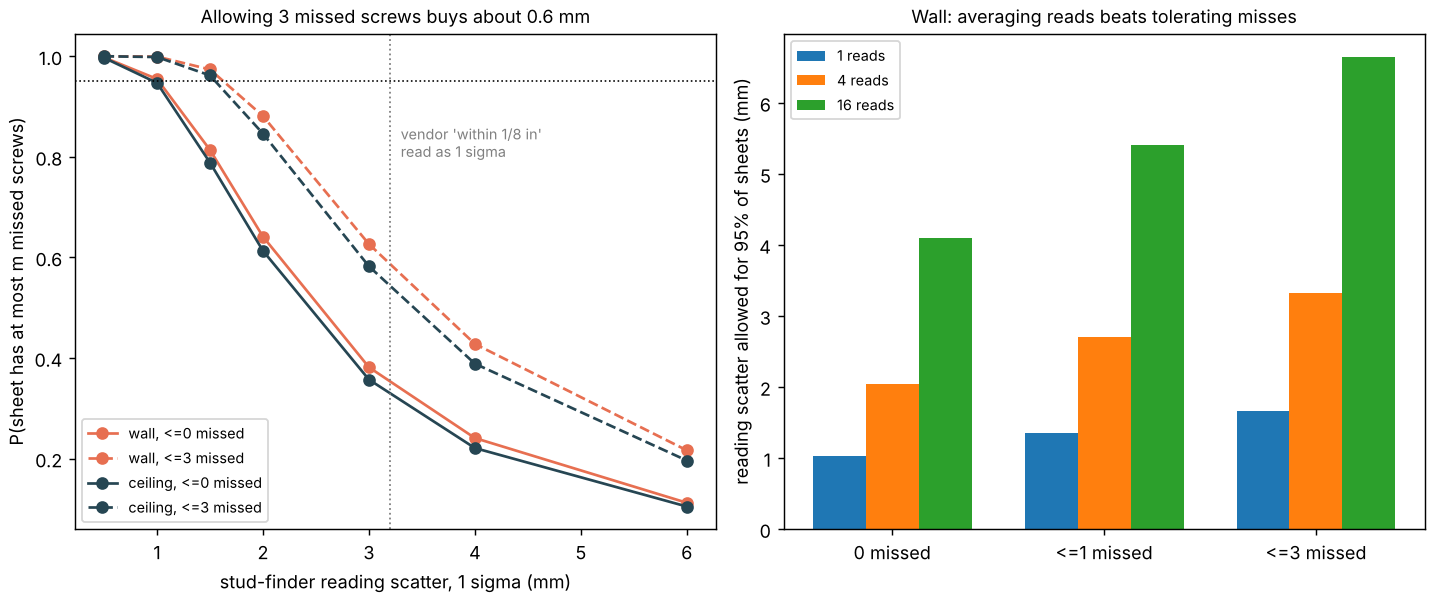
How well must a drywall-screwing robot find the framing? A 4x8 sheet (28 wall screws, 36 ceiling) needs one read per member good to 1.0 mm for 95% clean sheets, nearly the nailing figure; allowing 3 missed screws gives 1.7 mm, averaging 4 reads 2.1 mm.
What it found
Re-runs the buildbot-studfind error budget with a drywall schedule: 16 in screw pitch on walls (28 screws a sheet) and 12 in on ceilings (36), a #6 screw, 0.9 mm of robot scatter per screw from buildbot-fasten, and a shared reading error per framing member. One read of each member must be good to 1.02 mm (1 sigma) on a wall and 0.98 mm on a ceiling for 95% of sheets to land every screw, close to nailing's 0.89 mm because the two sheet-edge members (±3.9 mm windows), not the screw count, bind. Allowing 1 or 3 missed screws raises that to 1.35 or 1.66 mm; 4 or 16 averaged reads to 2.05 or 4.10 mm; re-measuring each screw (1.00 mm) is no better than a shared read. A stud finder’s ‘within 1/8 in’ claim gives 35% clean wall sheets from one read if taken as 1 sigma, 78% from four. Simulated: reading scatter is swept, not measured; pitch is from a USG FAQ, the 3/8 in edge distance from a gypsum-fibre guide and the screw size is nominal, none read from ASTM C840; reads are assumed independent and Gaussian.
A figure from its own output
Paper, code and results
More in Robots on the building site
- How many hours of an 8-hour shift can a battery-powered Unitree G1 actually work, and does it change whether it pays?How many hours of an 8-hour shift can a battery-powered Unitree G1 work? One 421 Wh pack gives 4.7 h; two packs and one charger give 7.7 h; above about 300 W the charger is the limit, and pack logistics move the cost break-even only from 2.42 to 2.27 to 2.46 (draw swept, not measured).
- Can the building-site robot skills be packaged as loadable files, and does training on two plants at once cover a third?Can the building-site robot skills ship as loadable files? Five JSON skill files reload and re-score exactly; a follow skill tuned on the worse of two plants passes 68%, 65% and 70% on the rigid, flexing and MuJoCo plants, no better than tuning on the flexing plant alone (72%, 69%, 71%).
- Does a sheet-following robot skill trained on a rigid-sheet simulator survive a flexing sheet, sensing delay and actuator lag?Does a sheet-following skill tuned on a rigid-sheet simulator survive a flexing sheet with delay? It passes 81% of episodes where it was tuned and 0-11% on the held-out plant; tuning on the held-out plant gives 61-66% there.
- How many times must a G1 humanoid re-stand to nail one 4x8 sheet of sheathing?How many times must a G1 humanoid re-stand to nail one 4x8 sheet? About 13 stances at 5 platform heights: with its feet planted it holds a 3.4 kg nailer at 50 N only 0.7-1.5 m high and 0.3 m sideways, so one stance covers at best 6 of 62 nails, and the sheet matches hand nailing (372 s) only if each re-stance takes under 26-29 s (push to seat and re-stance time are swept, not sourced; no walking simulated).
- How well must a nailing robot find the studs, and does measuring more beat measuring better?How well must a nailing robot find the studs? A 4x8 sheet needs a single stud reading good to 0.89 mm (1 sigma) for 95% clean sheets; a stud finder's 'within 1/8 in' claim gives 28% (8 of 62 nails missed) or 69%; averaging reads and pooling a straight wall help, re-measuring each nail is worst.
- Which tasks of building a wood-frame house hold the crew hours, and which can a stock humanoid even hold the load for?Which house-building tasks hold the crew hours, and which can a stock humanoid hold the load for? An open task book of a 28x40 ft wood-frame house: 20 tasks with cycles, masses, tolerances and crew-hours, scored against the simulated Unitree G1 and H1 payload envelopes; fastening is 31% of the hours, and the H1 passes the payload test for 53-81% of them (minutes per unit are assumptions, swept).
All 27 Robots on the building site projects →
Other research topics
Proper scoring & elicitation28Effort & peer prediction9Verification games & slashing19Detection & tolerances14Markets as routers13Prediction-market design9Paying contributors8Decentralised training systems23Digital twins & sim-to-real164LLM chip design loops40Robot manufacturing loops53Ambient AI assistant46Self-replicating manufacturing34Simulation-first design64Engineered clothing45Task-specific AI accelerators40Algorithmic chip-design loops42Open-source purpose-built robots44The software-engineering loop43Adversarial human imitation41Open-source residential construction41Autonomous multi-angle capture34Sensing, imaging and 3D31Energy supply and dense energy storage39Robot societies among people31Agentic co-design of low-cost robots27Laundry-hanging robots25Machine learning on qualitative data23Robots on the building site27Civilizations & group psychology1History & human sciences1
Produced with AI assistance (Claude). Results are from the code in this repository and are simulated or stylised unless the abstract says otherwise; nothing here implies affiliation with or endorsement by any lab, researcher or company cited. MIT licensed.