Which tasks of building a wood-frame house hold the crew hours, and which can a stock humanoid even hold the load for?
research/buildbot-taskbook
Which house-building tasks hold the crew hours, and which can a stock humanoid hold the load for? An open task book of a 28x40 ft wood-frame house: 20 tasks with cycles, masses, tolerances and crew-hours, scored against the simulated Unitree G1 and H1 payload envelopes; fastening is 31% of the hours, and the H1 passes the payload test for 53-81% of them (minutes per unit are assumptions, swept).
What it found
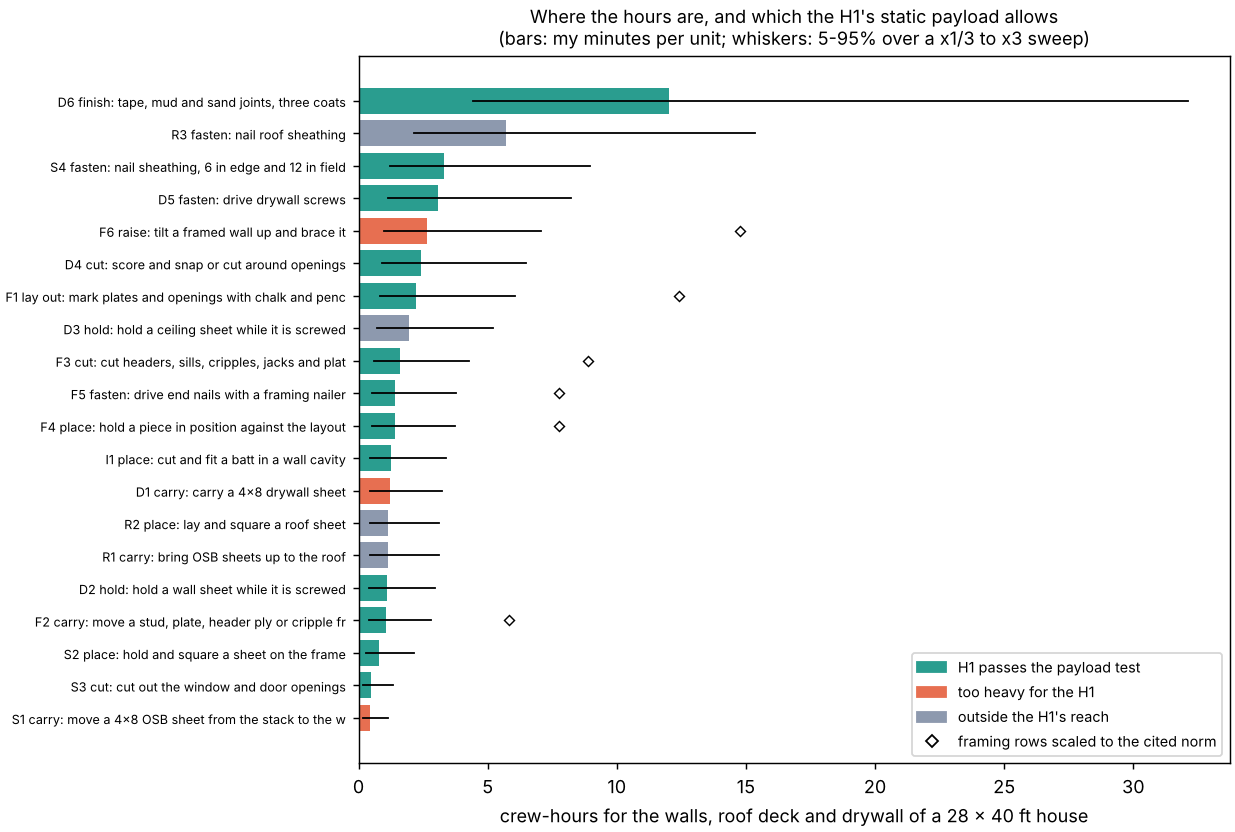
An open task book of one small house (28×40 ft, one storey, 2×6 at 16 in, from house-framing's takeoff): 20 tasks across wall framing, wall and roof sheathing, insulation and drywall, each with cycles, mass handled, hand height, reach, a tolerance, minutes per unit and crew-hours, as CSV and JSON. Counts come from code (210 framing pieces, 32 wall and 46 roof sheets, 72 drywall sheets, 8,760 fasteners); masses from the lumber, sheet and tool figures of buildbot-payload; robot verdicts from its simulated G1 and H1 payload envelopes. Minutes per unit are my assumptions: no primary time study could be read from this session, so they are swept ×1/3 to ×3, and my framing rows come out 5.5× below the one cited norm I found (Methvin, 0.12 man-hours per metre of stud, read as a search snippet), shown as a second scenario. Total 46 crew-hours (40–77 over the sweep) for this scope, or 93 with framing at the norm. Fastening is the biggest verb (29% of the hours, 21% in the second scenario) and taping and sanding drywall the biggest task. The H1 passes the payload test for tasks holding 54–81% of the hours (57–85% in scenario B), the G1 only 6–22% (7–31%); roof and ceiling work sits outside both robots' reach envelope. A payload pass is not a skill: force, placement accuracy and perception are untested.
A figure from its own output
Paper, code and results
More in Robots on the building site
- Which joint's torque limit sets how fast a stock humanoid can carry a load?Which joint's torque limit caps a stock humanoid's carrying? For the G1 it is the waist pitch: doubling it alone takes the heaviest feasible payload from 4 to 6 kg; the H1 has no single bottleneck.
- Do open permit records predict how long a permit and the build behind it take, better than each city's own averages?Research programme: LightGBM quantile models beat the per-city, per-type empirical-quantile baseline on pinball loss in 13 of 15 city/target/quantile cells (2024 test year, Chicago, San Francisco, Austin); Chicago's tails are the exception
- How long a step can a stock Unitree G1 or H1 take carrying lumber, and does that beat a labourer's carry rate?Can a stock humanoid carry a stud faster than a labourer? A MuJoCo single-support step envelope: the G1 steps 0.50 m with one 2x4 and cannot carry two; the H1 steps 0.20 m with one and 0.10 m with 15 kg; neither beats a labourer who takes a bundle of four, and the model is restrictive (no falls, drops or energy scored).
- Does planning the centre of pressure off the middle of the sole let a stock humanoid carry faster?Does moving the planned centre of pressure along the sole raise a humanoid's carry speed? Not by a constant offset: the G1's 4 kg result moves one grid cell (0.10 to 0.13 m/s) and joint torques, not the sole, set the limit.
- Can a stock Unitree G1 or H1 humanoid carry a stud across a site floor as fast as a labourer?Can a stock Unitree G1 or H1 carry a stud as fast as a labourer? A pendulum gait with no trunk compensation gets the G1 to 0.25 m/s unloaded and 0.10 m/s at 4 kg; a robot with one piece per trip would need 4-13 m/s to match a labourer carrying three.
- Does sweeping the planned centre of pressure from heel to toe let a stock humanoid carry faster?Does a heel-to-toe sweep of the planned centre of pressure raise a humanoid's carry speed? No: one grid cell for the G1 at 4 kg and the unloaded H1, and nothing for heavier loads, because joint torques set the limit.
All 27 Robots on the building site projects →
Other research topics
Proper scoring & elicitation28Effort & peer prediction9Verification games & slashing19Detection & tolerances14Markets as routers13Prediction-market design9Paying contributors8Decentralised training systems23Digital twins & sim-to-real164LLM chip design loops40Robot manufacturing loops53Ambient AI assistant46Self-replicating manufacturing34Simulation-first design64Engineered clothing45Task-specific AI accelerators40Algorithmic chip-design loops42Open-source purpose-built robots44The software-engineering loop43Adversarial human imitation41Open-source residential construction41Autonomous multi-angle capture34Sensing, imaging and 3D31Energy supply and dense energy storage39Robot societies among people31Agentic co-design of low-cost robots27Laundry-hanging robots25Machine learning on qualitative data23Robots on the building site27Civilizations & group psychology1History & human sciences1
Produced with AI assistance (Claude). Results are from the code in this repository and are simulated or stylised unless the abstract says otherwise; nothing here implies affiliation with or endorsement by any lab, researcher or company cited. MIT licensed.