Does a hand-written flexing-sheet plant agree with MuJoCo, and do its sim-to-sim transfer failures hold there?
research/buildbot-mjsheet
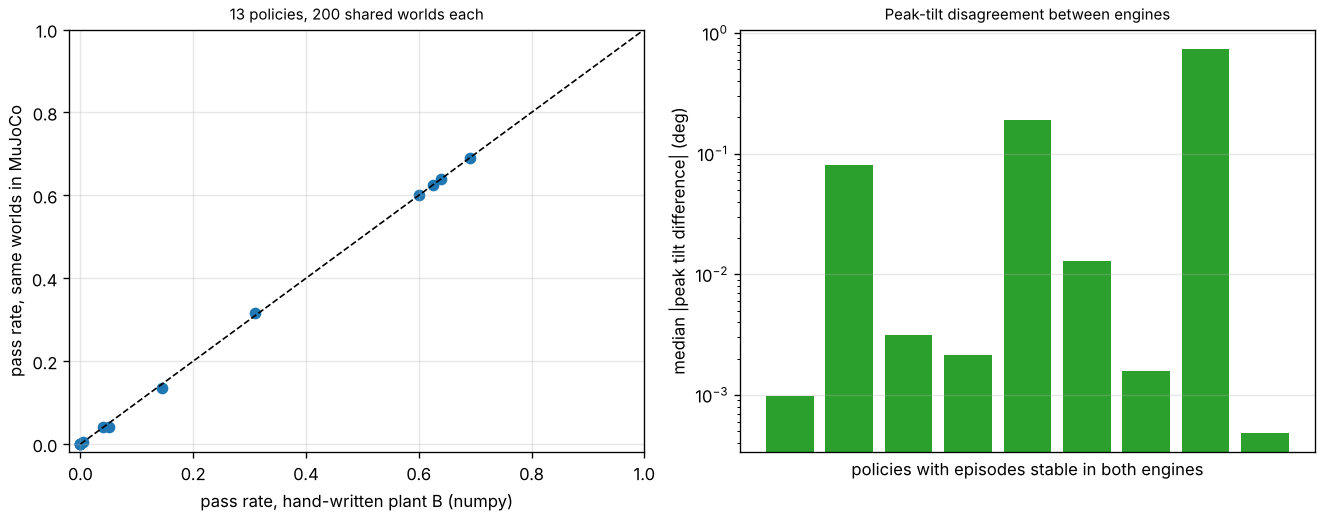
Does the hand-written flexing-sheet plant of buildbot-skills agree with MuJoCo? Pass/fail labels agree on 99.8% of 2600 episodes across 13 policies, so the sim-to-sim transfer failure (0-11% vs 81% where tuned) is not an artefact of my equations.
What it found
buildbot-skills reported that sheet-following skills tuned on a rigid-sheet model fail on a held-out plant with a flexing board, sensing delay and actuator lag, but that plant was my own numpy Lagrangian. Here the same plant is rebuilt in MuJoCo 3.16 (two boxes on hinges, a spring-damper at the midline, RK4, the pin's acceleration put into gravity) with the same Python controller, delay and actuator code, and the 13 policies of buildbot-skills are run on 200 shared random worlds each. The pass-fail label agrees on 99.8% of the 2600 episodes (at worst 99% for one policy); no policy's pass rate differs between engines by more than 1 point; the share of unstable episodes agrees for 12 of 13 policies. Median peak-tilt difference is 0.0005–0.003° for the usable (B-trained) gains and up to 0.7° for marginally stable gains. So the transfer failure is not an artefact of the hand-derived equations. It does not test the shared inputs: delay (0–30 ms), actuator lag, sheet stiffness (150–6000 N m/rad) and the planar two-force-point abstraction are the same ranges of mine and none was measured.
A figure from its own output
Paper, code and results
More in Robots on the building site
- Does a G1 humanoid on a drive-and-lift base nail a 4x8 sheet faster than a walking G1?Does a G1 on a drive-and-lift base nail a 4x8 sheet faster than a walking G1? Yes in 22 of 24 speed settings: 54-121 s a sheet (13 stances, 12 moves of 5-63 s) against 85-119 s walking and 372 s by hand, and it matches a 61 s gantry only with a fast tip, 0.5 m/s drive and 0.2 m/s lift (speeds swept, not a chosen machine; reach unchanged from static statics).
- How slow must a person be at nailing a sheet of sheathing for a Unitree G1 nailing it to pay?How slow must a person be at nailing a sheet of sheathing for a Unitree G1 nailing it to pay? A walking G1 (85 s a sheet) pays above 35 s of person time at 0.3 supervision, a base-mounted one above 26 to 76 s; about $110 a house, and the person's time per sheet is the unsourced unknown.
- Does a nailer's recoil slow a G1 down when it fires a whole 62-nail sheet in sequence?Does a nailer's recoil slow a G1 down when it fires a whole 62-nail sheet in sequence? Not by much: the arm is settled and back on the wall within 0.31 s at 4 N s of recoil, shorter than the 0.16 s moves only for a fast tip, so a sheet loses 0 s (2.3-2.5 s at 10 m/s2 and 4 N s) and the clean-sheet probability does not move; the stud finder still sets the budget (recoil, loop, tip speed and wall are swept, not sourced).
- What can a Unitree G1 or H1 humanoid lift on a house-building site?Can a stock humanoid carry building materials? MuJoCo static payload envelopes of the Unitree G1 (median 4.5 kg, waist-limited; matches Unitree's 2–3 kg rating) and H1 (median 14.2 kg, elbow-limited): the G1 can carry a 2x4 but not a 2x6, the H1 can take one end of an OSB or drywall sheet with a person and set a lightweight block, but not a whole sheet, a normal-weight block or a 60 lb bag, and neither reaches an 8 ft ceiling.
- Does a framing nailer's recoil knock a stock Unitree G1 arm off the stud window?Does a framing nailer's recoil knock a stock Unitree G1 arm off the stud window? In a closed-loop MuJoCo hold, up to 4 N s of recoil moves the tip 1-4 mm (window +-3.9 mm) but 1 N s or more lifts the nosepiece off the wall for 25-140 ms; stiff loops go unstable with 10-20 ms delay (recoil, delay and wall are swept, not sourced).
- How well must a drywall-screwing robot find the framing, and do a few missed screws matter?How well must a drywall-screwing robot find the framing? A 4x8 sheet (28 wall screws, 36 ceiling) needs one read per member good to 1.0 mm for 95% clean sheets, nearly the nailing figure; allowing 3 missed screws gives 1.7 mm, averaging 4 reads 2.1 mm.
All 27 Robots on the building site projects →
Other research topics
Proper scoring & elicitation28Effort & peer prediction9Verification games & slashing19Detection & tolerances14Markets as routers13Prediction-market design9Paying contributors8Decentralised training systems23Digital twins & sim-to-real164LLM chip design loops40Robot manufacturing loops53Ambient AI assistant46Self-replicating manufacturing34Simulation-first design64Engineered clothing45Task-specific AI accelerators40Algorithmic chip-design loops42Open-source purpose-built robots44The software-engineering loop43Adversarial human imitation41Open-source residential construction41Autonomous multi-angle capture34Sensing, imaging and 3D31Energy supply and dense energy storage39Robot societies among people31Agentic co-design of low-cost robots27Laundry-hanging robots25Machine learning on qualitative data23Robots on the building site27Civilizations & group psychology1History & human sciences1
Produced with AI assistance (Claude). Results are from the code in this repository and are simulated or stylised unless the abstract says otherwise; nothing here implies affiliation with or endorsement by any lab, researcher or company cited. MIT licensed.