Does a searched posture let a Unitree G1 hold a stud longer than the default pose?
research/buildbot-holdpose
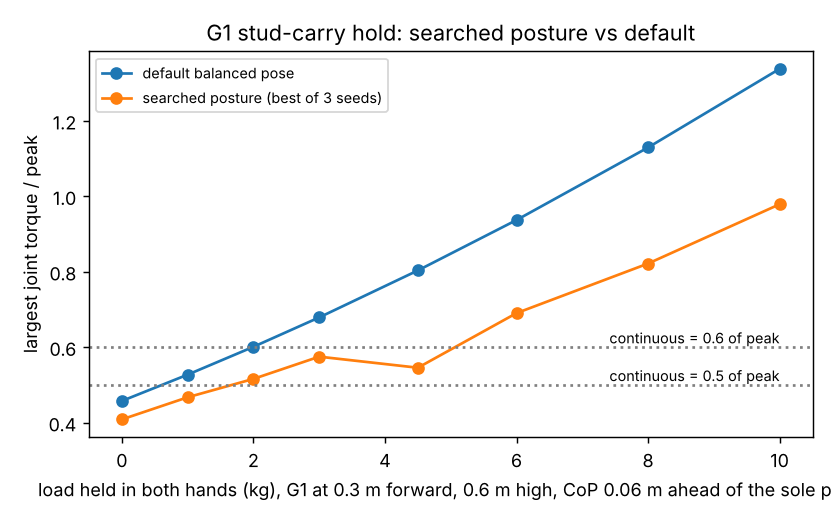
Does a searched arm and waist posture let a G1 hold a stud longer? In MuJoCo the stud's peak joint fraction falls from 0.91 (default) to 0.76 with the centre of pressure on the sole point and to 0.49 (best of three noisy seeds) 3 cm inside the toe edge, enough to make a stud sustainable at a continuous rating of 0.5 of peak; a 2x6 goes 0.93 to 0.68 and sheets stay above peak.
What it found
buildbot-holdheat found the G1 waist at 0.54 of peak torque with empty hands at the stud-carry pose and 0.91 with a 3.8 kg stud. The arms are redundant for a fixed hand position and the centre of pressure can move along the foot, so this searches both in MuJoCo (random anchors then a (1+1) evolution strategy, self-collision rejected, three seeds, best kept). With the centre of pressure 3 cm inside the toe edge the default posture gives 0.744 and the best searched posture 0.487 (other seeds 0.63 and 0.68, so the search is noisy and 0.487 is an upper bound on the minimum); a continuous rating of 0.5 of peak then makes the stud sustainable. With the centre of pressure on the sole point the gain is 0.910 to 0.756; at the toe edge 0.586. A 2x6 goes 0.93 to 0.68; sheet, block and drywall cases stay above peak. For a continuous rating of 0.4 or less nothing is sustainable at this pose. Static only; the continuous rating and thermal time constant remain unsourced (swept), the toe edge is read from the model, and the search is weak.
A figure from its own output
Paper, code and results
More in Robots on the building site
- Does a hand-written flexing-sheet plant agree with MuJoCo, and do its sim-to-sim transfer failures hold there?Does the hand-written flexing-sheet plant of buildbot-skills agree with MuJoCo? Pass/fail labels agree on 99.8% of 2600 episodes across 13 policies, so the sim-to-sim transfer failure (0-11% vs 81% where tuned) is not an artefact of my equations.
- Does a G1 humanoid on a drive-and-lift base nail a 4x8 sheet faster than a walking G1?Does a G1 on a drive-and-lift base nail a 4x8 sheet faster than a walking G1? Yes in 22 of 24 speed settings: 54-121 s a sheet (13 stances, 12 moves of 5-63 s) against 85-119 s walking and 372 s by hand, and it matches a 61 s gantry only with a fast tip, 0.5 m/s drive and 0.2 m/s lift (speeds swept, not a chosen machine; reach unchanged from static statics).
- How slow must a person be at nailing a sheet of sheathing for a Unitree G1 nailing it to pay?How slow must a person be at nailing a sheet of sheathing for a Unitree G1 nailing it to pay? A walking G1 (85 s a sheet) pays above 35 s of person time at 0.3 supervision, a base-mounted one above 26 to 76 s; about $110 a house, and the person's time per sheet is the unsourced unknown.
- Does a nailer's recoil slow a G1 down when it fires a whole 62-nail sheet in sequence?Does a nailer's recoil slow a G1 down when it fires a whole 62-nail sheet in sequence? Not by much: the arm is settled and back on the wall within 0.31 s at 4 N s of recoil, shorter than the 0.16 s moves only for a fast tip, so a sheet loses 0 s (2.3-2.5 s at 10 m/s2 and 4 N s) and the clean-sheet probability does not move; the stud finder still sets the budget (recoil, loop, tip speed and wall are swept, not sourced).
- What can a Unitree G1 or H1 humanoid lift on a house-building site?Can a stock humanoid carry building materials? MuJoCo static payload envelopes of the Unitree G1 (median 4.5 kg, waist-limited; matches Unitree's 2–3 kg rating) and H1 (median 14.2 kg, elbow-limited): the G1 can carry a 2x4 but not a 2x6, the H1 can take one end of an OSB or drywall sheet with a person and set a lightweight block, but not a whole sheet, a normal-weight block or a 60 lb bag, and neither reaches an 8 ft ceiling.
- Does a framing nailer's recoil knock a stock Unitree G1 arm off the stud window?Does a framing nailer's recoil knock a stock Unitree G1 arm off the stud window? In a closed-loop MuJoCo hold, up to 4 N s of recoil moves the tip 1-4 mm (window +-3.9 mm) but 1 N s or more lifts the nosepiece off the wall for 25-140 ms; stiff loops go unstable with 10-20 ms delay (recoil, delay and wall are swept, not sourced).
All 27 Robots on the building site projects →
Other research topics
Proper scoring & elicitation28Effort & peer prediction9Verification games & slashing19Detection & tolerances14Markets as routers13Prediction-market design9Paying contributors8Decentralised training systems23Digital twins & sim-to-real164LLM chip design loops40Robot manufacturing loops53Ambient AI assistant46Self-replicating manufacturing34Simulation-first design64Engineered clothing45Task-specific AI accelerators40Algorithmic chip-design loops42Open-source purpose-built robots44The software-engineering loop43Adversarial human imitation41Open-source residential construction41Autonomous multi-angle capture34Sensing, imaging and 3D31Energy supply and dense energy storage39Robot societies among people31Agentic co-design of low-cost robots27Laundry-hanging robots25Machine learning on qualitative data23Robots on the building site27Civilizations & group psychology1History & human sciences1
Produced with AI assistance (Claude). Results are from the code in this repository and are simulated or stylised unless the abstract says otherwise; nothing here implies affiliation with or endorsement by any lab, researcher or company cited. MIT licensed.