Does a stock humanoid pay for itself on a house site, and how much of a new home's price could it remove?
research/buildbot-cost
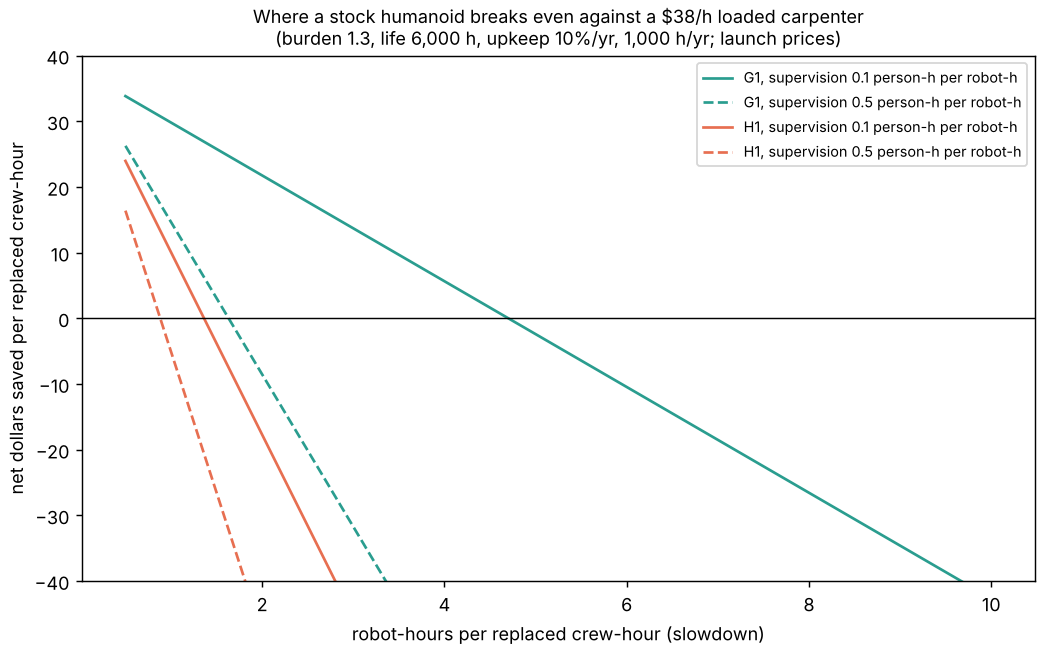
Does a stock humanoid pay for itself on a house site? The break-even slowdown against a $38/h loaded carpenter is about 2.4 for a $16k Unitree G1 and 1.1 for a $90k H1; over a sweep the G1 saves money in 15% of draws, the H1 in 0.4%, and a perfect H1 would remove 0.19% of an average home's price on the taskbook scope (inputs swept, not measured).
What it found
Prices the 46 crew-hours of buildbot-taskbook against the ownership cost of a Unitree G1 ($16,000 launch price) or H1 ($90,000) and a $29.12/h carpenter median (BLS, May 2025). A robot may take only the tasks whose static payload test it passes (H1 32.7 h, G1 5.9 h). The net saving per replaced crew-hour is the loaded wage less slowdown × (ownership rate + supervision × wage), so there is a break-even slowdown: about 2.4 robot-hours per crew-hour for the G1 and 1.1 for the H1 at 0.3 supervision. Over a 4,000-draw sweep the G1 saves money in 15% of draws and the H1 in 0.4%; the best draw saves about $200 on this scope, and a free instant H1 would remove $1,217, 0.18% of NAHB's $665,298 average price. A crude cost-scaled scenario (hours matched to NAHB's framing share) gives up to 8.1% as a ceiling. Slowdown, supervision, success, burden, life and upkeep are swept, not measured: no robot skill is simulated yet, prices are 2024 launch figures, and payload passes are upper bounds.
A figure from its own output
Paper, code and results
More in Robots on the building site
- Does a purpose-built nailing gantry beat a stock humanoid at fastening sheathing, and at what house volume does it pay?Does a purpose-built nailing gantry beat a stock humanoid at fastening sheathing? A modelled two-axis bridge nails a 62-nail sheet in 61 s (6.1x hand nailing); a $100k machine needs about 150 houses a year to break even on walls (50 with roof cassettes), where the H1 saves money in 0.4% of draws (price and times swept, not sourced).
- Can a stock Unitree G1 or H1 humanoid push a nailer into a wall and place nails inside a stud face?Can a stock Unitree G1 or H1 push a nailer into a wall and place nails inside a stud face? One 4x8 sheet is 62 nails, 34 with a +-3.9 mm window; the tip needs 1.24 mm scatter for a 95% sheet. The G1 pushes up to 142 N and reaches 18 of 62 nails from one stance, the H1 up to 276 N and 36 of 62 (static, peak torque, no policy).
- Can a G1 humanoid nail a 4x8 sheet lying flat on a table?Can a G1 humanoid nail a 4x8 sheet lying flat on a table? Not better than on a wall: pushing down at 50 N with its feet planted it holds only 30 of 693 reach cells, reaching 48 of the sheet's 62 nails in 16 stances (13 stances for all 62 on a wall), and matching hand nailing (372 s) only if each re-stance takes under 23-24 s (push, standoff and re-stance time are swept, not sourced; static IK, no walking).
- With the simulated carry and nailing results in place of a swept slowdown, does a stock humanoid pay on a house site?With simulated carry and nailing results in place of a swept slowdown, does a stock humanoid pay on a house site? The H1's carry slowdown is 0.41 to 1.70 against a one-stud labourer (pays in 72% of cells) and 1.63 to 6.82 against a bundle carrier (never pays), against a break-even of 1.07; the dollars are tens per house.
- How long can a Unitree G1 hold a building load before its motors overheat?Can a stock humanoid hold a stud for a minute? G1 static joint torques re-read against a swept continuous-torque fraction: the waist is at 0.54 of peak with empty hands at the carry pose and 0.91 with a 3.8 kg stud, so below a 0.6 continuous ratio nothing is sustainable (0.6 kg at 0.6) and a stud reaches the winding limit in 0.14 thermal time constants at 1/3. A 150-pose search finds a posture (hands 0.15 m ahead, 0.7 m high) at 0.33 of peak, so the 0.91 is not the floor.
- Does a searched posture let a Unitree G1 hold a stud longer than the default pose?Does a searched arm and waist posture let a G1 hold a stud longer? In MuJoCo the stud's peak joint fraction falls from 0.91 (default) to 0.76 with the centre of pressure on the sole point and to 0.49 (best of three noisy seeds) 3 cm inside the toe edge, enough to make a stud sustainable at a continuous rating of 0.5 of peak; a 2x6 goes 0.93 to 0.68 and sheets stay above peak.
All 27 Robots on the building site projects →
Other research topics
Proper scoring & elicitation28Effort & peer prediction9Verification games & slashing19Detection & tolerances14Markets as routers13Prediction-market design9Paying contributors8Decentralised training systems23Digital twins & sim-to-real164LLM chip design loops40Robot manufacturing loops53Ambient AI assistant46Self-replicating manufacturing34Simulation-first design64Engineered clothing45Task-specific AI accelerators40Algorithmic chip-design loops42Open-source purpose-built robots44The software-engineering loop43Adversarial human imitation41Open-source residential construction41Autonomous multi-angle capture34Sensing, imaging and 3D31Energy supply and dense energy storage39Robot societies among people31Agentic co-design of low-cost robots27Laundry-hanging robots25Machine learning on qualitative data23Robots on the building site27Civilizations & group psychology1History & human sciences1
Produced with AI assistance (Claude). Results are from the code in this repository and are simulated or stylised unless the abstract says otherwise; nothing here implies affiliation with or endorsement by any lab, researcher or company cited. MIT licensed.