Is the gap in an assistant that learns only from windows where it spoke caused by selection bias or by too few labels?
research/ambient-labelmatch
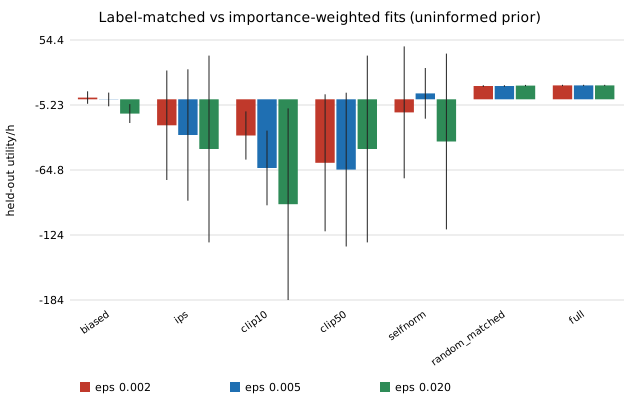
Is the self-selected-feedback gap bias or label volume: mostly bias (a random sample of equal size nearly reaches the oracle); clipped weights help only with an informed prior (stylised)
What it found
A stylised follow-up to ambient-fullinfo. A control that fits on a uniformly random sample of windows, of the same size as the biased fit’s label set, gets 12.2–12.5 utility per hour against an oracle of 12.71, while the biased fit gets 10.6–11.4 with an informed prior and fails with an uninformed one: in this world the gap is mostly selection bias. Capping the inverse-propensity weights at 10 or 50 beats raw weights and the biased fit with the informed prior, but is worse than the biased fit with the uninformed prior; self-normalised weights are noisy. The control uses labels a real assistant never sees, so it locates the loss rather than recovering it. Stylised: chosen distributions, independent windows, noise-free feedback, simulated only.
A figure from its own output
Paper, code and results
More in Ambient AI assistant
- Does a doubly robust estimator fix learning from an assistant’s own self-selected feedback?Does a doubly robust estimator beat IPS on an assistant's self-selected feedback: no, a stylised negative result; its pseudo-labels carry 1/ε residuals and are worse than the biased fit except with an informed prior.
- Does capping the inverse-propensity correction rescue doubly robust learning from an assistant’s own feedback?Does capping the inverse-propensity correction rescue doubly robust learning from an assistant's own feedback: with an informed prior yes (the collapse at ε = 0.002 goes from 0.26 to about 12 utility/h), with an uninformed prior no; stylised, simulated only.
- Does cross-fitting the outcome model help capped doubly robust learning from an assistant’s own feedback?Does fitting the doubly robust outcome model out-of-sample (2-fold cross-fitting) help the capped correction: no, a negative result; differences are within seed noise or worse, and the unclipped collapse at ε = 0.002 persists (1.53 vs 0.26 utility/h); stylised, simulated only.
- Can the doubly robust cap be chosen by validation on an assistant’s own logs?Can the capped doubly robust cap be chosen by 4-fold IPS validation on the log: with an informed prior it matches the best fixed cap within seed noise, with an uninformed prior it does not rescue learning; stylised, simulated only.
- Does a doubly robust validation score choose the doubly robust cap better than an IPS score?A doubly robust validation score does not pick the DR cap better than IPS with the same 4 folds (equal with an informed prior, mixed with the uninformed one); 8 random folds with the DR score is best in all three uninformed cells but still far below the label-matched control (stylised).
- Which of score, fold count and fold type made cap selection better in ambient-drvalid?Ablating the three changes in
ambient-drvalid(score, fold count, fold type): in the uninformed cells random folds help more than the DR score (IPS on 8 random folds is as good as DR on 8), no factor wins everywhere, and every selector stays far below the label-matched control (stylised, negative).
All 46 Ambient AI assistant projects →
Other research topics
Proper scoring & elicitation28Effort & peer prediction9Verification games & slashing19Detection & tolerances14Markets as routers13Prediction-market design9Paying contributors8Decentralised training systems23Digital twins & sim-to-real164LLM chip design loops40Robot manufacturing loops53Ambient AI assistant46Self-replicating manufacturing34Simulation-first design64Engineered clothing45Task-specific AI accelerators40Algorithmic chip-design loops42Open-source purpose-built robots44The software-engineering loop43Adversarial human imitation41Open-source residential construction41Autonomous multi-angle capture34Sensing, imaging and 3D31Energy supply and dense energy storage39Robot societies among people31Agentic co-design of low-cost robots27Laundry-hanging robots25Machine learning on qualitative data23Robots on the building site27Civilizations & group psychology1History & human sciences1
Produced with AI assistance (Claude). Results are from the code in this repository and are simulated or stylised unless the abstract says otherwise; nothing here implies affiliation with or endorsement by any lab, researcher or company cited. MIT licensed.