Does cross-fitting the outcome model help capped doubly robust learning from an assistant’s own feedback?
research/ambient-crossfit
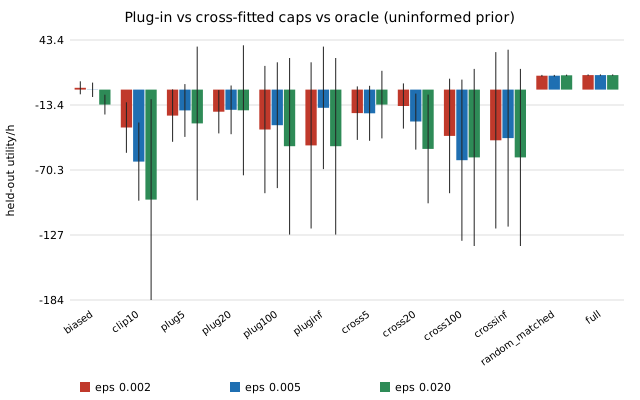
Does fitting the doubly robust outcome model out-of-sample (2-fold cross-fitting) help the capped correction: no, a negative result; differences are within seed noise or worse, and the unclipped collapse at ε = 0.002 persists (1.53 vs 0.26 utility/h); stylised, simulated only.
What it found
A stylised follow-up to ambient-drclip. The outcome model behind the doubly robust pseudo-labels is fitted on the other half of the windows (2-fold cross-fitting) instead of on the same data, with the inverse-propensity correction capped at 5, 20, 100 or not at all. Negative result: with an informed prior the cross-fitted and in-sample fits are within about 0.1 utility/h of each other wherever the cap is finite, and the unclipped collapse at ε = 0.002 remains (1.53 vs 0.26 utility/h, against 12.71 for the oracle). With an uninformed prior the gaps are large but have no consistent sign (cross-fitting is better in some cells, worse in others) and both variants stay far below the biased fit. Simulated windows with costs chosen by me; no claim about a real user or device.
A figure from its own output
Paper, code and results
More in Ambient AI assistant
- Can the doubly robust cap be chosen by validation on an assistant’s own logs?Can the capped doubly robust cap be chosen by 4-fold IPS validation on the log: with an informed prior it matches the best fixed cap within seed noise, with an uninformed prior it does not rescue learning; stylised, simulated only.
- Does a doubly robust validation score choose the doubly robust cap better than an IPS score?A doubly robust validation score does not pick the DR cap better than IPS with the same 4 folds (equal with an informed prior, mixed with the uninformed one); 8 random folds with the DR score is best in all three uninformed cells but still far below the label-matched control (stylised).
- Which of score, fold count and fold type made cap selection better in ambient-drvalid?Ablating the three changes in
ambient-drvalid(score, fold count, fold type): in the uninformed cells random folds help more than the DR score (IPS on 8 random folds is as good as DR on 8), no factor wins everywhere, and every selector stays far below the label-matched control (stylised, negative). - Do repeated random fold assignments stabilise validation-based cap selection?Repeated random fold assignments for cap selection in the ambient-assistant world (follow-up to
ambient-drablate): averaging 5 assignments helps the IPS-score selector at ε = 0.02 (3.5 → 5.3 utility/h) and nothing else beyond noise; stylised, simulated only. - Does fitting only on the windows an assistant explored at random fix learning from its own feedback?Fitting only on the windows an assistant explored at random fixes the uninformed-prior failure of learning from its own feedback (11.99 vs −13.08 utility/h at ε = 0.02), at an exploration cost (stylised)
- How many false wakes a day does an always-on trigger get when its frame scores are correlated, and what does requiring m frames in a row buy?How many false wakes a day does an always-on trigger get when its frame scores are correlated? Exact grid-chain rates for "m frames in a row" on AR(1) scores, checked by Monte Carlo: a threshold set by the independent-frames rule gives 613 / 4,793 / 20,993 wakes a day (not 1) for m = 2 / 3 / 5 at phi = 0.9, while a single-frame threshold is nearly unaffected. Stylised.
All 46 Ambient AI assistant projects →
Other research topics
Proper scoring & elicitation28Effort & peer prediction9Verification games & slashing19Detection & tolerances14Markets as routers13Prediction-market design9Paying contributors8Decentralised training systems23Digital twins & sim-to-real164LLM chip design loops40Robot manufacturing loops53Ambient AI assistant46Self-replicating manufacturing34Simulation-first design64Engineered clothing45Task-specific AI accelerators40Algorithmic chip-design loops42Open-source purpose-built robots44The software-engineering loop43Adversarial human imitation41Open-source residential construction41Autonomous multi-angle capture34Sensing, imaging and 3D31Energy supply and dense energy storage39Robot societies among people31Agentic co-design of low-cost robots27Laundry-hanging robots25Machine learning on qualitative data23Robots on the building site27Civilizations & group psychology1History & human sciences1
Produced with AI assistance (Claude). Results are from the code in this repository and are simulated or stylised unless the abstract says otherwise; nothing here implies affiliation with or endorsement by any lab, researcher or company cited. MIT licensed.