Once the MFCC front end is counted, does the energy-optimal keyword model change?
research/accel-sysmodel
Joining accel-cascade's committed results with accel-frontend's 46.8 nJ per frame: cascades' classifier-only saving of up to 28% becomes at most 0.42% of whole-system energy, while the most accurate model (about 0.75 test accuracy) costs 23 to 26 times the cheapest classifier but only 5% more system energy (modelled, not measured)
What it found
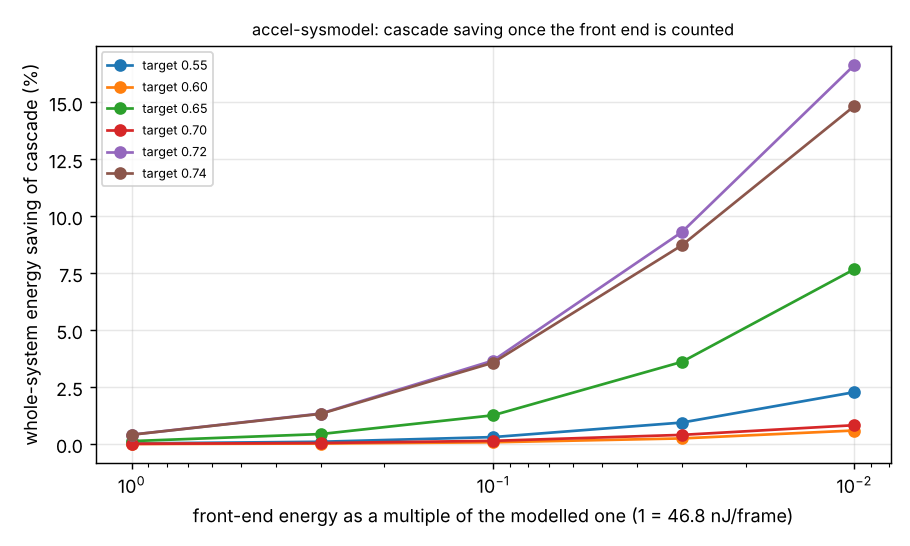
accel-cascade found two-stage cascades cut classifier energy by up to 28% but said the saving would vanish next to the MFCC front end. This project computes it by joining that project's committed per-design energies and accuracies (5 seeds, 40 models each) with accel-frontend's 46.77 nJ per frame, at 50 frames and 4 decisions per second (584.6 nJ per decision). The cascades' whole-system saving is at most 0.42% (mean over seeds, accuracy targets 0.50 to 0.74), with 0.3 to 1.4 points of test accuracy lost; the front end must get about 10 to 30 times cheaper before cascades reach a few per cent, and 100 times cheaper for up to 17%. In the other direction, the model with the best validation accuracy (test 0.747 to 0.758) draws 23 to 26 times the cheapest model above 0.5 validation accuracy (test 0.47 to 0.49) in the classifier, but only 5.2 to 5.8% more in the whole system. Modelled energy from accel-kws constants (checked against Horowitz 2014 within 4% in accel-horowitzcheck); the front-end scale factors are a sweep; accuracies are from float features, not the integer front end; nothing is retrained or measured.
A figure from its own output
Paper, code and results
More in Task-specific AI accelerators
- How big a keyword-spotting model fits a real Tiny Tapeout tile once the hidden layer goes past 64 units?Synthesising the streaming keyword-spotting engine at 96, 128, 192 and 256 hidden units (SKY130 HD, Yosys): area grows about 250 µm² per unit, so H = 128 (0.752 accuracy, 4-bit) needs a 2x2 tile (75,603 µm²) against a 1x2 (36,347 µm²) for H = 64 (0.737): +0.015 accuracy for twice the tile; H = 256 needs 4x2 at 50% utilisation, and its 8-bit layer-2 accumulator overflows 20 bits on a random model.
- Do trained keyword-spotting models fit a Tiny Tapeout tile's 16-bit bias and 20-bit accumulator?All 96 retrained keyword-spotting models fit the Tiny Tapeout engine's 16-bit bias and 20-bit accumulator limits (worst use 43% and 30%), accuracy through the tile contract equals the reference, and 32 trained models run bit-exact in RTL.
- Does Tiny Tapeout's real tile-size table change which keyword-spotting model fits a tile?Tiny Tapeout's real SKY130 tile sizes (1x1 is 161 × 111.52 µm = 17,955 µm², 0.43% below the value assumed earlier) applied to the synthesised keyword-spotting engine and the retrained models: the best 1x1 model is unchanged at 100% and 50% utilisation and flips at 70% (H = 16, 4-bit, 0.596 instead of 8-bit, 0.616, a 29 µm² miss); H = 64 with 8-bit weights (0.737) fits a 1x2 tile.
- How small can a keyword-spotting accelerator get, and what does each bit of precision cost?Keyword-spotting accelerator: quantised MLP on Speech Commands, serial-MAC RTL bit-exact against an integer reference, accuracy vs cycles, cells and modelled energy over width and weight bits (stylised).
- Does a keyword-spotting accelerator fit in a Tiny Tapeout tile, and how accurate can it be?A streaming keyword-spotting engine with no weight memory, exact against an integer reference and synthesised to SKY130 on 32 geometries (6,300 to 24,500 um2); 16 hidden units at 8-bit weights is the most accurate (0.616) that fits one assumed 1x1 Tiny Tapeout tile at 70% utilisation, 64 units at 4 bits (0.738) needs two. Stylised: synthesis only.
- Under a latency deadline, how much engine area does picking the most accurate model first cost, compared with choosing model and lane count together?Model-first vs joint choice of model and MAC lane count under a latency deadline, on the 40 measured
accel-kwsmodels; accepting 2 validation points less cuts engine area 31–42% (stylised, table-based, cycles for more than one lane analytic).
All 40 Task-specific AI accelerators projects →
Other research topics
Proper scoring & elicitation28Effort & peer prediction9Verification games & slashing19Detection & tolerances14Markets as routers13Prediction-market design9Paying contributors8Decentralised training systems23Digital twins & sim-to-real164LLM chip design loops40Robot manufacturing loops53Ambient AI assistant46Self-replicating manufacturing34Simulation-first design64Engineered clothing45Task-specific AI accelerators40Algorithmic chip-design loops42Open-source purpose-built robots44The software-engineering loop43Adversarial human imitation41Open-source residential construction41Autonomous multi-angle capture34Sensing, imaging and 3D31Energy supply and dense energy storage39Robot societies among people31Agentic co-design of low-cost robots27Laundry-hanging robots25Machine learning on qualitative data23Robots on the building site27Civilizations & group psychology1History & human sciences1
Produced with AI assistance (Claude). Results are from the code in this repository and are simulated or stylised unless the abstract says otherwise; nothing here implies affiliation with or endorsement by any lab, researcher or company cited. MIT licensed.