With a locking-free finite-element simulator, how much surrogate error can a design loop tolerate?
research/accel-surrogatelock
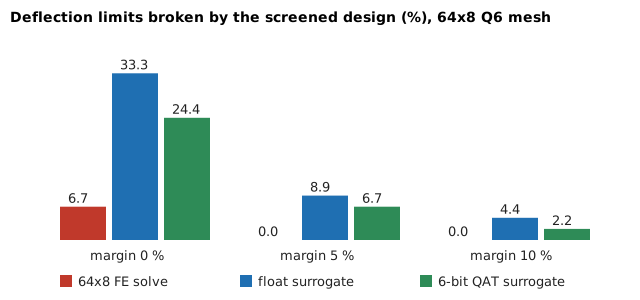
With a locking-free Q6 finite-element simulator, how much surrogate error can a design loop tolerate? At 64x8 the surrogate adds 0.5 to 0.8 points to the FE's 2.3 % error; with no safety margin a min-mass screen breaks the limit in 24 to 33 % of cases, with a 5 to 10 % margin 2 to 9 %. Stylised.
What it found
The 2D cantilever of accel-surrogate2d with a locking-free Q6 (incompatible-modes) element, which is within 0.6 % of Timoshenko theory on a 16×2 mesh where Q4 gives half the deflection. An 8-32-32-1 MLP (float, 6 and 8 bits) imitates it at three mesh sizes. At 64×8 the surrogate adds about 0.5 to 0.8 points to the FE's own 2.3 % error. In a minimum-mass search over 1,000 designs and 15 limits, a screen with no safety margin breaks the limit in 24 to 33 % of cases (FE alone 6.7 %); a 5 to 10 % margin cuts this to 2 to 9 % for about 0.5 to 1.6 % extra mass. Stylised, random-pool screen, 3 seeds, modelled energy.
A figure from its own output
Paper, code and results
More in Task-specific AI accelerators
- When the beam simulator is a 2D finite-element model, does a quantised surrogate (and an accelerator for it) pay?When the beam simulator is a 2D plane-stress FE model, does a quantised MLP surrogate (and an accelerator) pay? The energy break-even is met (34x at 32x4 mesh, 319x at 64x8, assumed constants), and the surrogate's 2 % error against its FE is small beside the FE's own 9 % discretisation error; but the locking Q4 simulator is itself inaccurate. Stylised.
- Can a quantised MLP surrogate of a finite-element beam beat the beam's own model-form error, and when would an accelerator for it pay?Can a quantised MLP surrogate of an FE cantilever beat the Euler-Bernoulli vs Timoshenko gap (0.09 % median), and would an accelerator pay? No: float error is 1.7 % (18x the gap), 6-bit QAT stays within 0.3 points of float, and the surrogate only beats the solver above ~1,600 simulator flops. Stylised.
- Does a small control network need an accelerator to meet the control-rate deadline?Can a small behaviour-cloned control network meet the control-rate deadline on a microcontroller or a P-lane accelerator for a two-link arm? Stylised and preliminary: the int8 policies track 300+ times worse than their teacher, so policy accuracy, not hardware speed, is the limit; the latency model (assumed constants) shows hardware matters only above about 10 kHz.
- Does the keyword-spotting engine fit a small open-toolchain FPGA, and how fast does it clock?The
accel-kwsserial-MAC engine through Yosys and nextpnr-ice40 on UP5K and HX8K for 15 geometries (random weights, synthesis only): all fit in at most 22% of the UP5K's logic, weights land in block RAM, Fmax 15–22 MHz on UP5K. Stylised; no board, no power. - When does a task's accuracy tolerance let an accelerator drop its multipliers?Pruning, int4/int8, ternary and binary MLPs on scikit-learn digits (substitute task) with a modelled-energy engine: when does the accuracy slack let the hardware drop multipliers? Stylised; at 1–2 points tolerance, pruned int8 still beats multiplier-free.
- Does the pruning and ternary-weight result from digits hold on real keyword-spotting features?
accel-sparse's pruning, int4/int8, ternary and binary sweep re-run on real Speech Commands MFCC features: no multiplier-free design is within 5 points of float32 (ternary 19 down), where digits said 1; int8 pruned 50% is the cheapest within 2 points. Stylised, untuned negative.
All 40 Task-specific AI accelerators projects →
Other research topics
Proper scoring & elicitation28Effort & peer prediction9Verification games & slashing19Detection & tolerances14Markets as routers13Prediction-market design9Paying contributors8Decentralised training systems23Digital twins & sim-to-real164LLM chip design loops40Robot manufacturing loops53Ambient AI assistant46Self-replicating manufacturing34Simulation-first design64Engineered clothing45Task-specific AI accelerators40Algorithmic chip-design loops42Open-source purpose-built robots44The software-engineering loop43Adversarial human imitation41Open-source residential construction41Autonomous multi-angle capture34Sensing, imaging and 3D31Energy supply and dense energy storage39Robot societies among people31Agentic co-design of low-cost robots27Laundry-hanging robots25Machine learning on qualitative data23Robots on the building site27Civilizations & group psychology1History & human sciences1
Produced with AI assistance (Claude). Results are from the code in this repository and are simulated or stylised unless the abstract says otherwise; nothing here implies affiliation with or endorsement by any lab, researcher or company cited. MIT licensed.