How much of a digital-twin run should be thrown away because it started in the wrong state?
research/warmup-twin
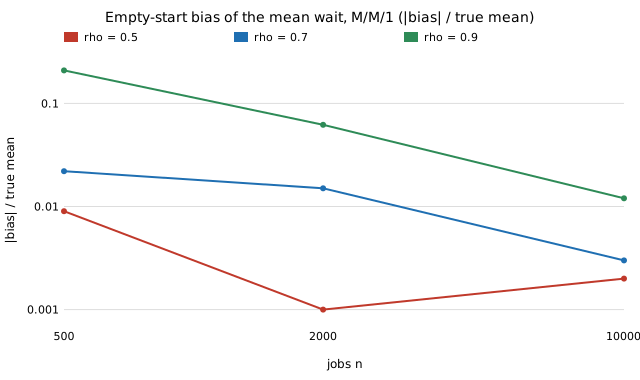
A twin started in the wrong state: exact AR(1) warm-up bias and MSE-optimal deletion (≈ one relaxation time, ≤1.5× gain), M/M/1 empty-start bias (−21% at ρ=0.9, n=500; 1% at 10⁴), and a negative result: MSER-5 truncation leaves more bias and more false SLA certifications than fixed deletion.
What it found
A twin started from an empty queue or a nominal sensor value is biased at first. For AR(1) output the bias and variance of the run mean are exact (0.300 vs 0.300 simulated at φ=0.9, n=100), and the MSE-optimal warm-up is about one relaxation time 1/(1−φ) with a gain of at most 1.5× and 1.03× once n is about a hundred relaxation times. An M/M/1 instrument started empty underestimates the mean wait by 21%, 6% and 1.2% at ρ=0.9 with 500, 2000 and 104 jobs, but at 5000 jobs the bias (−0.14) is far below the run-to-run RMSE (2.4). Negative result: fixed deletion does not lower RMSE, and MSER-5 truncation leaves a larger bias (−0.77), covers 61% against 72% for no truncation, and passes a violating system 28% of the time against 18%. Stylised (Gaussian AR(1), M/M/1, simulated “real” system).
A figure from its own output
Paper, code and results
More in Digital twins & sim-to-real
- How wrong is a twin's localisation error when real ranges have non-line-of-sight bias?A twin with Gaussian range noise vs real non-line-of-sight bias: exact rms law
GDOP·√(σ²+p(2−p)m²)(4.5–7.3× the twin's error, zero mean), a predictable bias for a blocked side, anchor counts 4 → 28–46 for a 1 m / 95% corridor, and a trimming fix that costs 24% when NLOS is absent. - Can a twin identified from logs of the deployed controller tell you whether a different controller is stable?A twin identified from logs of the deployed controller: held-out error is 1.00σ² at every dither level while the predicted pole under a new gain has sd
(σ/√n)√((k−k')²/τ²+1/v)(0.037→0.82), no dither gives a confident wrong twin (b̂=−0.22 vs +1), point-rule false stability certification 3–48% vs 0.1–4.7% for the OLS bound. - How much of a digital twin's error is that it was fitted to finite real data, however long it is simulated?A twin fitted to finite real data: exact delta-method error
√(1+(2−ρ)²)/((1−ρ)√n)of its steady-state wait, data needed grows as(1−ρ)⁻²(22 100 per stream for 10% at ρ=0.9), exact instability probability, false SLA certification 36–46% fixed by bootstrap/posterior bounds (delta bound under-covers). - For a fixed budget, how much should a fitted digital twin spend on real data and how much on simulation length?Real data or more simulation for a fitted twin: relative variance
a(ρ)/n + b(ρ)/m(matches simulation), one real pair ≈ 2 simulated jobs at any load, optimal real-data share 0.57–0.97 by cost ratio, and a simulation-only interval whose real coverage falls 0.79→0.17 as the run lengthens while the input-aware one stays 0.92–0.95. - When should a twin run that counts rare failures stop?When to stop a twin run counting rare failures: sequential Wald stopping halts on zero failures (90% of runs at
p=10⁻³, coverage 9.6%), inverse sampling tomfailures gives exactly unbiased(m−1)/(N−1)with relative sd≈1/√(m−2)and an exact interval (95.0–95.5%), while a fixed run planned for the wrongpdelivers 63–200% half-width. - What stopping distance can a twin with independent terrain cells certify?Stopping distance certified by a twin with independent per-cell friction: exact incomplete-gamma law (matches braking simulation), 100 twin cells certify 1.17× the mean distance but real terrain with 1–10 patches exceeds it 44%–18% (claimed 0.1%), finer cells are worse, the mean is nearly right, and the measured patch count repairs it.
All 164 Digital twins & sim-to-real projects →
Other research topics
Proper scoring & elicitation28Effort & peer prediction9Verification games & slashing19Detection & tolerances14Markets as routers13Prediction-market design9Paying contributors8Decentralised training systems23Digital twins & sim-to-real164LLM chip design loops40Robot manufacturing loops53Ambient AI assistant46Self-replicating manufacturing34Simulation-first design64Engineered clothing45Task-specific AI accelerators40Algorithmic chip-design loops42Open-source purpose-built robots44The software-engineering loop43Adversarial human imitation41Open-source residential construction41Autonomous multi-angle capture34Sensing, imaging and 3D31Energy supply and dense energy storage39Robot societies among people31Agentic co-design of low-cost robots27Laundry-hanging robots25Machine learning on qualitative data23Robots on the building site27Civilizations & group psychology1History & human sciences1
Produced with AI assistance (Claude). Results are from the code in this repository and are simulated or stylised unless the abstract says otherwise; nothing here implies affiliation with or endorsement by any lab, researcher or company cited. MIT licensed.