How many real rollouts does a biased digital twin save when certifying a policy?
research/twin-control-variate
Certifying a policy with a biased digital twin: exact twin/plant cost correlation, optimal twin-to-real rollout split and speed-up (matched by simulation), bias first order but correlation second order in model error so the replayable-disturbance fraction caps the twin's value, and twin-only intervals cover ~0%.
What it found
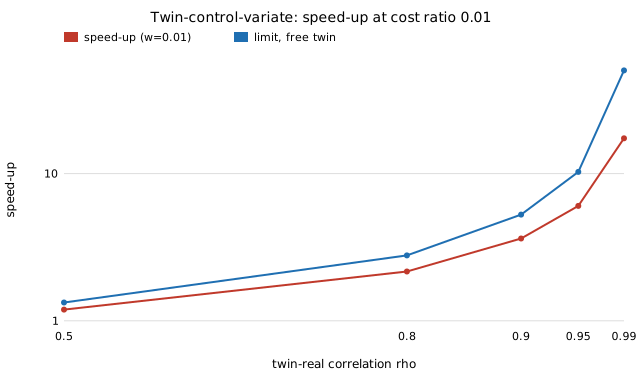
A twin evaluated alone is biased however many rollouts you run (nominal 95% intervals cover the truth 0–0.4% of the time at a 12% bias, 20% gain error); used as a control variate it removes variance without bias. In scalar LQ the rollout cost is a Gaussian quadratic form, so the twin/plant correlation ρ = λ tr(GG′)/√(tr G2 tr G′2) is exact, the optimal twin-to-real ratio is ρ/√((1−ρ2)w) and the speed-up 1/(√(1−ρ2)+ρ√w)2, matched by simulation to a few percent. Twin gain error is first order in the bias (5% error → 2.7%) but second order in 1−ρ, so the twin’s value is capped by the fraction λ of the real disturbance it can replay: a 5% certificate costs 168 real-only, 28 with λ = 0.95 and 163 with λ = 0.3. Twin-only beats real-only only below σ2/bias2 real rollouts (35 at 10% error). Stylised.
A figure from its own output
Paper, code and results
More in Digital twins & sim-to-real
- What does a Gaussian-clutter radar twin promise about detection, not just false alarms?What a Gaussian-clutter radar twin promises about detection: exact Pfa/Pd laws for CA- and OS-CFAR in textured clutter, OS inflated like CA, an SNR shortfall (6.3 dB at ν=2) larger than the threshold repair, and no CA/OS ranking reversal.
- How do you estimate a controller's real-world cost with a biased digital twin?Estimating a controller's real cost with a biased digital twin as a control variate: cost correlation in closed form (
0.985 → 0.472as the twin's gain error grows while its bias grows 300×), exactlyλ²under partial disturbance replay, optimal twin/real ratio√(c_rρ²/(c_t(1−ρ²)))and break-even twin price, simulated variance ratio 0.228 vs 0.225 predicted. - How fast can a deployed digital twin be caught going stale, and when is it invisible?Anytime-valid monitoring of a deployed twin: e-process on closed-loop residuals (2.3% vs 51.6% false alarms under peeking), rate = twin-transfer score gap, an invisible blind line
Δa = kΔbthat needs ditherv, and when dithering pays. - How far can DiLoCo reports be compressed?Compressing DiLoCo reports: unbiased compression multiplies the contraction (
c = 1+ω/M, stable iffαsc<2, participation isω = 1/p−1), dithered quantisation only addsΔ²/12and keeps stability, and at fixed bandwidth quantisation has an interior optimum near 1.3 bits per coordinate (~4× below 8-bit reports) while sparsification favours few full reports. - What does it cost to send only a fraction of the outer update, and does error feedback help?Sending a fraction
pof the outer update: unbiased rescaling costs1/pin noise floor, error feedback costs only1+αs(1/p−1)at small steps but caps contraction at√(1−p); exact closed form, stability limits, horizon losses. - Can a DiLoCo-style run hide its synchronisation by applying the outer update rounds late?Overlapping the DiLoCo sync by applying the outer step
τrounds late does not pay: stable iffαs < 2 sin(π/(4τ+2)), best rate1−2 sin(π/(4τ+2))/κ_H(exactlyκ_H/(κ_H+1)atτ=1), momentum is useless onceτ≥1(69 → 1388 rounds atκ_H=100), hidden-sync gain ≤(τ+1) sin(π/(4τ+2)) ≤ 1(search: 1.5–4.9× slower than blocking averaging), fixed if the fresh pseudo-gradient has weight>½.
All 164 Digital twins & sim-to-real projects →
Other research topics
Proper scoring & elicitation28Effort & peer prediction9Verification games & slashing19Detection & tolerances14Markets as routers13Prediction-market design9Paying contributors8Decentralised training systems23Digital twins & sim-to-real164LLM chip design loops40Robot manufacturing loops53Ambient AI assistant46Self-replicating manufacturing34Simulation-first design64Engineered clothing45Task-specific AI accelerators40Algorithmic chip-design loops42Open-source purpose-built robots44The software-engineering loop43Adversarial human imitation41Open-source residential construction41Autonomous multi-angle capture34Sensing, imaging and 3D31Energy supply and dense energy storage39Robot societies among people31Agentic co-design of low-cost robots27Laundry-hanging robots25Machine learning on qualitative data23Robots on the building site27Civilizations & group psychology1History & human sciences1
Produced with AI assistance (Claude). Results are from the code in this repository and are simulated or stylised unless the abstract says otherwise; nothing here implies affiliation with or endorsement by any lab, researcher or company cited. MIT licensed.