Can a DiLoCo-style run hide its synchronisation by applying the outer update rounds late?
research/outer-delay
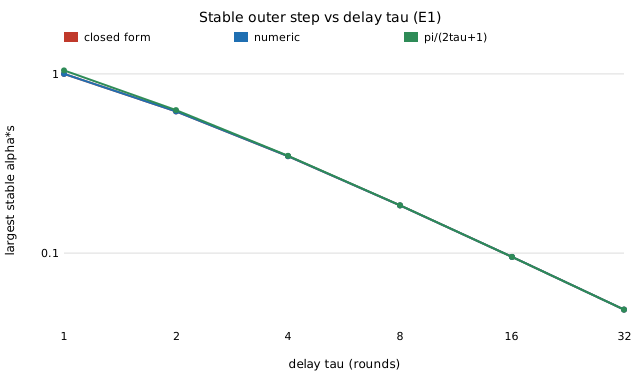
Overlapping the DiLoCo sync by applying the outer step τ rounds late does not pay: stable iff αs < 2 sin(π/(4τ+2)), best rate 1−2 sin(π/(4τ+2))/κ_H (exactly κ_H/(κ_H+1) at τ=1), momentum is useless once τ≥1 (69 → 1388 rounds at κ_H=100), hidden-sync gain ≤ (τ+1) sin(π/(4τ+2)) ≤ 1 (search: 1.5–4.9× slower than blocking averaging), fixed if the fresh pseudo-gradient has weight >½.
What it found
Applying the outer step τ rounds late gives a mode the recursion xt+1 = xt − αs xt−τ, stable iff αs < 2 sin(π/(4τ+2)) ≈ π/(2τ+1). The best step sits at that edge, so the rate is 1 − 2 sin(π/(4τ+2))/κH (exactly κH/(κH+1) at τ=1), and outer momentum stops helping the moment τ ≥ 1 (69 rounds at τ=0 become 1388 at κH=100). Even with the sync fully hidden the gain over blocking averaging is at most (τ+1) sin(π/(4τ+2)) ≤ 1, and an exact search over (H, τ) finds overlapped training 1.5–4.9× slower than blocking averaging and 2.3–31× slower than blocking with tuned momentum. Giving the fresh pseudo-gradient weight above ½ removes the penalty entirely (stable for every τ; at weight 0.75 and τ=1 the stale term acts as negative momentum, 2× faster than no delay). Stylised: noiseless quadratic, shared Hessian, one common delay.
A figure from its own output
Paper, code and results
More in Digital twins & sim-to-real
- A twin whose wind gusts are matched to the logged variance each step: how wrong is the position variance of a PD-held vehicle, and does matching the spectrum instead fix it?A twin whose wind gusts are iid per step with the logged variance: real position variance is
s²(a+k_d)/(k_d k_p(a²+a k_d+k_p)), the twin's is 141× smaller ata=1,dt=0.01 and scales asdt, its 1e-3 margin is exceeded 78% of the time, and a spectrum-matched white twin is always conservative. - A free-space radar twin ignores ground-bounce lobing: how wrong is it, and can a two-ray twin with a slightly wrong target height be worse?Free-space radar twin vs two-ray ground-bounce lobing: detection fraction exactly 2/3 at the free-space range edge, real detects 44% beyond it, a two-ray twin with height error δh disagrees ≈
4h_rδh/(λr)and is worse than free space at short range, a height-jitter ensemble scores Brier 0.119 vs 0.197 deterministic. Stylised. - A point-target radar twin of two unresolved scatterers: it has the right median, so what does it get wrong, and does averaging looks converge where it says?Point-target radar twin of two unresolved scatterers under ideal monopulse: real mean is exactly the strong scatterer and median exactly the power centroid, outside-span probability
arccos(r)/π, a variance-matched Gaussian twin is 27× too optimistic at a 3σ gate (r=0.9), averaging looks floors at bias2r²/(1+r²)where the twin predicts√(var/N), and the median beats the mean for r≥0.477. Stylised. - A constant-variance Gaussian camera twin of Poisson photon counting: which dark/bright decision rule does it teach, and what does that cost on the real sensor?Constant-variance Gaussian camera twin of Poisson photon counting: the real Bayes threshold is the logarithmic mean, the twin's the arithmetic mean (7.28 vs 8.00 for 4 vs 12), a detector tuned in it has 1.25–1.83× the optimal error and 23× at λ0=200 (λ1=2λ0), and a square-root twin recovers the optimum in 8 of 9 pairs. Stylised.
- A radar twin whose targets occupy a single range cell: how far around a strong target does the real matched filter ghost, and does tapering fix it?Single-cell radar twin vs a real matched filter: exact Rician ghost false alarms (0.020 at 20 dB, 1.0 at 30 dB for rect vs the twin's 1e-6), ghost zone radius growing
√10per 10 dB, taper gain exactly sidelobe difference + ENBW loss, and a 60 dB Hamming zone 6× Hann's despite the lower peak sidelobe. Stylised. - A link twin with independent packet loss says to send repeats back to back: what does burstiness do to repetition coding for shared maps, and what does spacing buy?Independent-loss link twin vs a bursty loss chain for repeated map updates: exact residual
p·q_g^(r−1), the twin's 5 back-to-back copies leave 81–311× the claimed loss at λ=0.5–0.8, spacing needs 6–36 slots for two copies, and with ≤8 copies the best design is 12–154 slots of latency vs the twin's 4.
All 164 Digital twins & sim-to-real projects →
Other research topics
Proper scoring & elicitation28Effort & peer prediction9Verification games & slashing19Detection & tolerances14Markets as routers13Prediction-market design9Paying contributors8Decentralised training systems23Digital twins & sim-to-real164LLM chip design loops40Robot manufacturing loops53Ambient AI assistant46Self-replicating manufacturing34Simulation-first design64Engineered clothing45Task-specific AI accelerators40Algorithmic chip-design loops42Open-source purpose-built robots44The software-engineering loop43Adversarial human imitation41Open-source residential construction41Autonomous multi-angle capture34Sensing, imaging and 3D31Energy supply and dense energy storage39Robot societies among people31Agentic co-design of low-cost robots27Laundry-hanging robots25Machine learning on qualitative data23Robots on the building site27Civilizations & group psychology1History & human sciences1
Produced with AI assistance (Claude). Results are from the code in this repository and are simulated or stylised unless the abstract says otherwise; nothing here implies affiliation with or endorsement by any lab, researcher or company cited. MIT licensed.