Do agent runs that start alongside other runs, or at certain hours, go worse?
research/swe-startslot
Do agent runs that start alongside other runs, or at certain hours, go worse? Raw, crowded starts look better (error recorded 9.8% vs 21.0%) but that is a day effect; shuffled within days there is no detectable difference over 660 timed records, and hour of day shows nothing (negative, preliminary, low power).
What it found
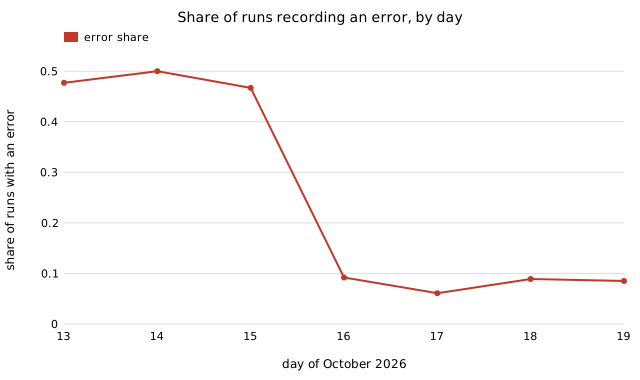
Joins 660 run records that have a start time (1 to 19 October 2026) to how many other runs started within 5, 10 or 30 minutes. Raw, crowded starts look better (error recorded in 9.8% against 21.0%), but that is a day effect: 13 to 15 October had 47–50% error records and few concurrent starts, 16 October on 6–9% and many. Shuffling the crowded label within calendar days finds no detectable difference (12 tests, one p = 0.018 on a 50-run group, not counted), and six-hour blocks of the day show nothing. Preliminary and low power: association only, errors is self-reported, and duplicate work, the cost swe-schedule models, is not in the records.
A figure from its own output
Paper, code and results
More in The software-engineering loop
- Do parallel review sessions duplicate each other?Do parallel review sessions duplicate each other? 6 of 35 review-track PRs (17.1%, Wilson 8.1–32.7%) are the second of a pair merged 0.4 to 2.5 minutes apart, and 5 of 6 pairs edited the same generated files; cost unmeasured (3 of 35 priced). Preliminary.
- Do the agent run records match git? Does every landed session leave one?Do the agent run records match git? All 522 records naming a pull request in this repository name one that landed, but only 79.8% of sessions landing commits from 13 October have a record (ventures 79.2%, research 92.2%; preliminary, seven days).
- Why do landed ventures sessions leave fewer run records than research sessions?Why do landed ventures sessions leave fewer run records? 79.6% against research 92.2%; scope, size and kind explain nothing, the ventures sub-prompts alone omit the record step, and coverage rose from 53% to 84–89% in a week (preliminary).
- How often does this portfolio report a negative or mixed result?How often does this portfolio report a negative or mixed result? In an 80-summary hand-labelled sample, 59% of the summaries that test a claim against an alternative (43–73%) report a negative or mixed result (preliminary, one labeller).
- Do later projects build on earlier ones?Do later projects build on earlier ones? A reference graph of 723 READMEs: 61.7% of projects are named by at least one later project (Wilson 58% to 65%), inbound counts are very uneven (Gini 0.69) and 71% of references stay within a track; naming is an upper bound on reuse.
- Does an Opus agent run cost more than a Sonnet run on the same kind of work? 6x the cost, 3x the tool calls, 1.4x per self-estimated human hourDoes an Opus agent run cost more than a Sonnet run on the same kind of work? Matched on date and track, 6.3× the cost (CI 4.7–8.0), 3.2× the tool calls and 2.0× per call; 1.4× per self-estimated human hour. 46 Opus vs 958 Sonnet runs, preliminary.
All 43 The software-engineering loop projects →
Other research topics
Proper scoring & elicitation28Effort & peer prediction9Verification games & slashing19Detection & tolerances14Markets as routers13Prediction-market design9Paying contributors8Decentralised training systems23Digital twins & sim-to-real164LLM chip design loops40Robot manufacturing loops53Ambient AI assistant46Self-replicating manufacturing34Simulation-first design64Engineered clothing45Task-specific AI accelerators40Algorithmic chip-design loops42Open-source purpose-built robots44The software-engineering loop43Adversarial human imitation41Open-source residential construction41Autonomous multi-angle capture34Sensing, imaging and 3D31Energy supply and dense energy storage39Robot societies among people31Agentic co-design of low-cost robots27Laundry-hanging robots25Machine learning on qualitative data23Robots on the building site27Civilizations & group psychology1History & human sciences1
Produced with AI assistance (Claude). Results are from the code in this repository and are simulated or stylised unless the abstract says otherwise; nothing here implies affiliation with or endorsement by any lab, researcher or company cited. MIT licensed.