Do parallel review sessions duplicate each other?
research/swe-reviewdup
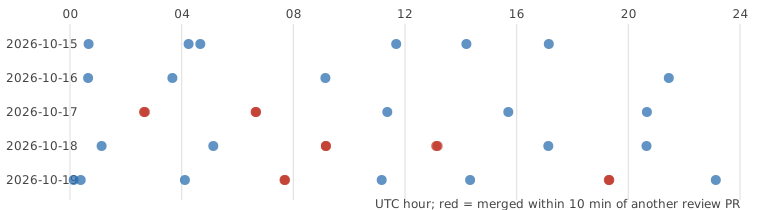
Do parallel review sessions duplicate each other? 6 of 35 review-track PRs (17.1%, Wilson 8.1–32.7%) are the second of a pair merged 0.4 to 2.5 minutes apart, and 5 of 6 pairs edited the same generated files; cost unmeasured (3 of 35 priced). Preliminary.
What it found
Reads the 35 review-track pull requests merged on main from 14 to 19 October 2026 and groups those merged within 10 minutes of each other. Six are the second member of a pair (17.1%, Wilson 8.1–32.7%; 22.9% at a 30-minute window), all merged 0.4 to 2.5 minutes apart, so they are sessions that started together. None of the extra pull requests was record-only, but in five of six pairs both edited prompts/derived/runs.json or prompts/experiments.md, so the later merge resolved a conflict. Only 3 of 35 review PRs have a priced run record, so the cost of the duplication is not measured. Descriptive and preliminary: six days, merge time stands in for start time.
A figure from its own output
Paper, code and results
More in The software-engineering loop
- Do the agent run records match git? Does every landed session leave one?Do the agent run records match git? All 522 records naming a pull request in this repository name one that landed, but only 79.8% of sessions landing commits from 13 October have a record (ventures 79.2%, research 92.2%; preliminary, seven days).
- Why do landed ventures sessions leave fewer run records than research sessions?Why do landed ventures sessions leave fewer run records? 79.6% against research 92.2%; scope, size and kind explain nothing, the ventures sub-prompts alone omit the record step, and coverage rose from 53% to 84–89% in a week (preliminary).
- How often does this portfolio report a negative or mixed result?How often does this portfolio report a negative or mixed result? In an 80-summary hand-labelled sample, 59% of the summaries that test a claim against an alternative (43–73%) report a negative or mixed result (preliminary, one labeller).
- Do later projects build on earlier ones?Do later projects build on earlier ones? A reference graph of 723 READMEs: 61.7% of projects are named by at least one later project (Wilson 58% to 65%), inbound counts are very uneven (Gini 0.69) and 71% of references stay within a track; naming is an upper bound on reuse.
- Does an Opus agent run cost more than a Sonnet run on the same kind of work? 6x the cost, 3x the tool calls, 1.4x per self-estimated human hourDoes an Opus agent run cost more than a Sonnet run on the same kind of work? Matched on date and track, 6.3× the cost (CI 4.7–8.0), 3.2× the tool calls and 2.0× per call; 1.4× per self-estimated human hour. 46 Opus vs 958 Sonnet runs, preliminary.
- Is an agent run getting more expensive day by day? Research runs grew about 5% a day in cost and tool calls, other tracks did notOn 1,053 priced run records (16 to 21 October 2026) the median research run grew about 4.9% a day in API-equivalent cost (95% interval +2.8 to +7.0) and 5.7% a day in tool calls, while cost per call stayed flat; ventures runs show no drift (preliminary, observational, six days)
All 43 The software-engineering loop projects →
Other research topics
Proper scoring & elicitation28Effort & peer prediction9Verification games & slashing19Detection & tolerances14Markets as routers13Prediction-market design9Paying contributors8Decentralised training systems23Digital twins & sim-to-real164LLM chip design loops40Robot manufacturing loops53Ambient AI assistant46Self-replicating manufacturing34Simulation-first design64Engineered clothing45Task-specific AI accelerators40Algorithmic chip-design loops42Open-source purpose-built robots44The software-engineering loop43Adversarial human imitation41Open-source residential construction41Autonomous multi-angle capture34Sensing, imaging and 3D31Energy supply and dense energy storage39Robot societies among people31Agentic co-design of low-cost robots27Laundry-hanging robots25Machine learning on qualitative data23Robots on the building site27Civilizations & group psychology1History & human sciences1
Produced with AI assistance (Claude). Results are from the code in this repository and are simulated or stylised unless the abstract says otherwise; nothing here implies affiliation with or endorsement by any lab, researcher or company cited. MIT licensed.