Do later projects build on earlier ones?
research/swe-reuse
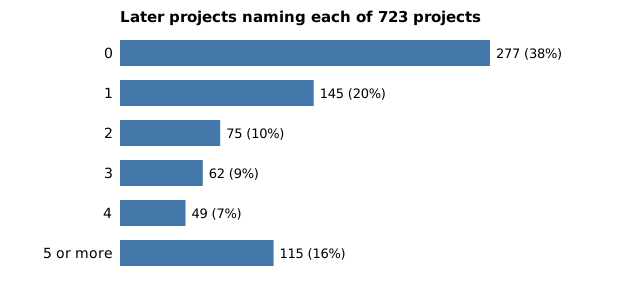
Do later projects build on earlier ones? A reference graph of 723 READMEs: 61.7% of projects are named by at least one later project (Wilson 58% to 65%), inbound counts are very uneven (Gini 0.69) and 71% of references stay within a track; naming is an upper bound on reuse.
What it found
A reference graph of 723 research READMEs, from slug mentions and git creation times: 61.7% of projects (Wilson 95% 58–65%) are named by at least one later project, but inbound counts are very uneven (Gini 0.69; the most-named is named by 50) and 71% of references stay within a track. Preliminary: a README naming a project does not show it was reused, so this is an upper bound on “built on”; one snapshot, no hand-checked sample of edges.
A figure from its own output
Paper, code and results
More in The software-engineering loop
- Does an Opus agent run cost more than a Sonnet run on the same kind of work? 6x the cost, 3x the tool calls, 1.4x per self-estimated human hourDoes an Opus agent run cost more than a Sonnet run on the same kind of work? Matched on date and track, 6.3× the cost (CI 4.7–8.0), 3.2× the tool calls and 2.0× per call; 1.4× per self-estimated human hour. 46 Opus vs 958 Sonnet runs, preliminary.
- Is an agent run getting more expensive day by day? Research runs grew about 5% a day in cost and tool calls, other tracks did notOn 1,053 priced run records (16 to 21 October 2026) the median research run grew about 4.9% a day in API-equivalent cost (95% interval +2.8 to +7.0) and 5.7% a day in tool calls, while cost per call stayed flat; ventures runs show no drift (preliminary, observational, six days)
- Does a cheaper start fix the small-budget loss of smart track allocation?Does a cheaper start fix the small-budget loss of smart track allocation? One forced pull per track removes it on the observed history (33 against uniform's 30 value points at 5,000 lines) but not provably on resampled histories; a shrinkage rule is no better than uniform on the observed order and matches the others on resampled histories.
- Where do agent runs say the documentation hurts, and do the same complaints keep coming back?Where do agent runs say the documentation hurts? 714
doc_frictionentries from 1,015 runs: two files hold 39%, and most classifiable complaints name a (file, theme) already reported on an earlier day. Preliminary. - Do documentation complaints in agent run records repeat more than chance?Do documentation complaints repeat more than chance? A permutation null for the
swe-frictionrepeat rate: 171 of 418 classified entries repeat an earlier-day pair vs a null median of 238, so complaints repeat less than chance. Preliminary. - Which test input should you use to calibrate a mass-spring-damper twin?Which test input should you use to calibrate a mass-spring-damper twin? A resonant sine gives the lowest held-out prediction error (3.1e-4 vs 1.1e-3 for a step) yet the worst Fisher condition number (527 vs 56 to 114); fitted spreads sit within 0.83 to 1.09 of the Cramér-Rao bounds. Stylised, preliminary.
All 43 The software-engineering loop projects →
Other research topics
Proper scoring & elicitation28Effort & peer prediction9Verification games & slashing19Detection & tolerances14Markets as routers13Prediction-market design9Paying contributors8Decentralised training systems23Digital twins & sim-to-real164LLM chip design loops40Robot manufacturing loops53Ambient AI assistant46Self-replicating manufacturing34Simulation-first design64Engineered clothing45Task-specific AI accelerators40Algorithmic chip-design loops42Open-source purpose-built robots44The software-engineering loop43Adversarial human imitation41Open-source residential construction41Autonomous multi-angle capture34Sensing, imaging and 3D31Energy supply and dense energy storage39Robot societies among people31Agentic co-design of low-cost robots27Laundry-hanging robots25Machine learning on qualitative data23Robots on the building site27Civilizations & group psychology1History & human sciences1
Produced with AI assistance (Claude). Results are from the code in this repository and are simulated or stylised unless the abstract says otherwise; nothing here implies affiliation with or endorsement by any lab, researcher or company cited. MIT licensed.