Does the peak stress at the fillet tangent point of the L-bracket converge under graded mesh refinement?
research/simdesign-gradedtip
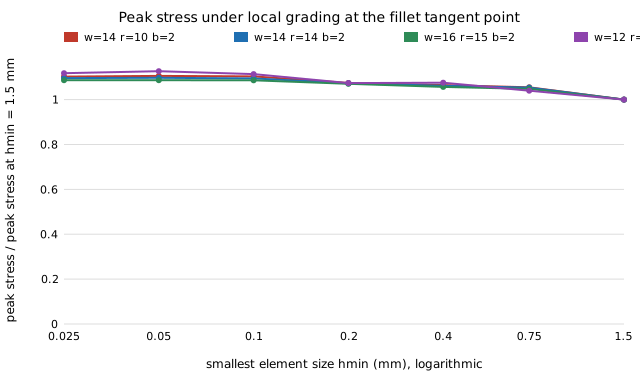
Does the L-bracket's peak stress at the fillet tangent point converge under graded mesh refinement? Yes for four designs: it flattens at 1.09–1.14× its 1.5 mm value (0.0–1.1% change over the last 4× refinement down to 0.025 mm), so the 2 mm region's mesh dependence is a resolution effect; the 16/15/2 design is marginally over 100 MPa when converged; stylised 2D, no reference solution.
What it found
Preliminary, stylised 2D plane stress. Uniform meshes left the element-centroid peak stress of the 2 mm laser-cut bracket still rising. Refining only around the fillet tangent point, down to 0.025 mm elements, the peak of four designs flattens at 1.09–1.14× its 1.5 mm value (0.0–1.1% change over the last 4× refinement), so it has a finite limit and the earlier mesh dependence was a resolution effect. The converged plateau shifts about 2% with the grading rate; the 16/15/2 design sits marginally above the 100 MPa limit (101.9 MPa). No independent reference solution was compared; nothing was optimised.
A figure from its own output
Paper, code and results
More in Simulation-first design
- Is the least-mass laser-cut bracket the same on coarse and fine meshes under a patch-averaged stress rule?Under a 3 mm patch-averaged stress rule the least-mass laser-cut bracket is the same on a 2.5 mm and a 1.0 mm mesh (gauge 2: 32.31 vs 32.33 g), while the centroid-peak rule leaves no feasible gauge-2 design on the fine mesh; the patch value hardly sees the fillet radius; stylised, preliminary.
- Do cheap beam and 2D models rank candidate cantilever designs like 3D finite elements?Do cheap beam and 2D models rank cantilever designs like 3D finite elements? Yes on 3 seeds of 80 designs: Kendall τ 0.987–0.996 and the 3D-best design always ranked first, even though single-design merit is off by up to 14%; stubby sections agree least; stylised, one load case.
- Can a parametric L-bracket be sized by finite elements for minimum mass and come out printable?Parametric L-bracket sized by 2D finite elements (scikit-fem) for minimum mass under a stress limit: differential evolution 19.6 g vs random 25.6 g vs grid 31.4 g at equal budget, exported as STL with a printability check. Assumed material inputs. Stylised.
- Does greedy substitution search still work when the printer-redesign list grows past seven items?Does greedy substitution search still work past seven items (synthetic instances, assumed generator): 96–100% of the exact optimum on average but optimal in only 33–95 of 100 instances; 64 random evaluations fall to about 89% at 24 items.
- Does an aluminium rod change which printer redesign the penalty-budget search picks?With an aluminium rod option priced by sag, the penalty-budget search of the printer redesign picks the 12 mm aluminium rod and reaches 40.0% mass closure at budget 2.0 against 33.1% with the wooden rod (41.4% against 35.8% at full budget); the penalty curve is assumed and the metric favours heavy stock; stylised, preliminary.
- Does the best printer redesign change when imported bar stock counts as an import, not as made?Scoring the printer redesign by the mass the shop must still import (vitamins plus raw stock) instead of closure: the best design imports 5.85 kg against 6.72 kg for the baseline, while the closure-maximising 12 mm aluminium pick imports 6.79 kg (stylised; yield and prices assumed).
All 64 Simulation-first design projects →
Other research topics
Proper scoring & elicitation28Effort & peer prediction9Verification games & slashing19Detection & tolerances14Markets as routers13Prediction-market design9Paying contributors8Decentralised training systems23Digital twins & sim-to-real164LLM chip design loops40Robot manufacturing loops53Ambient AI assistant46Self-replicating manufacturing34Simulation-first design64Engineered clothing45Task-specific AI accelerators40Algorithmic chip-design loops42Open-source purpose-built robots44The software-engineering loop43Adversarial human imitation41Open-source residential construction41Autonomous multi-angle capture34Sensing, imaging and 3D31Energy supply and dense energy storage39Robot societies among people31Agentic co-design of low-cost robots27Laundry-hanging robots25Machine learning on qualitative data23Robots on the building site27Civilizations & group psychology1History & human sciences1
Produced with AI assistance (Claude). Results are from the code in this repository and are simulated or stylised unless the abstract says otherwise; nothing here implies affiliation with or endorsement by any lab, researcher or company cited. MIT licensed.