How short can SIMP penalty continuation be and still remove the dependence on the starting density field?
research/simdesign-contlength
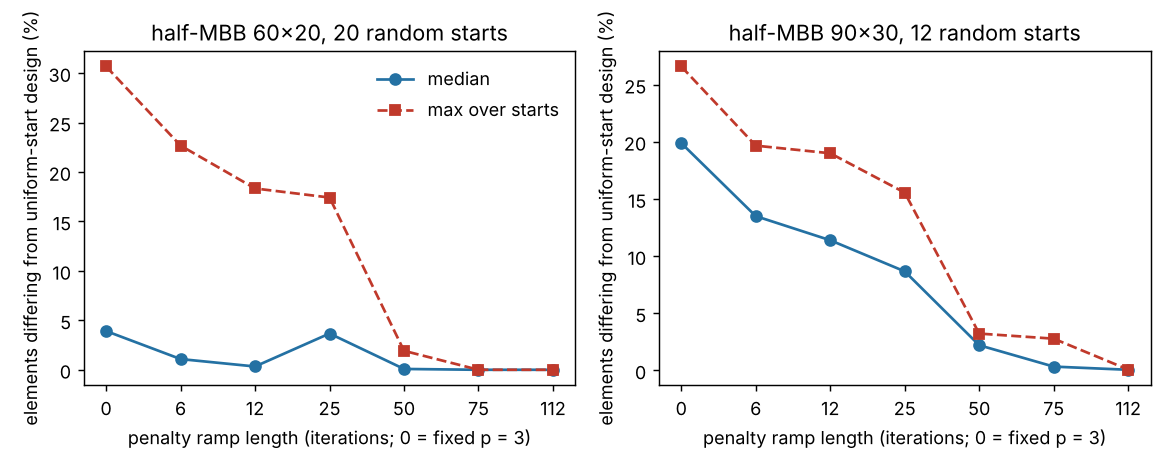
How short can SIMP penalty continuation be and still remove the start dependence? A ramp of 25 iterations or fewer leaves much of it (worst start differs in 16–23% of elements, 27–31% for a fixed penalty); 50 iterations cuts compliance spread to 0.01–0.23%, and a 112-iteration ramp is most repeatable but ends at a worse compliance (stylised, 2D, 150 iterations).
What it found
Follow-up to simdesign-starts. Half-MBB, volume 0.5, final p = 3, exactly 150 OC iterations, random starts (noise ±0.3; 20 on 60×20, 12 on 90×30), with the penalty ramped 1 → 3 over 0, 6, 12, 25, 50, 75 or 112 iterations. Ramps of 25 iterations or fewer leave most of the start dependence of a fixed penalty (worst start differs from the uniform-start design in 31% and 27% of elements on the two meshes): for ramps of 6–25 it is still 17–23% (60×20) and 16–20% (90×30), and compliance spreads 0.5–1.3%. At 50 iterations the spread falls to 0.01% (60×20) and 0.23% (90×30); at 75 the median disagreement is 0.0–0.3%. A 112-iteration ramp is the most repeatable but gives a worse final compliance (203.55 against 203.08 on 60×20; 197.3 against 196.6 on 90×30), because few iterations remain at full penalty. Stylised: 2D, one problem, two meshes, 150 iterations, not run to convergence.
A figure from its own output
Paper, code and results
More in Simulation-first design
- When does a cheaper beam model pick the same design as 3D finite elements?Cantilever sizing with Euler–Bernoulli, Timoshenko, 2D and 3D finite elements: stress agrees everywhere, deflection differs; cheap models land within ~5% of the 3D depth, unsafe when narrow and stubby (Euler–Bernoulli) and oversized when wide (plane stress). Stylised, assumed material.
- How do design proposals from a language-model agent compare with CMA-ES, Bayesian optimisation and random search at an equal simulation budget?Session-agent design proposals vs CMA-ES, Bayesian optimisation and random search on a bracket sized by finite elements, 40 evaluations each: agent 23.0 g vs 32–39 g baseline medians (best known 22.4 g); the agent had prior knowledge, n = 1, not an LLM benchmark. Stylised.
- What do manufacturing rules cost a sized bracket on FDM, CNC routing, laser cutting and casting?Manufacturability rules (FDM, CNC routing, laser cutting, sand casting) added to the sized L-bracket: the mass price of each rule set against the same material with no rules (casting +43% from its even-section rule, CNC +24% from plate stock, laser and FDM ~0); designs overshoot the stress limit by 17–26% on a fine mesh (stylised, assumed rule values).
- How much does a bolt hole cost a tension plate, and which rule sets its width?Tension plate with a required bolt hole sized under net-section, Kt = 3 and finite-element stress models and per-process hole rules (stylised).
- Does weighting parts by mass change which shop process, and which machine, matters?Does weighting parts by mass change which shop process, and which machine, matters? With a tip load FDM covers 0.30 of parts by count and 0.58 by mass, the laser-versus-CNC order flips, and at budgets 600–800 exhaustive search picks the laser cutter by count but the casting setup by mass (one seed). Stylised, assumed rules and prices, simulated only.
- Do the mass-weighting machine-choice flips of simdesign-coverweight survive across seeds?Do the mass-weighting machine-choice flips of
simdesign-coverweightsurvive across seeds? Over 20 seeds,logflips from the laser cutter (count) to the casting setup (mass) in 20/20 at budgets 600–800,largeonly at 800,smallnever; the 1100–1400 flips are near-ties (≤0.26 points). Stylised, assumed rules and prices, simulated only.
All 64 Simulation-first design projects →
Other research topics
Proper scoring & elicitation28Effort & peer prediction9Verification games & slashing19Detection & tolerances14Markets as routers13Prediction-market design9Paying contributors8Decentralised training systems23Digital twins & sim-to-real164LLM chip design loops40Robot manufacturing loops53Ambient AI assistant46Self-replicating manufacturing34Simulation-first design64Engineered clothing45Task-specific AI accelerators40Algorithmic chip-design loops42Open-source purpose-built robots44The software-engineering loop43Adversarial human imitation41Open-source residential construction41Autonomous multi-angle capture34Sensing, imaging and 3D31Energy supply and dense energy storage39Robot societies among people31Agentic co-design of low-cost robots27Laundry-hanging robots25Machine learning on qualitative data23Robots on the building site27Civilizations & group psychology1History & human sciences1
Produced with AI assistance (Claude). Results are from the code in this repository and are simulated or stylised unless the abstract says otherwise; nothing here implies affiliation with or endorsement by any lab, researcher or company cited. MIT licensed.