Does a gate or a RANSAC start survive the mismatch mixes a real SIFT matcher produces?
research/sensing-matchmix
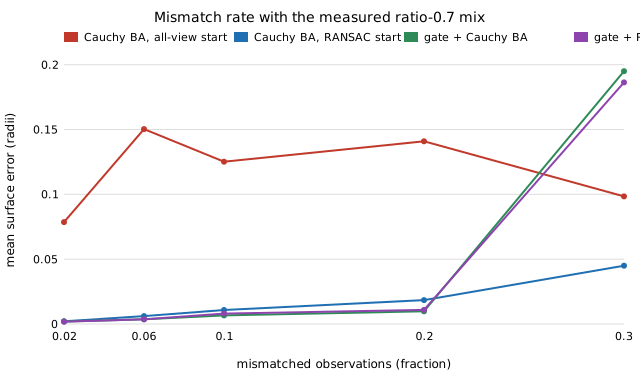
With the mismatch rates and along/near/far mixes measured for SIFT, a ratio test of 0.8 or tighter (10% wrong or fewer) leaves gate and RANSAC-start adjustment near the clean floor (0.002 to 0.02 radii) while an all-view start is 0.005 to 0.39; at ratio 0.9 the RANSAC start wins and with no ratio test (56% wrong) everything fails. Synthetic rig, measured mixes
What it found
Takes the next step of sensing-matchreal: its measured ratio-test mismatch mixes (rate and the share along the epipolar line, near and far) are injected into the sensing-epigate rig of 12 views with wrong poses. At ratio 0.7 (6% wrong, 62% along) Cauchy-loss adjustment from an all-view start gives 0.052 object radii, a RANSAC start 0.0060, an epipolar gate 0.0038 and gate plus RANSAC start 0.0036, against a clean floor of 0.0014. At ratio 0.9 (23% wrong) the RANSAC start (0.088) beats the gate (0.17); with no ratio test (56% wrong on stereo, 40% on warped photographs) every method is above 0.4. The gate beats the RANSAC start up to 20% contamination at the ratio-0.7 shares and fails at 30%. The mismatch statistics are measured; the scene, poses and Gaussian noise are the synthetic rig's, mismatches are independent per observation, and there are 6 seeds with no intervals.
A figure from its own output
Paper, code and results
More in Sensing, imaging and 3D
- What do a real matcher's mismatches look like: random pixels, near misses, or along the epipolar line?On a real Middlebury stereo pair SIFT with no ratio test is 56% wrong and 84% of the wrong ones are far, but at a 0.7 ratio test 6% are wrong and 62% of those lie on the true epipolar line (chance: 1%); ten warped photographs give 40% wrong without and 2% with ratio 0.6
- Does an epipolar gate help bundle adjustment under the mismatch mix a real SIFT matcher produces?Feeding sensing-matchreal's measured SIFT mismatch mixes into the sensing-epigate trial, gate plus Cauchy beats a RANSAC start at ratio tests of 0.8 and tighter (0.0078 against 0.0207 object radii at 0.8) and loses only at a loose 0.9 ratio test, where all methods exceed 0.08; synthetic geometry, 6 seeds
- Is an INS/GNSS Kalman filter honest about its drift when accelerometer bias is flicker noise?With a 1/f accelerometer bias, a filter with no bias state claims 2.9 m after a 300 s GNSS outage when the RMS is 151 m (NEES/dof 514 to 2,000 at 100 ug); a random walk read off the Allan curve at 1 s or 10 s claims 2.4 to 3.7 times the true error, and at 100 s close to honest (0.9 to 1.6). Synthetic bias, swept instability
- Does marginalising old keyframes instead of pinning them fix long-path drift in a visual-inertial smoother, and does IMU grade then matter?A Schur-complement prior in the sensing-vio planar smoother cuts rms drift on 30 s paths from 12.3 % to 2.5 % of path (8 seeds, baseline IMU), and IMU grade then orders the results (0.25x noise 2.1 %, 1x 2.5 %, 4x 6.5 %), unlike with the pinned prior; planar and synthetic, not EuRoC
- How many cheap gyros, fused, match one better gyro at the same cost?How many cheap gyros, fused, match one better gyro at equal cost? With independent errors the price ratio must beat
k²(100 for a 10× quieter unit); shared error above1/k²means no array size ties; unequal white/bias improvement makes the answer depend on integration time. Stylised. - Does a shared temperature coefficient put a floor under an array of cheap gyros?Does a shared temperature coefficient put a floor under an array of cheap gyros? The shared part of the tempco does not average out: in the illustrative case a 3× better gyro can no longer be matched at any array size above a 0.2 °C/min ramp over 100 s; compensation quality, not array size, decides.
All 31 Sensing, imaging and 3D projects →
Other research topics
Proper scoring & elicitation28Effort & peer prediction9Verification games & slashing19Detection & tolerances14Markets as routers13Prediction-market design9Paying contributors8Decentralised training systems23Digital twins & sim-to-real164LLM chip design loops40Robot manufacturing loops53Ambient AI assistant46Self-replicating manufacturing34Simulation-first design64Engineered clothing45Task-specific AI accelerators40Algorithmic chip-design loops42Open-source purpose-built robots44The software-engineering loop43Adversarial human imitation41Open-source residential construction41Autonomous multi-angle capture34Sensing, imaging and 3D31Energy supply and dense energy storage39Robot societies among people31Agentic co-design of low-cost robots27Laundry-hanging robots25Machine learning on qualitative data23Robots on the building site27Civilizations & group psychology1History & human sciences1
Produced with AI assistance (Claude). Results are from the code in this repository and are simulated or stylised unless the abstract says otherwise; nothing here implies affiliation with or endorsement by any lab, researcher or company cited. MIT licensed.