Does a shared temperature coefficient put a floor under an array of cheap gyros?
research/sensing-imutemp
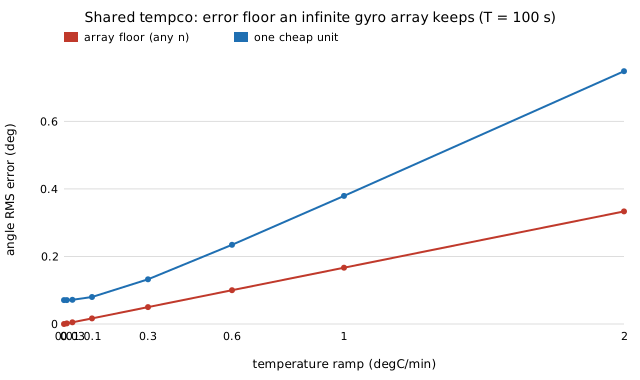
Does a shared temperature coefficient put a floor under an array of cheap gyros? The shared part of the tempco does not average out: in the illustrative case a 3× better gyro can no longer be matched at any array size above a 0.2 °C/min ramp over 100 s; compensation quality, not array size, decides.
What it found
Follow-up to sensing-imuarray. Each gyro has a temperature coefficient ci = μ + s·ei; under a temperature ramp the shared mean μ leaves an angle-error floor μrT2/2 that no array size removes. In the illustrative case (100 s) a 3× better unit can be matched at 10–15 units up to 0.1 °C/min but at no size from 0.3 °C/min; a 10× better one at none from 0.1 °C/min. Compensating both grades equally brings the array size back near k2 only at about 2% residual tempco. Monte Carlo matches the closed form within 1%. Stylised: assumed tempcos, no real IMU data, no prices claimed.
A figure from its own output
Paper, code and results
More in Sensing, imaging and 3D
- How many frames from a small sensor, merged, match one frame from a bigger one?How many frames from a small sensor, merged, match one frame from a sensor with A× the pixel area? A shot-noise-limited burst needs A frames, a read-noise-limited one up to A² (formula and simulation agree); splitting the same total exposure never ties; registration blur and bracketed HDR are measured. Synthetic scenes only.
- What does a moving subject do to a burst merge, and what does robust merging cost?What does a moving subject do to a burst merge? A plain mean ghosts at every speed and gets worse as frames are added (30.5 dB at 8 frames, 25.0 at 48), median and sigma-clip do no better for a slow subject, and a reference-guided merge keeps improving and ties a 4×-area frame at about 6 frames at 0.1 dB cost when nothing moves. Synthetic scenes only.
- Can aligning a moving subject, instead of rejecting it, rescue a burst merge?Can aligning a moving subject rescue a burst merge instead of rejecting it? Inside the subject, yes (37.0 dB against 31.5 for reject-only and 32.8 for a 4×-area frame at 8 frames), but over the whole image rejecting is as good or better (31.7 against 31.8 dB), the aligner moves 10–31% of static pixels on noise, and the revealed-background ring stays 4 dB short of the large frame. Synthetic scenes only.
- Can a burst of hand-shaken low-resolution frames recover detail that merging and upsampling cannot?Can a burst of hand-shaken low-resolution frames recover detail that merging and upsampling cannot? At 2× in bright light a least-squares reconstruction reaches 29.5 dB at 16 frames against 24.0 for merge-and-upsample and 26.6 for merge-and-deblur, so 2.9 dB is sub-pixel information; it nearly vanishes in dim light and falls to nothing at about 0.27 px of shift error. Synthetic scenes only.
- How many milliseconds of camera-to-gyro time offset double a fused attitude error, and can online calibration recover it?How many milliseconds of camera-to-gyro time offset double a fused attitude error, and can an alignment fit recover it? About 12–14 ms at 30 deg/s motion; the fit recovers it to ~1 ms with motion and fails on a still platform. Synthetic, single axis.
- How much motion does a camera-to-gyro offset fit need, and what does clock skew do to a one-off calibration?How much motion does a camera-to-gyro offset fit need, and what does clock skew do to a one-off calibration? A 20 ms offset needs about 16 deg/s rms motion to fit reliably; 1000 ppm skew leaves 0.254 deg error after a fixed-offset fit against 0.155 deg when skew is fitted too. Stylised, synthetic.
All 31 Sensing, imaging and 3D projects →
Other research topics
Proper scoring & elicitation28Effort & peer prediction9Verification games & slashing19Detection & tolerances14Markets as routers13Prediction-market design9Paying contributors8Decentralised training systems23Digital twins & sim-to-real164LLM chip design loops40Robot manufacturing loops53Ambient AI assistant46Self-replicating manufacturing34Simulation-first design64Engineered clothing45Task-specific AI accelerators40Algorithmic chip-design loops42Open-source purpose-built robots44The software-engineering loop43Adversarial human imitation41Open-source residential construction41Autonomous multi-angle capture34Sensing, imaging and 3D31Energy supply and dense energy storage39Robot societies among people31Agentic co-design of low-cost robots27Laundry-hanging robots25Machine learning on qualitative data23Robots on the building site27Civilizations & group psychology1History & human sciences1
Produced with AI assistance (Claude). Results are from the code in this repository and are simulated or stylised unless the abstract says otherwise; nothing here implies affiliation with or endorsement by any lab, researcher or company cited. MIT licensed.