Does a fundamental-matrix gate on the matches, fitted from the matches alone, let bundle adjustment survive mismatches?
research/sensing-epigate
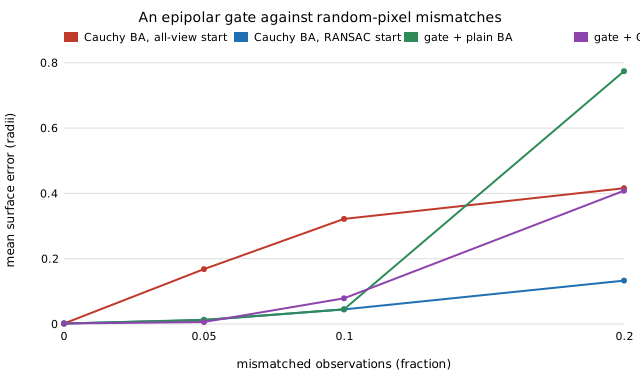
An epipolar gate removes 93% of 10% random-pixel mismatches (5% of good observations lost) and takes 5% contamination from 0.168 to 0.0061 object radii, but a RANSAC start does as well at 10% and better at 20%; near-miss mismatches are mild for a robust loss already. Synthetic only
What it found
Follows sensing-baoutlier with the geometric verification it left out. For each pair of nearby views a fundamental matrix is fitted by RANSAC from the matches alone (normalised 8-point, Sampson distance under 2 px, no use of the wrong poses) and an observation is kept if half its pairs accept it. On the 12-view rig it removes 94%, 93% and 89% of random-pixel mismatches at 5%, 10% and 20% while losing 2%, 5% and 16% of good observations; at 5% Cauchy adjustment improves from 0.168 to 0.0061 object radii (floor 0.0015). It is no better than the RANSAC pair start: equal at 10% (0.045) and worse at 20% (0.41 to 0.77 against 0.13). Near-miss (10 to 40 px) and along-epipolar-line mismatches are removed at 79–87% and are mild for a robust loss anyway (0.005 at 10%). Limits: synthetic, my own mismatch models, 6 seeds, untuned gate settings, scoring set differs from sensing-baoutlier.
A figure from its own output
Paper, code and results
More in Sensing, imaging and 3D
- Does the epipolar gate survive mismatches that repeat across views?When a bad feature is wrong by the same offset in more consecutive views, the gate's recall falls from 0.81 to 0.59 at a 10% wrong rate and its lead over a RANSAC start shrinks from 1.7x to a tie within seed noise, though typical errors stay at 2 to 3.5 times the clean floor; a single failed seed in 12 can dominate a mean
- Does the epipolar gate still help when mismatches have the mix and rate a real SIFT matcher produces?With the mismatch rates and mixes measured from SIFT on a real stereo pair, a ratio test of 0.8 to 0.6 (10% to 5% wrong) leaves gate + Cauchy adjustment at 0.008 to 0.003 object radii against 0.013 to 0.004 for the RANSAC start, and the all-random-pixel assumption overstated plain Cauchy's error 1.3 to 59 times; with no ratio test (56% wrong) every method fails
- Does modelling the sub-pixel coverage of a moving subject fix the edge ring that burst merging leaves behind?Does modelling the sub-pixel coverage of a moving subject fix the edge ring? Yes, on a known shape: a layered disc-over-background model fitted from the burst lifts the ring from 27.1 to 33.1 dB at 8 frames and 2 px per frame (4×-area frame: 31.7 dB), less at slow speeds, and it is sensitive to a 0.5 px centre error. Synthetic flat disc only.
- Can a background estimate or a subject mask fix the edge ring that burst alignment leaves behind?Can a temporal-median background or a subject mask fix the edge ring that burst alignment leaves behind? No: four ring treatments leave it at 21.6–27.2 dB at 8 frames against 31.6–32.0 for a 4×-area frame, none beats plain aligned-plus-reject (27.0 dB), and the mask misses most of a slow subject. Synthetic scenes only.
- How accurately does a real keypoint detector localise features as images get noisier and blurrier?On 30 warped real photographs SIFT keypoints localise to 0.13 px per axis at zero noise and 0.32 px at noise sigma 10 grey levels, 0.59 px at 40, so sensing-ba's assumed 0.5 px sits at roughly sigma 28; large keypoints are worse, blur matters little
- Does a gate or a RANSAC start survive the mismatch mixes a real SIFT matcher produces?With the mismatch rates and along/near/far mixes measured for SIFT, a ratio test of 0.8 or tighter (10% wrong or fewer) leaves gate and RANSAC-start adjustment near the clean floor (0.002 to 0.02 radii) while an all-view start is 0.005 to 0.39; at ratio 0.9 the RANSAC start wins and with no ratio test (56% wrong) everything fails. Synthetic rig, measured mixes
All 31 Sensing, imaging and 3D projects →
Other research topics
Proper scoring & elicitation28Effort & peer prediction9Verification games & slashing19Detection & tolerances14Markets as routers13Prediction-market design9Paying contributors8Decentralised training systems23Digital twins & sim-to-real164LLM chip design loops40Robot manufacturing loops53Ambient AI assistant46Self-replicating manufacturing34Simulation-first design64Engineered clothing45Task-specific AI accelerators40Algorithmic chip-design loops42Open-source purpose-built robots44The software-engineering loop43Adversarial human imitation41Open-source residential construction41Autonomous multi-angle capture34Sensing, imaging and 3D31Energy supply and dense energy storage39Robot societies among people31Agentic co-design of low-cost robots27Laundry-hanging robots25Machine learning on qualitative data23Robots on the building site27Civilizations & group psychology1History & human sciences1
Produced with AI assistance (Claude). Results are from the code in this repository and are simulated or stylised unless the abstract says otherwise; nothing here implies affiliation with or endorsement by any lab, researcher or company cited. MIT licensed.