How big a sensor can a K-frame burst of a small sensor stand in for?
research/sensing-burstcap
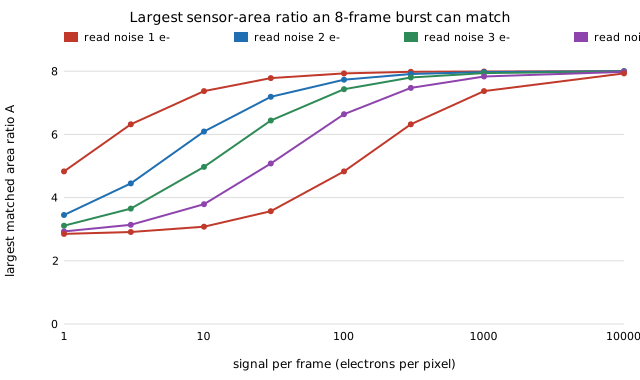
Inverting the burst break-even formula: the largest sensor-area ratio a K-frame burst matches runs from √K in the dark to K in bright light, so 8 frames at 3 e⁻ read noise match a 4×-area frame from 4.5 e⁻ per pixel per frame, a 6× frame from 21 e⁻ and never an 8× frame; Monte Carlo agrees to 1% in variance at 18 settings. Model only, swept ranges not sourced to a device
What it found
sensing-burst gave the break-even frame count N* = A2(e + r2)/(A e + r2) for a burst to match one frame from a sensor with A times the pixel area. This project solves it for A: the largest matched ratio is the positive root of (e + r2)A2 − K e A − K r2 = 0, between √K (read-noise limited) and K (shot-noise limited). Swept over 1 to 10,000 electrons per frame, read noise 1 to 10 electrons and K = 4, 8, 15: with 8 frames and 3 e− read noise a burst matches a 4× frame from 4.5 e− per pixel per frame and a 6× frame from 21 e−, and never an 8× frame; 15 frames match 12× from 3.6 e− (r = 1) to 358 e− (r = 10). A Monte Carlo of the Poisson-Gaussian model gives a variance ratio of 0.990 to 1.009 at 18 settings. Limits: it is the same model as sensing-burst (perfect registration, static scene, no clipping, dark current or fixed-pattern noise); the electron and read-noise ranges are swept, not taken from any device, because the one public sensor-data site found is all rights reserved.
A figure from its own output
Paper, code and results
More in Sensing, imaging and 3D
- How many checkerboard photos does OpenCV camera calibration need before the focal length stops moving?On OpenCV's 13 real checkerboard photos, random subsets of 3 views put the focal length within 2% of the 13-view value in 99% of draws (5–95% band 2.3% wide), 12 views give 0.5%; noise-only re-renders predict the band, and a one-term lens model doubles held-out error. One camera, one board
- Does a fundamental-matrix gate on the matches, fitted from the matches alone, let bundle adjustment survive mismatches?An epipolar gate removes 93% of 10% random-pixel mismatches (5% of good observations lost) and takes 5% contamination from 0.168 to 0.0061 object radii, but a RANSAC start does as well at 10% and better at 20%; near-miss mismatches are mild for a robust loss already. Synthetic only
- Does the epipolar gate survive mismatches that repeat across views?When a bad feature is wrong by the same offset in more consecutive views, the gate's recall falls from 0.81 to 0.59 at a 10% wrong rate and its lead over a RANSAC start shrinks from 1.7x to a tie within seed noise, though typical errors stay at 2 to 3.5 times the clean floor; a single failed seed in 12 can dominate a mean
- Does the epipolar gate still help when mismatches have the mix and rate a real SIFT matcher produces?With the mismatch rates and mixes measured from SIFT on a real stereo pair, a ratio test of 0.8 to 0.6 (10% to 5% wrong) leaves gate + Cauchy adjustment at 0.008 to 0.003 object radii against 0.013 to 0.004 for the RANSAC start, and the all-random-pixel assumption overstated plain Cauchy's error 1.3 to 59 times; with no ratio test (56% wrong) every method fails
- Does modelling the sub-pixel coverage of a moving subject fix the edge ring that burst merging leaves behind?Does modelling the sub-pixel coverage of a moving subject fix the edge ring? Yes, on a known shape: a layered disc-over-background model fitted from the burst lifts the ring from 27.1 to 33.1 dB at 8 frames and 2 px per frame (4×-area frame: 31.7 dB), less at slow speeds, and it is sensitive to a 0.5 px centre error. Synthetic flat disc only.
- Can a background estimate or a subject mask fix the edge ring that burst alignment leaves behind?Can a temporal-median background or a subject mask fix the edge ring that burst alignment leaves behind? No: four ring treatments leave it at 21.6–27.2 dB at 8 frames against 31.6–32.0 for a 4×-area frame, none beats plain aligned-plus-reject (27.0 dB), and the mask misses most of a slow subject. Synthetic scenes only.
All 31 Sensing, imaging and 3D projects →
Other research topics
Proper scoring & elicitation28Effort & peer prediction9Verification games & slashing19Detection & tolerances14Markets as routers13Prediction-market design9Paying contributors8Decentralised training systems23Digital twins & sim-to-real164LLM chip design loops40Robot manufacturing loops53Ambient AI assistant46Self-replicating manufacturing34Simulation-first design64Engineered clothing45Task-specific AI accelerators40Algorithmic chip-design loops42Open-source purpose-built robots44The software-engineering loop43Adversarial human imitation41Open-source residential construction41Autonomous multi-angle capture34Sensing, imaging and 3D31Energy supply and dense energy storage39Robot societies among people31Agentic co-design of low-cost robots27Laundry-hanging robots25Machine learning on qualitative data23Robots on the building site27Civilizations & group psychology1History & human sciences1
Produced with AI assistance (Claude). Results are from the code in this repository and are simulated or stylised unless the abstract says otherwise; nothing here implies affiliation with or endorsement by any lab, researcher or company cited. MIT licensed.