A zero-wind twin of a UAV out-and-back leg: does a tailwind repay the headwind, and what does a twin calibrated on one leg say about the return?
research/roundtrip-twin
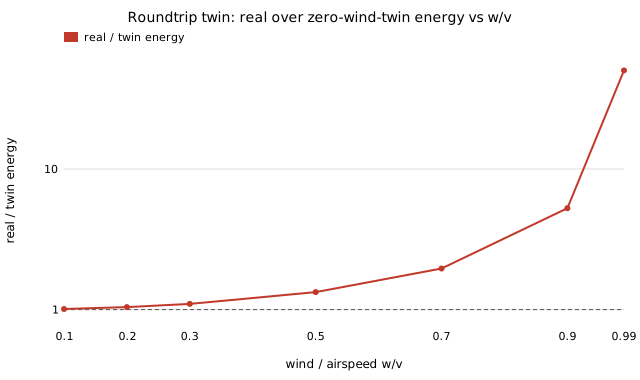
Zero-wind twin of a UAV out-and-back leg: wind does not cancel (real/twin energy 1/(1−(w/v)²)), the best airspeed moves to v²=w²+√(w⁴+1), and a one-leg-calibrated twin is off by exactly ±w/v with the sign of the leg flown.
What it found
Real round-trip energy is (v4+1)/(v2−w2), so wind does not cancel: real/twin is exactly 1/(1−(w/v)2), 1.33× at w/v=0.5 and 5.3× at 0.9, the same for either sign, with no return at |w|≥v. The twin-optimal airspeed is 1 for every wind while the real optimum solves v2=w2+√(w4+1), so flying the twin's optimum costs 1.5%, 9.8%, 52% extra at w=0.4, 0.6, 0.8. A twin calibrated on one leg and assumed to see the same wind back is off by exactly +w/v (headwind leg) or −w/v (tailwind leg): ±33% at w=0.5, v=1.5, with a sign set by which leg was flown. Stylised: steady along-track wind, constant airspeed, two-term power law.
A figure from its own output
Paper, code and results
More in Digital twins & sim-to-real
- A constant-gain twin of a motor holding a load certifies every load: what does thermal derating do to the real hold?A constant-gain twin of a motor holding a load certifies every load: magnet derating makes holding a positive thermal feedback with a fold at
λ=4/27(real temperature 1.33–2.25× the twin's near it, no hold above it, runaway in≈4π/(9√ε)thermal time constants), short tests cannot see it, the twin overstates holdable torque 1.1–1.6×, and refitting a constant gain does not remove the fold. - What does a twin whose sensor reads at any distance get wrong about a loop with a range-limited lidar or radar?A twin whose sensor reads at any distance vs a range-limited one: exact step-count law (49 vs 4021 steps from 1000R), PI overshoot neither bound nor lower bound (4.1× at 1000R), exact scale invariance, and the gain fitted from logs of a given extent.
- One long twin run or many replications when every run starts in the wrong state?One long twin run or many replications under a start-up transient: exact AR(1) MSE and t-interval coverage (single run minimises MSE; replication costs 1.07×–2.2×; 92% coverage at MSE-optimal deletion for short replications), batch means not worse, preliminary M/M/1 coverage 6–84%.
- How biased is a short digital-twin run that starts from a default state?Cold-start bias of short twin runs: exact AR(1) bias/variance/warm-up deletion, M/M/1 empty-start bias constant
ρ/(1−ρ)³, negligible at valid-interval lengths but −5.6 of 9 at 50 jobs; MSER-5 did not help. - How many designs should a digital twin shortlist for real-plant verification?Shortlisting K designs in a twin and verifying the top m on the real plant under a fixed trial budget: twin-only value exactly
ρc_K, best m falls from 8 to 2 as ρ rises 0.6→0.95 (K=50, B=20), and a useless twin still gains 0.12 from budget concentration alone. Stylised. - How far should a real-plant estimate be pulled toward its digital twin?Pulling a real-plant parameter estimate toward its twin (James–Stein): exact risk
d−(d−2)²E[1/(d−2+2K)], never worse in total for d≥3, perfect twin risk 2 at any d, worthn+σ²/τ²real samples at large d, but one mismatched parameter takes ≈d/4noise variances (25.5 at d=100) unless shrinkage is blockwise (1.65 at blocks of 5, d=30).
All 164 Digital twins & sim-to-real projects →
Other research topics
Proper scoring & elicitation28Effort & peer prediction9Verification games & slashing19Detection & tolerances14Markets as routers13Prediction-market design9Paying contributors8Decentralised training systems23Digital twins & sim-to-real164LLM chip design loops40Robot manufacturing loops53Ambient AI assistant46Self-replicating manufacturing34Simulation-first design64Engineered clothing45Task-specific AI accelerators40Algorithmic chip-design loops42Open-source purpose-built robots44The software-engineering loop43Adversarial human imitation41Open-source residential construction41Autonomous multi-angle capture34Sensing, imaging and 3D31Energy supply and dense energy storage39Robot societies among people31Agentic co-design of low-cost robots27Laundry-hanging robots25Machine learning on qualitative data23Robots on the building site27Civilizations & group psychology1History & human sciences1
Produced with AI assistance (Claude). Results are from the code in this repository and are simulated or stylised unless the abstract says otherwise; nothing here implies affiliation with or endorsement by any lab, researcher or company cited. MIT licensed.