Does the loose 20 mm/s “holds” threshold stay settings-robust at other friction and under lift?
research/robofab-slipmu
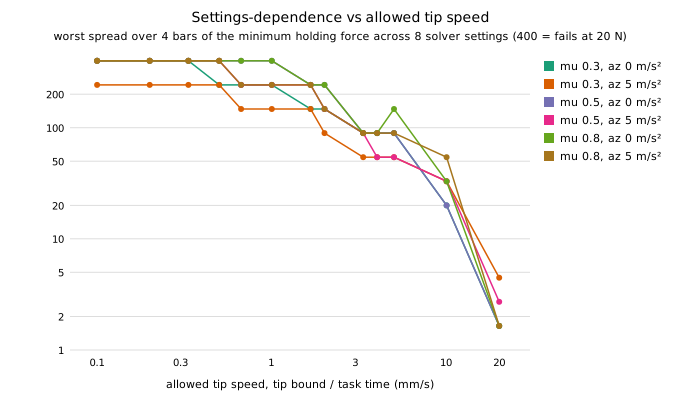
Does the loose 20 mm/s "holds" threshold stay settings-robust at other friction and under lift? It is the only threshold under 5x spread in all six conditions (1.6 to 4.5), every other is at least 20x (stylised, preliminary).
What it found
A follow-up to robofab-slipthresh, repeating its 16-threshold sweep at friction 0.3, 0.5 and 0.8, with and without a 5 m/s2 lift acceleration. The loose 20 mm/s threshold (10 mm in 0.5 s) is the only one with a worst-case spread of the minimum holding force under 5× in all six conditions: 1.6× in four, 2.7× at mu 0.5 with lift and 4.5× at mu 0.3 with lift. Every other threshold is at least 20×. Robustness comes from looseness, and it weakens at low friction under load. Stylised, one engine, no physical grip.
A figure from its own output
Paper, code and results
More in Robot manufacturing loops
- Does a stiffer friction cone make the held-bar result in robofab-liftload threshold-free?Does a stiffer friction cone make the held-bar result threshold-free? Creep falls about as 1/
impratio(3.66 to 0.004 deg/s); fromimpratio10 the 1 and 5 degree forces agree within 26%, and MuJoCo needs 0.67 to 1.17 times the old torque bracket's lower bound (stylised). - How much clearance does a printed two-pin cover need to assemble, and how wasteful is worst-case stacking?How much clearance does a printed two-pin cover need to assemble, and how wasteful is worst-case stacking? At position sd 0.10 mm and size sd 0.05 mm, 99% yield needs 0.62 mm diametral clearance and a ±3σ worst-case stack asks for 2.0 mm (stylised, assumed process spreads).
- When does the textbook milling chatter chart mislead?Zero-order milling stability lobes against semi-discretisation and time-domain simulation for a one-mode tool: exact at slotting, but at 10% up-milling the limit is up to 3.3 times too high at some speeds, and in down-milling the zero-order chart predicts no chatter while the tool goes unstable below 0.9 mm; the best spindle speed raises removal rate 5 to 18 times.
- How far below a clairvoyant schedule is online pick dispatch in a robotic waste-sorting cell?Follow-up to infra-sortvalue: an exact dynamic-programming bound on the best possible pick schedule (agreeable deadlines make arrival order optimal) shows highest-value-first dispatch reaches 96.5% of the clairvoyant optimum at 6 items/m and 93.9% at 10, FIFO 94.7% and 89.6%, and that the largest headroom (about 10 to 11%) sits at faster belts and slower arms, not at the loads where pick order helped most. A rolling-horizon rule that re-solves the schedule with a 1 s look ahead recovers most of it: 99.7% of the optimum at 6 items/m and 98.0% in the hardest cells.
- How fast can a belt run before a robot pick cell stops recovering recyclables?Single-robot conveyor pick cell fed with the class mix and object sizes of the 4,784 TACO litter annotations: with a 1 s pick and 1 m of reach, recovery of bottles and cans holds near 0.65 up to 0.5 m/s, falls to 0.48 at 1.0 m/s and is zero from 1.5 m/s (reach/pick-time is a hard limit); detector size threshold and false-call rate move purity and recovery more than the pick-order policy, which changes nothing.
- Does pick order matter for a robotic waste-sorting cell once items differ in value and arm travel?Follow-up to infra-sorting: with TACO's class mix, assumed item values (drink can = 4 plastic bottles) and 0.5 to 1.5 s of arm travel, picking the highest-value item first beats FIFO by only 0.1% at 1 item/m, 2.0% at 6/m and 4.8% at 10/m, and value-per-second picking matches it; belt speed and pick time matter far more than pick order.
All 53 Robot manufacturing loops projects →
Other research topics
Proper scoring & elicitation28Effort & peer prediction9Verification games & slashing19Detection & tolerances14Markets as routers13Prediction-market design9Paying contributors8Decentralised training systems23Digital twins & sim-to-real164LLM chip design loops40Robot manufacturing loops53Ambient AI assistant46Self-replicating manufacturing34Simulation-first design64Engineered clothing45Task-specific AI accelerators40Algorithmic chip-design loops42Open-source purpose-built robots44The software-engineering loop43Adversarial human imitation41Open-source residential construction41Autonomous multi-angle capture34Sensing, imaging and 3D31Energy supply and dense energy storage39Robot societies among people31Agentic co-design of low-cost robots27Laundry-hanging robots25Machine learning on qualitative data23Robots on the building site27Civilizations & group psychology1History & human sciences1
Produced with AI assistance (Claude). Results are from the code in this repository and are simulated or stylised unless the abstract says otherwise; nothing here implies affiliation with or endorsement by any lab, researcher or company cited. MIT licensed.