Does pick order matter for a robotic waste-sorting cell once items differ in value and arm travel?
research/infra-sortvalue
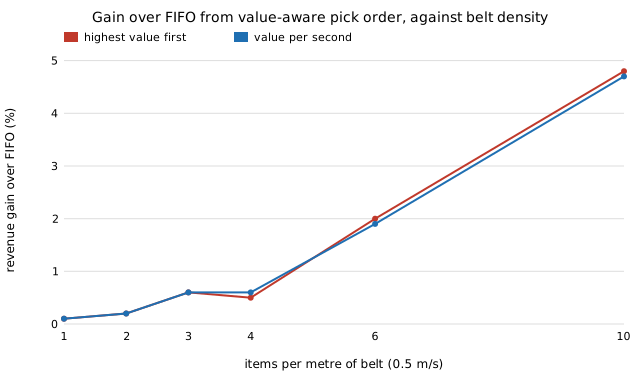
Follow-up to infra-sorting: with TACO's class mix, assumed item values (drink can = 4 plastic bottles) and 0.5 to 1.5 s of arm travel, picking the highest-value item first beats FIFO by only 0.1% at 1 item/m, 2.0% at 6/m and 4.8% at 10/m, and value-per-second picking matches it; belt speed and pick time matter far more than pick order.
What it found
infra-sorting found that FIFO, LIFO and largest-first tie because every item had the same value, pick time and window. This project gives items a value by TACO category (assumed: a drink can is worth 4 plastic bottles, swept 1 to 16; glass 0.15) and a pick time of 0.5 to 1.5 s from lateral arm travel, and compares FIFO, highest-value-first and value-per-second dispatch on identical simulated arrival streams (40 runs, paired, 95 % intervals). Value-first beats FIFO by 0.1 % at 1 item/m, 0.6 % at 3, 2.0 % at 6 and 4.8 % at 10; the gain rises with can value (+1.1 % to +2.6 %), peaks for a mid-speed arm (0.6 m/s) and is near zero for a very slow or very fast one, and grows to +4.2 % when each contaminant costs two bottles. The two value-aware rules tie. Category values, arm speed, detector, grasp and reach are assumed (only can value and arm speed swept), the detector is not trained, and only greedy rules are tried, so this is no upper bound on dispatch gain; a real cell is not measured.
A figure from its own output
Paper, code and results
More in Robot manufacturing loops
- Which assembly orders survive a better checker?Assembly-order planning for a printed gearbox: exact subset DP, collision-only admits 10.6% of orders but support checking leaves 0.077%, the collision-only optimum is infeasible, greedy disassembly needs 4 direction changes vs 1 optimal. Stylised.
- Does a quasi-static support rule agree with a physics engine?MuJoCo settle tests of all 2,048 partial gearbox assemblies vs the quasi-static support rule: 95.6% agreement, 81 mutual-support false accepts and 10 bore-capture false rejects, valid-order count unchanged at 30,760. Stylised.
- Does an insertion policy tuned in one simulator survive a better one?Peg-in-hole search policies tuned by CEM in MuJoCo at three fidelity levels or with domain randomisation: tuned on the simplest level 0.91 success there but 0.53 / 0.26 on a stiffer-contact / held-out level; training on the stiffer level or with randomisation gives 0.43–0.46 held-out and cannot be ranked with 5 seeds. Stylised, sim-to-sim.
- How much of the gap between “the twin passes” and “it fails for real” does each twin fidelity close?Session-written pick-and-place programs checked in a kinematic SCARA twin at three fidelities against a held-out reference: of 69 reference-failing injected-bug mutants the levels reject 38, 46 and 60 with no false alarms; misses are unmodelled effects (stylised).
- Which resource limits a small robot-printer-inspection cell, and does the busiest one tell you what to upgrade?Discrete-event twin of an arm, printers and an inspection station: printers have the highest utilisation at every size, yet at 6 printers an extra arm saves 10.9 min vs 2.3 for an extra inspection station; dispatch rules trade makespan for flow time; a mean-value twin is optimistic. Stylised, illustrative parameters.
- Where is the bottleneck of an arm, printer and inspection cell?Discrete-event twin of an arm, 3D printers and an inspection station: a utilisation bound names the bottleneck (printers to 10, the arm from 12, ~12.7 good parts/h) and the simulation sits 10–11% below it near the switch; a 25% faster arm lifts 11.34 to 12.68 parts/h at 12 printers, a second inspector nothing (stylised).
All 53 Robot manufacturing loops projects →
Other research topics
Proper scoring & elicitation28Effort & peer prediction9Verification games & slashing19Detection & tolerances14Markets as routers13Prediction-market design9Paying contributors8Decentralised training systems23Digital twins & sim-to-real164LLM chip design loops40Robot manufacturing loops53Ambient AI assistant46Self-replicating manufacturing34Simulation-first design64Engineered clothing45Task-specific AI accelerators40Algorithmic chip-design loops42Open-source purpose-built robots44The software-engineering loop43Adversarial human imitation41Open-source residential construction41Autonomous multi-angle capture34Sensing, imaging and 3D31Energy supply and dense energy storage39Robot societies among people31Agentic co-design of low-cost robots27Laundry-hanging robots25Machine learning on qualitative data23Robots on the building site27Civilizations & group psychology1History & human sciences1
Produced with AI assistance (Claude). Results are from the code in this repository and are simulated or stylised unless the abstract says otherwise; nothing here implies affiliation with or endorsement by any lab, researcher or company cited. MIT licensed.