How wide should domain randomization be, and what does it buy?
research/randomized-twin
Domain randomization over a twin, exactly: cliff-limited width, quartic price when the twin was right, cliff pushed out ~15%, but uniform-average training is not minimax and the best width tracks the prior.
What it found
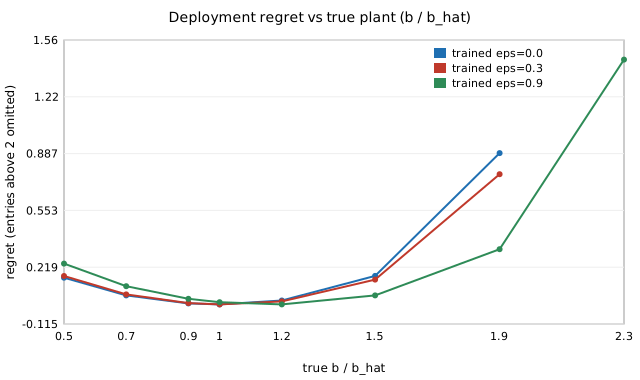
Randomizing the twin's input gain over ±ε trains a more conservative gain (monotone in ε; small-width law kε−k* = −(εb)2Jkbb/(6Jkk)) at a quartic price when the twin was right, and moves the deployment stability cliff out by about 15%. At 2.3× the twin's gain the nominal controller has regret 84 versus 1.4 at ε=0.9. But uniform-average training is not minimax: its worst-case regret exceeds the nominal gain's for ε ≤ 0.7, and the best width equals the prior's half-width, paying off only when the prior reaches the cliff. Stylised.
A figure from its own output
Paper, code and results
More in Digital twins & sim-to-real
- What does it cost to keep a digital twin in sync with a drifting plant, and is probing worth it?Keeping a digital twin in sync with a drifting plant: closed-form Kalman tracking variance and control regret (matched to simulation), a frozen twin loses half its edge in
ln 2/(2(1−ρ))steps, probing never pays for one drifting parameter, and a two-parameter closed-loop blind direction gives a mean-field dither lawν* ∝ q^{1/6}that self-exciting certainty-equivalent control mostly makes unnecessary. - How often, and how long, should a digital twin be re-identified as the plant drifts?Re-identifying a drifting twin by dedicated experiments: closed-form interval
T*∝q_d^{−2/3}with downtime, noise and drift regret exactly equal at the optimum, excess∝q_d^{1/3}, a 4× drift misjudgement costs ≤26%, but the second-order optimum destabilises 0.7–15% of cycles and a safe schedule is 37–200× worse than an always-on Kalman twin. - What should you pay a digital-twin provider for?What to pay a digital-twin provider for: cost-paid twins differ from Brier-paid ones, certainty-equivalence loss is quartic in spread, payment caps make the elicited twin jump at a closed-form threshold, and Brier mispays probing by 15×.
- How long can a digital twin be wrong before you can prove it, and what does waiting cost?Anytime-valid e-process audit of a digital twin in closed loop: peeking-safe (2.4% vs 58% false alarms), delay set by the controller's own excitation, regret before detection nearly independent of the gap, dither pays only for gross errors.
- What does a Gaussian-clutter radar simulator do to a CFAR detector's false-alarm rate?What a Gaussian-clutter radar twin does to a CA-CFAR detector: exact false-alarm law under gamma texture (matched to simulation), 9–30× inflation at design 1e-4, 1.9–3.7 dB threshold repair, shared texture is harmless, and a real-cell calibration budget (median 1.1× at 1000 cells).
- Does a more robust CFAR detector survive a Gaussian-clutter radar simulator?Does a more robust CFAR survive a Gaussian-clutter twin? CA, OS and log-t all inflate 8–44× at design 1e-4 (no detector escapes), a known-scale oracle inflates as much as CA (the test cell's own texture), and CA detects best at equal real Pfa after repair.
All 164 Digital twins & sim-to-real projects →
Other research topics
Proper scoring & elicitation28Effort & peer prediction9Verification games & slashing19Detection & tolerances14Markets as routers13Prediction-market design9Paying contributors8Decentralised training systems23Digital twins & sim-to-real164LLM chip design loops40Robot manufacturing loops53Ambient AI assistant46Self-replicating manufacturing34Simulation-first design64Engineered clothing45Task-specific AI accelerators40Algorithmic chip-design loops42Open-source purpose-built robots44The software-engineering loop43Adversarial human imitation41Open-source residential construction41Autonomous multi-angle capture34Sensing, imaging and 3D31Energy supply and dense energy storage39Robot societies among people31Agentic co-design of low-cost robots27Laundry-hanging robots25Machine learning on qualitative data23Robots on the building site27Civilizations & group psychology1History & human sciences1
Produced with AI assistance (Claude). Results are from the code in this repository and are simulated or stylised unless the abstract says otherwise; nothing here implies affiliation with or endorsement by any lab, researcher or company cited. MIT licensed.