Do LLM-style qualitative codes predict outcomes better than bag-of-words at the same labelling budget?
research/qual-features-outcomes
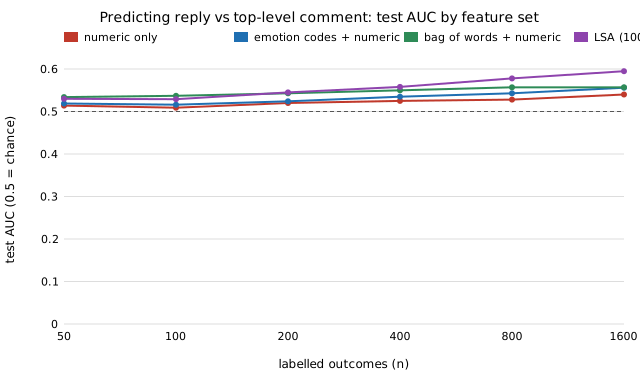
Do LLM-style qualitative codes predict outcomes better than bag-of-words at the same labelling budget? On 5,313 GoEmotions comments, not for a reply-vs-top-level outcome: emotion codes (human, an upper bound) reach AUC 0.527 against 0.557 for words and 0.595 for LSA, and 5% coder error erases their gain. All sets are weak; not an LLM.
What it found
On 5,313 real GoEmotions comments, 28 human-coded emotion codes (an upper bound for an LLM coder) predicted whether a comment replies to another comment with test AUC 0.527 at 1,600 labelled outcomes, below bag-of-words (0.557) and a 100-d LSA embedding (0.595 with numeric features); 5% simulated coder error erased the codes’ small gain over numeric features alone. Every feature set was weak (AUC at most 0.60) because the outcomes are not emotional, a coin-flip control stayed within 0.494–0.511, and a nine-subreddit outcome was too thin to rank anything. The codes are human votes, not an LLM’s.
A figure from its own output
Paper, code and results
More in Machine learning on qualitative data
- Does a hand-coded audit protect a group gap when it only checks the overall count?Does a hand-coded audit protect a group gap when it only checks the overall count? On 3,188 GoEmotions comments, a coder with zero overall bias still distorted a short-vs-long gap by 0.20, and the overall-bias gate covered the gap 0.4% of the time at 1,600 audited items. Not an LLM; one corpus.
- Can you estimate a group gap from an audit that hand-codes only a few of the coder's negatives?Can you estimate a group gap from an audit that hand-codes only a few of the coder's negatives? Not usefully: 0.9-wide intervals at 5 items, and a plain random audit (0.23 wide) beats the design. Pooling the groups' negatives covers 3%. 3,188 GoEmotions comments, not an LLM.
- If a hand-coded audit finds no bias in a coder, can you trust its counts?If a hand-coded audit finds no bias in a coder, can you trust its counts? On 3,188 GoEmotions comments, an audit-then-trust rule covered the truth in 8% of draws for a coder 2.6 points off, while always applying the prediction-powered correction covered 94–97%. Not an LLM; one corpus.
- Does a low audit rate for coder-negatives pay when the coder has high recall?Does a low audit rate for coder-negatives pay when the coder has high recall? On 3,188 GoEmotions comments the best share falls with recall (50%, 20%, 2%), but the narrowest interval (0.115–0.119 at 200 items) only matches a random audit with no coder (0.1195). Not an LLM.
- Do hypotheses about what separates two sets of documents survive a held-out check?Do hypotheses about what separates two sets of documents survive a held-out check? On 5,313 GoEmotions comments a word-counting proposer's effects are 7.6× too large at 100 discovery comments (1.5× at 2,000); a BH check on 3,000 held-out comments confirms almost nothing with shuffled labels, but 36–59% of confirmed hypotheses are the label's own vocabulary. Not an LLM proposer.
- How much of a human emotion codebook does a codebook induced from the text alone recover?How much of a human emotion codebook does a codebook induced from the text alone recover? On 5,313 GoEmotions comments, NMF and k-means codebooks agree with the human emotion label above chance but weakly (NMI 0.26 vs 0.12 for 27 codes); the best single code per emotion reaches AUC about 0.6. Topic models, not an LLM.
All 23 Machine learning on qualitative data projects →
Other research topics
Proper scoring & elicitation28Effort & peer prediction9Verification games & slashing19Detection & tolerances14Markets as routers13Prediction-market design9Paying contributors8Decentralised training systems23Digital twins & sim-to-real164LLM chip design loops40Robot manufacturing loops53Ambient AI assistant46Self-replicating manufacturing34Simulation-first design64Engineered clothing45Task-specific AI accelerators40Algorithmic chip-design loops42Open-source purpose-built robots44The software-engineering loop43Adversarial human imitation41Open-source residential construction41Autonomous multi-angle capture34Sensing, imaging and 3D31Energy supply and dense energy storage39Robot societies among people31Agentic co-design of low-cost robots27Laundry-hanging robots25Machine learning on qualitative data23Robots on the building site27Civilizations & group psychology1History & human sciences1
Produced with AI assistance (Claude). Results are from the code in this repository and are simulated or stylised unless the abstract says otherwise; nothing here implies affiliation with or endorsement by any lab, researcher or company cited. MIT licensed.